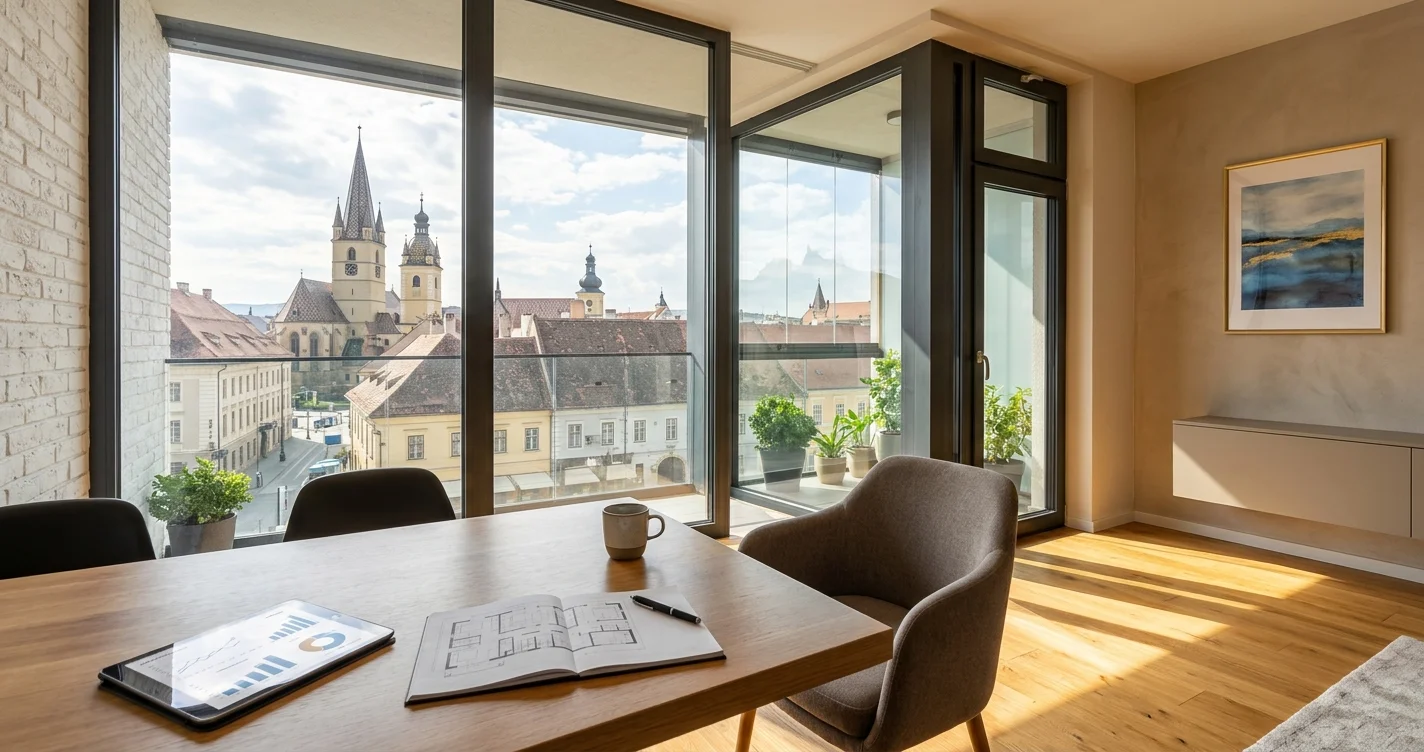
Vianto Properties negotiates the price based on comparable property prices, not the asking price, using arguments such as renovation costs and time the listing has been on the market. Sibiu benchmark: the average asking price for apartments is 2,034 EUR/sqm (September 2026, Imobiliare.ro). For a penthouse, the terrace also matters, usually valued separately from usable area, roof and insulation condition, and maintenance costs.
You negotiate the price when buying a home in Sibiu with data, not emotions: you start from the transaction price of similar properties, not the asking price in the listing. The arguments that move the price are real comparables, renovation costs, time the listing has been on the market, and your payment method (cash or credit). A well-founded offer is hard to refuse.
In short: how to negotiate the price in Sibiu
- You start from real transaction prices, not the asking price.
- You use defects and renovation costs as arguments.
- You check how long the listing has been on the market (margin signal).
- Cash payment or pre-approved credit strengthen your position.
- You negotiate the package (price, furniture, terms), not just the amount.
- You stick to a firm, documented offer, without emotional pressure.
Contents
- 1) 2026 Context: what the market tells you about negotiation
- 2) Preparing for negotiation: figures, documents, scenarios
- 3) Practical strategies: how to ask for a discount without seeming like a "bargain hunter"
- 4) Sibiu neighbourhoods and lifestyle: how location influences negotiation
- 5) Credit, exchange rate, interest rates: how to negotiate when buying with financing
- 6) Final checklist: offer, preliminary agreement, notarial deed
- Frequently Asked Questions
1) 2026 Context: what the market tells you about negotiation
Asking price vs transaction price: where negotiation "hides"
In any discussion about apartment price negotiation in Sibiu, the first thing is to separate two concepts. The asking price is what you see in the listing. The transaction price is what is paid, in the end, in the notarial deed. The difference between them is where the negotiation margin appears.
In September 2026, the average asking price for apartments in Sibiu is 2,034 EUR/sqm (September 2026, according to Imobiliare.ro). This does not mean that all properties sell at this level. It means this is the "centre of gravity" of the market, and negotiations take place around it, depending on location, condition, floor, layout and documents.
A good buyer does not just ask "how much will you reduce?". They ask "what is the market price for comparable properties and what objective arguments support a negotiation discount?". That completely changes the conversation.
Strong demand and limited available stock: why you don't always get a big discount
Negotiation depends a lot on the market pace. In Sibiu, ANCPI data shows 936 transactions in June 2026, 26.7% more than in June 2025. This tells you there is sustained demand. When demand is sustained, the seller has more confidence and gives in less easily.
In many segments, especially for well-positioned apartments, there is a supply shortage. Practically, you have limited available stock on sought-after types: well-compartmented two-room apartments, three-room apartments for families, apartments with parking, or homes with quick access to the centre.
This does not mean you don't negotiate. It means you negotiate intelligently. Instead of asking for a big discount "out of habit", you look for real points: renovation costs, lack of parking, orientation, surroundings, or handover terms.
Interest rates and "Market Pulse": how the market feels on the ground
In 2026, interest rates are a major factor. According to the National Bank of Romania (BNR), IRCC is 5.57% (April 2026), and ROBOR 3M is 5.84% (August 2026). This weighs on buyers' budgets and sometimes opens a negotiation window, especially for properties with an optimistic asking price.
At the same time, Sibiu has a dynamics indicator, Market Pulse 29/100 (June 2026), meaning a cold market. I read it simply: the market is not "frozen", but it is not a permanent sprint either. There are transactions, there are mortgages, but buyers are more careful. This favours negotiations based on arguments, not pressure.
If you want to constantly track the context, visit our real estate market page. We update the figures and their interpretation regularly, in plain language.
Table: Sibiu in national and regional context (asking price)
| City | Average asking price (EUR/sqm) | Note for negotiation |
|---|---|---|
| Cluj-Napoca | 3.316 | High pressure on price, discount harder to get. |
| Brașov | 2.309 | Strong tourism, good properties move quickly. |
| București | 2.312 | Large market, big differences between areas. |
| Sibiu | 2.034 | Good balance: there is still room, but not everywhere. |
| Constanța | 2.020 | Seasonality, different negotiation by property types. |
| Iași | 2.000 | More affordable, but with very sought-after areas. |
| Timișoara | 1.984 | Negotiation possible on old stock, depends on location. |
| Oradea | 1.885 | Lower price, but good demand on certain segments. |
The above figures are average asking prices, according to Imobiliare.ro (September 2026). They help you understand why, in Sibiu, sellers are still firm, but not inflexible.
2) Preparing for negotiation: figures, documents, scenarios
Golden rule: negotiate before you fall completely in love
It sounds amusing, but it's very practical. When you become emotionally attached, your discipline drops. In negotiation, discipline means having clear limits: maximum budget, minimum conditions and decision deadline. If you don't have them, the seller senses it immediately.
Before your first offer, make a short list of "must-haves" and "nice-to-haves". Then write down three scenarios: asking price, target price and maximum acceptable price. This helps you avoid improvising.
Real comparables: how to estimate market price without guessing
Market price is approximated through comparables. That is, similar properties, in the same reference area, with similar characteristics. In Sibiu, differences between areas are large, and "close to the centre" can mean different things.
Look at listings, but don't stop there. Ask the agent what properties have sold recently, at what pace and what mattered in negotiation. If you work with a good consultant, they will explain the difference between a "test" asking price and a "market" asking price.
For an overview, you also have the Vianto Properties blog, where you'll find guides on buying, documents and financing.
Documents: what to check so you don't negotiate "on hearsay"
Serious negotiation relies on documents. If you want a negotiation discount, you need to show why there is a risk or a cost. Here's what I usually ask for before recommending a firm offer:
- Land register extract without encumbrances or clarification of existing encumbrances.
- Deeds of ownership and acquisition history.
- Survey and agreement with the situation on the ground.
- Energy certificate, as a consumption benchmark.
- Details about the homeowners' association and recurring costs, if applicable.
If unclear points appear, negotiation makes sense. Not as "punishment" for the seller, but as risk adjustment. In practice, a clean land register and a complete file reduce negotiation margin. An incomplete file increases it.
Viewing checklist: what to note so you have arguments
At viewing, don't rely on memory. Take notes. Take photos. Ask questions. Then turn observations into costs and timelines. Here's a simple checklist:
- Installations: electrical, water, heating, signs of work.
- Finishes: flooring, doors, windows, insulation.
- Building: roof, basement, stairwell, intercom.
- Surroundings: traffic, noise, orientation, natural light.
- Parking: dedicated space, real possibilities in the area.
With these notes, you can make a clear offer: "I accept price X if Y is resolved" or "I propose price X because I have renovation costs and a moving deadline". That's mature negotiation.
Table: factors that increase or decrease negotiation margin
| Factor | Effect on negotiation | How to use it in discussion |
|---|---|---|
| Location in area with high liquidity | Reduces discount | You move fast, offer clear timelines. |
| Good condition, recently renovated | Reduces discount | You negotiate more on conditions, not price. |
| Needs renovation | Increases discount | You argue with concrete works, without exaggeration. |
| Incomplete documents | Increases discount | You propose price conditional on clarifications. |
| Long handover period | Increases discount | You ask for adjustment for the cost of time. |
3) Practical strategies: how to ask for discount without seeming like a "bargain hunter"
Start with questions, not an offer
The first mistake is to throw out a sum without context. The second mistake is to attack the price. Instead, ask questions that reveal the seller's motivation:
- What is the ideal sale timeline?
- Are there already offers or repeated viewings?
- What are the preferred conditions: cash, credit, large deposit?
- What stays in the apartment: furniture, appliances?
The answers show you if you have room to negotiate. If the seller has a tight timeline, a discount can be more realistic. If they're not in a hurry, you negotiate differently: on conditions, on timelines, on flexibility.
The "anchor" technique and how to use it correctly
In negotiation, an "anchor" is the first serious numeric reference point. If the seller has anchored high, you must anchor realistically, but firmly. This doesn't mean offering absurdly low. It means offering justified.
A simple example: if the asking price seems above market price, you don't say "it's too expensive". You say: "I understand the asking price. I can offer you X, because the apartment needs work and because my financing timeline is Y." That's an anchor with arguments.
In many transactions, apartment price negotiation Sibiu is won through clarity. Sellers prefer determined buyers, not buyers who are "testing" the market.
Negotiating conditions: sometimes it's cheaper than a discount
Not everything comes down to price. Sometimes you gain more by negotiating conditions:
- Shorter handover timeline, to reduce temporary rent.
- Furniture included, to reduce furnishing costs.
- Minor repairs done before handover.
- Deposit payment in a way that helps the seller.
In a market with strong demand, the seller may refuse a discount, but accepts conditions. For you, the financial effect can be similar, without "hitting" the asking price.
What to say when the seller responds: "I don't negotiate"
"I don't negotiate" often means "I don't negotiate with just anyone". Your response should be calm and professional:
- Confirm interest: "I like the property and I'm ready to move forward."
- Remind them of conditions: "My offer is valid until date X."
- Leave the door open: "If things change, I remain available."
In practice, many negotiations close within 24-72 hours, when the seller compares real offers with viewings that lead nowhere.
Local case study: how negotiation differs by property type
Without inventing numbers by typology, I can describe real patterns from Sibiu:
Renovated apartment, in an area with high liquidity. Here, the negotiation margin is usually smaller. Competition is higher, and the seller is confident. The good strategy is to be quick, have financing ready, and negotiate on conditions.
Apartment needing renovation. Here you have better room. But you must come with concrete arguments: what work is needed, what risks exist, what timeline you have. If you exaggerate, you lose credibility.
Property with unclear documents. Here negotiation is more delicate. You can ask for a discount, but more importantly, condition your offer on clarifications: land register extract without encumbrances, land registration, consistency between documents and reality. In many cases, the right solution is not to rush the notarial deed.
Mini-checklist: how to formulate your written offer
- Mention the amount and currency clearly.
- State if it's cash or credit and the estimated timeline.
- Specify what's included: furniture, parking, storage.
- Set a response deadline.
- Condition on verifications: land register extract without encumbrances, complete documents.
A clear, written offer sets you apart. And increases your chances of getting a negotiation discount, without tension.
4) Neighbourhoods in Sibiu and lifestyle: how location influences negotiation
Why "lifestyle" matters in market price
In Sibiu, location doesn't just mean distance. It means pace of life. It means whether you can walk out for coffee, whether you have a park nearby, whether you have schools, whether you have quiet in the evening. All of this translates into demand and, implicitly, into negotiation margin.
In neighbourhoods with strong demand, sellers have more power. In areas where buyers are fewer or more selective, better windows appear for apartment price negotiation Sibiu.
Historic Centre (Citadel): walks, tourism, but also trade-offs
The Historic Centre has a unique lifestyle. It's about terraces, events, walking, and architecture. For some, it's a dream. For others, it's too much noise and too little parking.
In negotiations here, details matter a lot: car access, shared courtyard, building height restrictions, neighbours, building condition. If the property has clear limitations, you have arguments. If it's a rare, well-maintained home in a reference area, a discount is harder to get.
For general context about the city, you can also check the Wikipedia page about Sibiu, especially useful for those moving from another county.
Sub Arini (premium area): quiet, green, steady demand
Sub Arini is the classic premium area. The lifestyle is about the park, jogging, better air, and streets with a certain status. Buyers are typically less price-sensitive and more quality-sensitive.
Here, negotiation is subtle. You don't come with "how much will you take?". You come with "I can sign quickly, I have financing ready, but I need clarity on documents and timeline". If you're lucky with a property that's been on the market for a while, you can get a negotiation discount, but you need to be realistic.
Ștrand: balanced, for families, with good transaction pace
Ștrand is a balanced neighbourhood, highly sought by families. You have good access, services, schools, and the atmosphere is "urban" without the hustle of the centre. In such areas, we often talk about high-liquidity area.
In negotiation, your advantage appears when the property has a clear drawback: top floor without lift, no parking, less efficient layout. If the apartment ticks all boxes, the seller will be firm.
Hipodrom: high turnover, many options, quick negotiations
Hipodrom has high turnover. That means many listings, many viewings, many transactions. For a buyer, that's good: you have options. For negotiation, it's even better: you can compare easily.
In Hipodrom, the strategy is to make strict selection and negotiate based on comparables. If you have 3-4 real alternatives, you can make a firm offer with a short timeline. The seller feels you don't depend on that one apartment.
Turnișor: affordable, with a good mix of old and new
Turnișor is appreciated for affordability and the mix of homes. The lifestyle is quieter, more "neighbourhood", with relatively good access to the city. Here you can find situations where the asking price is set "after the neighbour", not after the market.
Negotiation works well when you come with arguments: building condition, renovation costs, lack of lift, orientation. If the property is well-positioned, the seller will ask a market price close to expectations.
Vasile Aaron: young families, functional, good for a start
Vasile Aaron attracts young families. It's a functional neighbourhood with services and good access. In negotiation, the apartment's condition and layout efficiency matter a lot.
If the apartment is "move-in ready", the discount is smaller. If it's "needs renovation", you have room. It's important not to confuse aesthetic renovation with technical renovation. Old installations are a stronger argument than outdated tiles.
Trei Stejari and Valea Aurie: quiet, green, but careful selection
Trei Stejari and Valea Aurie are sought-after areas for quiet and greenery. The lifestyle is calm, suitable for those who want to retreat after a busy day. In such areas, buyers are careful about neighbours and construction quality.
Negotiation can be efficient if you identify real drawbacks: orientation, no parking, building needing work. If the property is rare and well-maintained, the seller will be less flexible.
Calea Dumbrăvii and Mihai Viteazu: connectivity and services
Calea Dumbrăvii has a strong urban profile. You have connectivity, services, and good pace. Mihai Viteazu is similar, with good access and areas with heavier traffic. Here, negotiation depends a lot on micro-location: how close you are to the main road, how much noise you have, what view you have.
In such areas, an apartment with windows facing the back can be more attractive than one "on the boulevard", even if they're in the same reference area. That gives you leverage in discussion.
Table: neighbourhoods and negotiation type (indicative, no invented percentages)
| Neighbourhood | Lifestyle | Type of negotiation that works |
|---|---|---|
| Historic Center (Citadel) | Walks, events, tourism | On limitations: parking, access, building condition |
| Sub Arini (premium area) | Green, quiet, status | On timelines and certainty, less on price |
| Ștrand | Families, balance | On specific drawbacks: floor, lift, parking |
| Hipodrom | High turnover, many options | On comparables and decision speed |
| Turnișor | Affordable, mix of homes | On condition and renovation costs |
| Vasile Aaron | Young families, practical | On installations and layout efficiency |
If you want to see real properties, with clear positioning and complete details, go straight to the Vianto Properties website. It's easier to negotiate when you have good alternatives.
5) Credit, exchange rate, interest rates: how to negotiate when buying with financing
Why financing changes your negotiating power
When you buy with a loan, you face two challenges. First is time. Second is interest rate uncertainty. In 2026, according to BNR, IRCC is 5.57% (April 2026), and ROBOR 3M is 5.84% (August 2026). This makes the bank more cautious, and the buyer more prudent.
Sellers usually prefer cash buyers. But that doesn't mean a buyer with a loan is "weak". If you come with pre-approval, a clear down payment, and a realistic timeline, you become a strong buyer.
"Debt service": how to use it as an argument, without complaining
Debt service means the monthly effort of your loan. Don't use it to victimize yourself. Use it to explain why your offer is calculated and firm.
A good message sounds like this: "I can go up to amount X, because I want to keep a comfortable debt service. If you accept, we sign quickly and move straight to the notarial deed." It's calm, logical, and shows you're serious.
The EUR/RON exchange rate: how to bring it into negotiation
In Sibiu, many prices are quoted in euros, but payments are made in lei, at the exchange rate. According to BNR, the average EUR/RON in August 2026 is 5.2498. Small differences can matter on large sums.
In negotiation, you can ask for clarifications: at what rate is the conversion done, how is the final amount in lei set, what happens if the rate changes between preliminary agreement and final deed. It's not a "trick". It's a normal discussion that reduces risk.
New mortgages in Sibiu: what the number tells you about competition
According to ANCPI, in Sibiu there were 500 new mortgages registered in June 2026. This shows you that a significant part of buyers use financing. So you're not alone.
Practical conclusion: don't be afraid to negotiate with a loan. But do it professionally. With documents, with timelines, and with a written offer.
Negotiating when the bank appraisal comes in below the asking price
It happens. And it's one of the best moments for negotiation, if handled correctly. If the appraisal comes in below the asking price, you have three options:
- Cover the difference from your own funds.
- Renegotiate the price, using the appraisal as a benchmark.
- Walk away and look for another property.
In a good discussion, you don't "threaten". You simply say: "The bank finances up to the appraised value. I can go further if we adjust the transaction price or find a balanced solution." That's mature negotiation.
Table: how interest rates and demand influence negotiation tactics
| Indicator (2026) | Value | Impact in negotiation |
|---|---|---|
| IRCC (BNR) | 5.57% (April 2026) | Buyers are more cautious, budget arguments increase. |
| ROBOR 3M (BNR) | 5.84% (August 2026) | Loan cost remains relevant in the decision. |
| Transactions Sibiu, June 2026 (ANCPI) | 936 (+26.7% compared to June 2025) | Strong demand, sellers are firmer on price. |
| New mortgages Sibiu, June 2026 (ANCPI) | 500 | Credit is normalized, not an automatic disadvantage. |
| Average asking price Sibiu, September 2026 (Imobiliare.ro) | 2,034 EUR/sqm (+7.4% in one year) | Appreciating market, large discounts are rare. |
For a discussion tailored to your situation, you can request a quick analysis through the contact page. Sometimes a single conversation saves you from a wrong offer.
6) Final checklist: offer, preliminary agreement, notarial deed
Offer: what a clean negotiation looks like, without "tricks"
Good negotiation has respect. It doesn't mean "squeezing" the seller. It means reaching a fair transaction price, backed by reality. In Sibiu, in 2026, the market is active, and good properties move.
That's why when you do apartment price negotiation in Sibiu, you need two things: arguments and speed. If you come with arguments but move slowly, you lose. If you move fast but without arguments, you pay too much.
The preliminary agreement: what you clarify to avoid surprises
The preliminary agreement is the stage where you set the rules of the game. It's not just a formality. Here you clarify:
- The transaction price and currency.
- Deadline for the notarial deed.
- The deposit and refund conditions if problems arise.
- What happens if the bank delays or rejects the file.
- List of items that remain in the property.
If the seller promises "I'll leave the furniture", ask for it in writing. If they promise "I'll vacate quickly", ask for a deadline. Real negotiation shows in clauses, not in conversations.
Notarial deed: what you verify before signing
Before the notarial deed, verify the documents again. Especially:
- Land register extract without encumbrances or with encumbrances clearly explained and discharged.
- Identity of owners and right of disposal.
- Consistency between areas and documents.
- Co-ownership regime, if any.
Don't rush. A good negotiation isn't worth it if you enter a legal risk. A clean land register is the foundation of a healthy transaction.
Property transfer tax: how to include it in your budget
Buying and selling involve costs. One of them is property transfer tax, which is managed within the notarial procedure, according to applicable tax rules. I won't give you figures here, because they depend on the situation and legislation, but I recommend you discuss it early with the notary.
In negotiation, total budget matters. If you're at the limit with costs, the seller may accept a small negotiation discount if they see the transaction won't close otherwise.
Final checklist for buyer (mental printable)
- I've set target price and maximum price before making an offer.
- I have comparables and a market price estimate.
- I've verified land register extract without encumbrances or existing encumbrances.
- I have a realistic timeline for credit or cash.
- I have a written offer with response deadline.
- I have clear clauses in the preliminary agreement.
- I'm moving to the notarial deed only with a complete file.
If you want to explore other tactics, you'll find useful articles in the blog section. They're written exactly for real situations, from the field.
Frequently Asked Questions
1) How much is negotiated, on average, for an apartment in Sibiu in 2026?
There's no safe average, because it depends on location, condition, documents and demand pressure. We know the context though: the average asking price is 2,034 EUR/sqm (September 2026, Imobiliare.ro), and in June 2026 there were 936 transactions recorded (ANCPI). That shows an active market. In practice, negotiations are won on concrete arguments, not on "standard percentages".
2) What's the best opening line to start negotiating?
Start with questions about motivation and timelines, not a random sum. For example: "When would you like to finalize?" and "What do you prefer: cash or credit?". Then you make your offer: "I can go to X, with quick signing and full checks." That way you earn respect and increase your chances of a negotiation discount.
3) How do I negotiate if the apartment is in a high-liquidity area?
In a high-liquidity area, good properties sell fast. There, price negotiation is harder. The right strategy is to negotiate on conditions: move-out date, furniture included, minor repairs, or a clear timeline for the notarial deed. If you still want a discount, you need an objective minus: renovation, parking, documents.
4) What role do interest rates play in negotiation if I take a loan?
Interest rates affect your budget and, implicitly, your offer. According to BNR, IRCC is 5.57% (April 2026), and ROBOR 3M is 5.84% (August 2026). That makes buyers more cautious and can increase negotiation margin on overvalued properties. But you need to come with pre-approval and clear timelines. Otherwise, the seller prefers a safer buyer.
5) What checks can give me a real advantage in negotiation?
Documents and technical condition. A land register extract without encumbrances and a complete file reduce negotiation space, because risk is low. On the other hand, discrepancies between documents and reality, encumbrances to be discharged, or necessary technical work can justify a negotiation discount. It's important not to exaggerate. Say exactly what you found and what impact it has.
6) Is it worth working with an agent if I want to negotiate better?
Yes, if the agent works with data and defends your interest. A good consultant tells you if the asking price is close to market price, prepares your written offer and manages the discussion without emotion. Plus, they help you avoid legal risks and reach the notarial deed with complete documents. Negotiation isn't just about money, it's about controlling the process.
Conclusion: good negotiation in Sibiu means arguments, not luck
In 2026, Sibiu remains an active market. We have an average asking price of 2,034 EUR/sqm and a growth of 7.4% in a year, according to Imobiliare.ro (September 2026). We have 936 transactions and 500 new mortgages in a month (June 2026, ANCPI). That tells you one simple thing: there's movement, there's competition, and good properties don't wait long.
Still, apartment price negotiation in Sibiu works if you do it professionally. You need comparables, a clear budget, verified documents and a written offer. In neighbourhoods like Sub Arini or Centrul Istoric, you negotiate fine, on conditions and certainty. In high-turnover areas like Hipodrom, you negotiate faster, using real alternatives. And when you buy with credit, interest rates and exchange rates force you to be even more disciplined.
If you want to make a safe decision, check our real estate market analysis and the Vianto Properties blog. And if you already have a property in mind, we can tell you directly if the asking price is realistic and what negotiation margin makes sense.
Looking for advice on buying and negotiating in Sibiu? The Vianto Properties team is available to help with personalized recommendations. Contact us at +40 791 710 606 or office@vianto.ro, or explore our available properties directly on the site.
View properties and schedule a discussion with a Vianto Properties consultant
Send us the apartment details and we'll tell you how to negotiate correctly
Useful sources: ANCPI statistics on transactions and mortgages, BNR indicators (IRCC, ROBOR, exchange rate), general information about Sibiu.
Vianto Properties offers in Sibiu:
The correct selling price is determined by comparable transactions in your area, not by the asking prices in nearby listings. You can request a free property evaluation, with a response within 24 hours, or you can discuss with the Vianto Properties team before you decide.