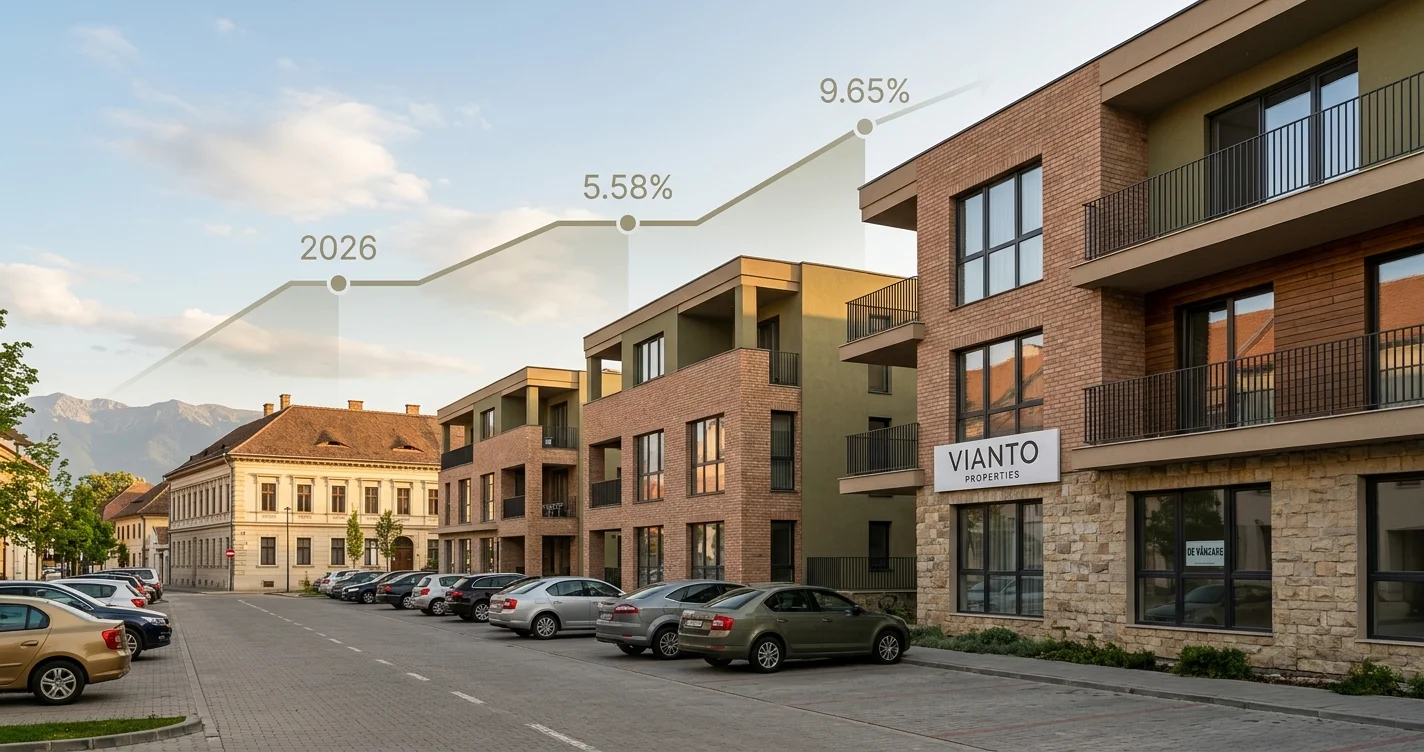
According to Vianto Properties analysis, 2026 data shows no real estate crisis, but an orderly correction: in Sibiu county, transactions reached 936 in June 2026, with +26.7% year-on-year, a sign that the market remains active, although high interest rates (IRCC 5.57%) make buyers more selective.
The question "will there be a crisis?" always comes up when interest rates stay high. And when you see listings that stay on the market longer. In 2026, the discussion about real estate crisis in Romania 2026 makes sense, but not in the "apocalypse" form of headlines. Data shows a market that is moving, even if selectively. In Sibiu county, transactions reached 936 in June 2026, with +26.7% YoY, according to ANCPI data on transactions and mortgages. And on Imobiliare.ro, average asking price is 2,034 EUR/sqm, in September 2026. That does not show total blockage. It shows a market where location, financing and realism in asking price matter.
- Sibiu: average asking price 2,034 EUR/sqm, according to Imobiliare.ro (September 2026).
- Sibiu: year-on-year change +7.4% YoY, according to Imobiliare.ro (September 2026).
- Sibiu: 936 transactions in June 2026, +26.7% YoY, according to ANCPI.
- Sibiu: 500 new mortgages in June 2026, according to ANCPI.
- Romania: IRCC 5.57% and ROBOR 3M 5.84% (August 2026), according to BNR.
Contents
- 1) What does real estate crisis in Romania 2026 actually mean
- 2) The indicators that matter in 2026: interest rates, transactions, mortgages
- 3) Sibiu as a case study: prices, liquidity, neighbourhoods and lifestyle
- 4) Asking price vs transaction price: negotiation margin in practice
- 5) Investments in 2026: gross yield, net yield and positive ROI
- 6) Scenarios 2026: cooling, orderly correction or blockage
- FAQ: frequently asked questions about real estate crisis in Romania 2026
1) What does real estate crisis in Romania 2026 actually mean
Real crisis vs orderly correction
When people say "crisis", they think of sharp declines and forced sales. In practice, the market can go through an orderly correction. That is, gradual adjustments, especially in asking price. In 2026, we see more "negotiation" and less often "sells in two days". That does not automatically mean crisis. It means the market becomes more value-conscious.
In the discussion about real estate crisis in Romania 2026, the difference is simple. Crisis appears when financing locks up and transactions collapse. Orderly correction appears when demand remains, but becomes selective. And sellers adjust expectations.
Why rumours about crisis appear
Rumours appear when interest rates are high. IRCC is 5.57%, and ROBOR 3M is 5.84% (August 2026), according to BNR. That weighs on the budget of those with a loan. It increases pressure on debt service. And it reduces eligibility for a new loan.
Another factor appears. Inflation is 6.17% YoY (August 2026), according to INS. When prices rise in the economy, people become cautious. They postpone major decisions. Including buying a home.
What the market tells us, without emotion
A good test is transaction volume. In Sibiu county, transactions were 936 in June 2026, with +26.7% YoY, according to ANCPI. That does not show widespread panic. It shows that there is sustained demand, even if not for every product.
Another test is lending. In Sibiu county there were 500 new mortgages in June 2026, according to ANCPI. If mortgages were to fall sharply, the discussion about the crisis scenario would look different. Instead, we see a market that works, but with stricter filters.
Where cooling is seen fastest
Cooling is seen in areas where average asking price was pushed too high. And in properties with clear drawbacks. Top floor without lift, poor orientation, difficult layout, no parking. There, negotiation margin becomes real. And time on market increases.
On the other hand, in areas with high liquidity, good properties sell. Not always quickly, but they sell. Here, fundamentals remain solid. Especially when there is limited available stock or even supply shortage on certain property types.
2) The indicators that matter in 2026: interest rates, transactions, mortgages
Interest rates: how they influence demand
Interest rate is not a detail. It is the main filter for the buyer with a loan. In 2026, IRCC is 5.57%, and ROBOR 3M is 5.84% (August 2026), according to BNR. That means higher instalments. And a debt service harder to bear.
When debt service increases, two things happen. Some buyers temporarily exit the market. Others reduce their budget. Here pressure appears on asking price. Not necessarily on transaction price, in areas with high liquidity.
Transactions: the real thermometer of the market
In Romania, ANCPI is the correct source for transactions and mortgages. And that's it. ANCPI does not publish prices. In Sibiu county, 936 transactions in June 2026, with +26.7% YoY, according to ANCPI. This jump shows that the market is not frozen.
In the discussion about the hypothesis of a crisis, this is a key point. A real crisis comes with transactions that contract massively. Here, we see the opposite, at least in Sibiu. That does not guarantee the future. But it shows the present.
Mortgages: how much the market depends on credit
In Sibiu county there were 500 new mortgages in June 2026, according to ANCPI. Credit remains important. But it is not the only engine. There are also cash buyers. There is also diaspora. There are also investors looking for inflation protection.
Still, when interest rates are high, credit becomes selective. Banks ask for down payment, stability and clear documents. Here bank statement without liens and a good property history matter. A clean land register shortens the path to financing.
Salaries and Affordability
The average net salary in Sibiu County is 6.025 RON, while the national average net salary is 5.820 RON (July 2026), according to available data. When salaries rise slower than average asking prices, affordability decreases. This can fuel the narrative of a real estate crisis.
But affordability is not uniform. It depends on down payment, property type, and location. It also depends on exchange rates. BNR shows an average EUR/RON of 5,2498 per month (August 2026), according to BNR. For those saving in lei, this matters.
Table: key indicators 2026 (reliable sources)
| Indicator | Value | Area | Source |
|---|---|---|---|
| Average asking price | 2,034 EUR/sqm | Sibiu (September 2026) | Imobiliare.ro |
| Annual variation | +7.4% YoY | Sibiu (September 2026) | Imobiliare.ro |
| Monthly transactions | 936 (+26.7% YoY) | Sibiu County (June 2026) | ANCPI |
| New mortgages per month | 500 | Sibiu County (June 2026) | ANCPI |
| IRCC | 5,57% | National | BNR |
| ROBOR 3M | 5.84% (August 2026) | National | BNR |
| Inflation (CPI) | 6.17% YoY (August 2026) | National | INS |
3) Sibiu as a case study: prices, liquidity, neighbourhoods and lifestyle
Where Sibiu stands in the national landscape
As average asking price, Sibiu is at 2.034 EUR/sqm, according to Imobiliare.ro (September 2026). Compared to 8 cities, Cluj-Napoca is at 3.316, Bucharest at 2.312, Brașov at 2.309, and Sibiu at 2.034. Then come Constanța 2.020, Iași 2.000, Timișoara 1.984 and Oradea 1.885, according to the same source.
This matters in the crisis discussion. Sibiu is not the most expensive. But not "cheap" either. It is a city with steady demand, tourism, services and a good profile for medium-term investments.
Table: price comparison across 8 cities
| City | Average asking price (EUR/sqm) | Source |
|---|---|---|
| Cluj-Napoca | 3.316 | Imobiliare.ro (September 2026) |
| Brașov | 2.309 | Imobiliare.ro (September 2026) |
| București | 2.312 | Imobiliare.ro (September 2026) |
| Sibiu | 2.034 | Imobiliare.ro (September 2026) |
| Constanța | 2.020 | Imobiliare.ro (September 2026) |
| Iași | 2.000 | Imobiliare.ro (September 2026) |
| Timișoara | 1.984 | Imobiliare.ro (September 2026) |
| Oradea | 1.885 | Imobiliare.ro (September 2026) |
Neighbourhoods in Sibiu: lifestyle, not just a map
In Sibiu, "location" is not a whim. It is the difference between a liquid property and one hard to sell. If you want to understand the city, it is worth taking an overview: Sibiu's presentation on Wikipedia gives you the historical and urban context.
Centre and Ultra-Centre mean walkability. Cafés, events, markets, tourism. It is the area where you buy both for lifestyle and for rental income. Here, limited available stock is a reality. And demand remains strong, even when the market shows signs of cooling.
Strand is about balance. You have good access to the city, services, schools. It is an area sought by young families. When a well-positioned property appears, it moves quickly. Especially if it has parking and good layout.
Sub Arini is Sibiu's established premium neighbourhood. Interwar villas, wide avenues, mature vegetation, quiet yet close to the centre. Buyers seek long-term stability here and quick access to the city without the tourist bustle of the Centre. Demand remains strong, and limited available stock keeps prices firm.
Hipodrom functions as a high-turnover market. Apartments with classic layout, many mortgage-backed buyers, good commercial infrastructure. Here, the exact positioning of the property matters enormously: renovated building, floor with lift, arranged parking—these make the difference between a sale in 2 months and one stuck for 6 months. The area constantly absorbs demand from families and investors for classic rental.
Turnișor is the accessible area for smaller budgets, with good transport to the centre and new developments that have grown in recent years. The buyer profile is usually first-time buyer or investor with higher gross yield than in the Centre. Here you see selectivity most clearly: new projects with correct finishes sell, while old neglected buildings receive the steepest negotiation discounts.
Why Sibiu resists shocks well
One reason is transaction dynamics. 936 transactions in June 2026 means an active market, according to ANCPI. Another reason is that Sibiu does not depend on a single buyer type. You have locals, diaspora, investors. And you have buyers who come for quality of life.
In 2026, when we discuss the crisis narrative, Sibiu is a good example. The market may slow, but it does not stop. It resets. And it penalizes overvalued properties.
Where to find local, up-to-date analysis
If you want to follow local developments, visit our real estate market page. There we explain in clear terms what is happening in Sibiu. And how it connects to the national context.
For practical guides, there is also the Vianto Properties blog. You will find articles on buying, selling and investing. They are written for real decisions, not for headlines.
4) Asking price vs transaction price: negotiation margin in practice
Why the difference matters
In any mature market, average asking price is just the start of the conversation. Transaction price is the end. In 2026, the gap between them may widen. Especially when the seller starts from emotion, not market price.
This is where the crisis myth is born. People see price reductions in listings. But the reduction may just be a return to reality. Not a market collapse.
Signs that asking price is too high
- The listing sits for a long time with no relevant viewings.
- You only receive offers with large negotiation discounts.
- Comparables in the reference area are lower.
- The property has drawbacks hard to "cosmetically" fix.
- Documents are not prepared, and the buyer walks away.
Selling checklist: how to reduce the risk of being stuck
In a market showing signs of cooling, good selling starts with preparation. Not with "let's test a price". Here is a short but practical list.
- Obtain land register extract without encumbrances or clarify existing encumbrances.
- Check that you have a clean land register, without errors.
- Prepare documents for notarial deed.
- Set market price, not just asking price "from hearsay".
- Define from the start the acceptable negotiation margin.
Buyer with a mortgage: what you need to know
If you take a mortgage, interest rates matter. IRCC is 5,57%, according to BNR. ROBOR 3M is 5,84% (August 2026), according to BNR. This means the bank carefully calculates your debt-to-income ratio. And verifies the stability of your income.
In 2026, the discussion about the crisis is closely linked to credit. Not because "everything stops". But because demand shifts towards more affordable products. And towards areas with high liquidity, where resale is easier.
Costs and taxes: no surprises at the end
In your budget, include transfer costs too. There is property transfer tax. There are notary costs for the notarial deed. There are also appraisal costs, if you have a mortgage. I won't go into figures, because they vary. But I recommend you discuss them in advance.
If you have a mortgage, the bank will require mortgage guarantee, usually first-rank mortgage. This means the documents must be flawless. Any unclear entry in the land register can delay the transaction.
5) Investments in 2026: gross yield, net yield and positive ROI
Real estate investment is not just "price appreciation"
Many investors enter with a single idea: capital gain. That is, capital gain on resale. In 2026, this strategy can work, but not blindly. The market may be appreciating in certain micro-zones. But it can also be selective.
That's why, when we discuss a crisis scenario, a good investor looks at two engines. One is rent. The other is capital gain. If one slows down, the other can sustain the investment.
Gross yield and net yield: how to look at them correctly
Gross yield is a simple indicator. You divide annual rent by purchase price. Net yield is more realistic. You subtract costs, periods without a tenant, repairs, taxes. In 2026, net yield is what tells you if you have positive ROI.
I don't use rent figures by property type here. They vary greatly, depending on location and quality. If you want an estimate for your property, the safest way is to discuss it with us. Or follow the guides in the blog.
Where investment in Sibiu makes sense, logically
In Sibiu, investments are well-linked to neighbourhoods with constant demand. Centre and Ultra-centre for short or medium-term rental. Strand and Hipodrom for classic rental, with good turnover. Sub Arini for premium profile, if the entry price is correct.
In a market showing signs of cooling, the investor looks for areas with high liquidity. There, vacancy risk decreases. And resale is easier, if you want to mark capital gain.
Table: how to compare an investment, without making up figures
| Criterion | What you check | Why it matters in 2026 |
|---|---|---|
| Location | Access, services, transport, reference area | Supports sustained demand and quick resale |
| Available stock | Limited available stock or supply deficit | Reduces pressure on negotiation discount |
| Building quality | Envelope, lift, parking, maintenance | Decreases costs and increases net yield |
| Documents | Land register extract without encumbrances, clean land register | Speeds up financing and the notarial deed |
| Strategy | Rent vs resale, positive ROI, break-even | Protects you if the market shows signs of cooling |
Investor checklist: 10 questions before you buy
- Is the property in an area with high liquidity?
- What is the market price, not just the asking price?
- What is a realistic negotiation margin in that area?
- Is there limited available stock for this property type?
- Have I obtained a land register extract without encumbrances, up to date?
- Is there a risk of old mortgage or litigation?
- What recurring costs affect my net yield?
- Can I achieve positive ROI without relying on capital gain?
- What's my plan if I have no tenant for 2-3 months?
- Do I have a clear exit: resale or refinancing?
Where to find properties suitable for investment
If you want to see real, up-to-date offers, go directly to the Vianto Properties website. And if you want to discuss specifics, use the contact page. A good brief saves a lot of time.
6) 2026 Scenarios: cooling, orderly correction, or credit freeze
Scenario 1: the market shows signs of cooling (most likely)
This is the scenario where the market doesn't break, but slows down. Interest rates stay high. IRCC is 5.57%, according to BNR. Buyers negotiate more. Weak properties correct. Good ones sell, but with selection.
In this scenario, the discussion about a real estate crisis is more about psychology. People get used to the idea that there are no linear increases everywhere. And that market price is built from real comparables.
Scenario 2: orderly correction, by segment
Here we see more visible adjustments in asking prices. Especially in areas with large inventory and little differentiation. Or in projects where deliveries increase. Orderly correction doesn't mean collapse. It means the market is cleaning up excesses.
In Sibiu, transaction dynamics, 936 in June 2026, according to ANCPI, suggest there is absorption. But absorption is not uniform. In neighbourhoods with clear lifestyle appeal, demand remains strong. In areas without identity, negotiation discounts become larger.
Scenario 3: temporary credit freeze
This is the scenario that could most fuel the idea of Romania real estate crisis 2026. If banks become much stricter, demand drops. And sellers who depend on quick sales may reduce their asking price.
However, in Sibiu County there were 500 new mortgages in June 2026, according to ANCPI. That shows financing still works. I'm not saying the risk is zero. I'm saying that, based on current data, we don't see a freeze.
How to position yourself, practically, in 2026
Regardless of scenario, you have two simple directions. If you're selling, be realistic. If you're buying, be prepared. In both cases, documents and strategy make the difference.
- Seller: start from market price, not from "what the neighbour asked for".
- Seller: accept that negotiation margin is part of the game.
- Buyer: check land register extract without encumbrances before making an offer.
- Buyer: calculate debt service with current interest rates.
- Investor: track net yield, not just gross return.
Where you see the difference between "crisis" and "selective market" most clearly
You see it in neighbourhoods. In Centre, if the property is good, it sells. In Strand, a dwelling with parking and good light attracts quickly. In Hipodrom, well-positioned apartments have turnover. In Sub Arini, quality and quiet justify interest, but the buyer pays attention to details.
That's the reality on the ground. And it's why, in 2026, I would describe the market more as "selective" rather than Romania real estate crisis 2026 in the classical sense.
FAQ: frequently asked questions about Romania real estate crisis 2026
1) Are there clear signs of Romania real estate crisis 2026?
Classic signs would be a credit freeze and transactions contracting massively. In Sibiu County, data shows 936 transactions in June 2026, with +26.7% YoY, according to ANCPI. That doesn't indicate a freeze. Instead, we see a market showing signs of cooling, especially in asking prices. Overvalued properties stay longer on the market.
2) Can high interest rates trigger Romania real estate crisis 2026?
High interest rates can reduce financed demand. IRCC is 5.57%, and ROBOR 3M is 5.84% (August 2026), according to BNR. That weighs on debt service. However, crisis only appears if financing freezes and sales stop. Currently, we see active lending, including 500 new mortgages in Sibiu County in June 2026, according to ANCPI.
3) In Sibiu, is the market appreciating or declining?
On Imobiliare.ro, average asking price is 2,034 EUR/sqm, with +7.4% YoY, in September 2026. That suggests market appreciation at the asking level. At the same time, the market shows signs of cooling through firmer negotiation. The gap between asking price and transaction price may widen, especially for properties with drawbacks.
4) Which Sibiu neighbourhoods are more "safe" in the context of Romania real estate crisis 2026?
"Safe" means liquidity. Centre and Ultra-Centre have limited available inventory and constant demand, supported by lifestyle and tourism. Strand is balanced for families, with good access to services. Hipodrom has high turnover, but quality and positioning matter a lot. Sub Arini is more premium and quieter, with buyers attentive to details and location.
5) What should I check before buying, to avoid risks?
Start with documents. Request land register extract without encumbrances and verify you have a clean land register. If you take a loan, the bank will require first-rank mortgage as mortgage security. Then, compare the asking price with the market price in your reference area. And set your negotiation margin from the start, so you don't waste time.
6) Is it worth waiting for the "crisis" to buy cheaper?
If you wait for a classical crisis, you might wait a long time. In many markets, adjustments come selectively, not across the board. In Sibiu, transactions are high, according to ANCPI, and average asking price is growing YoY on portals. A better strategy is to look for properties with unrealistic asking prices and negotiate. That's where real negotiation discounts appear.
Conclusion: is a real estate crisis coming in 2026?
If you ask me directly, in 2026 I don't see a generalized "crisis" by classical definition. I see a market showing signs of cooling. Interest rates are high, according to BNR, and that weighs on debt service. But transactions in Sibiu County, 936 in June 2026, with +26.7% YoY, according to ANCPI, show the market still has energy. Plus, average asking price in Sibiu is 2,034 EUR/sqm, with +7.4% YoY, according to Imobiliare.ro (September 2026). That doesn't sound like a total freeze.
Instead, Romania real estate crisis 2026 can exist "locally", on weak products and inflated prices. That's where orderly correction happens. If you're selling, prepare your documents and align your asking price with market price. If you're buying, look for an area with high liquidity and check land register extract without encumbrances. If you're investing, track gross return and net yield, so you have positive ROI.
For a complete picture, you can start with our analyses on the real estate market. And for applied guides, go to the blog. If you want to discuss your case, go to contact or explore Vianto Properties directly for properties and consultation.
Looking for advice on buying, selling or investing in Sibiu? The Vianto Properties team is available to help you with personalised recommendations. Contact us at +40 791 710 606 or office@vianto.ro, or explore our available properties directly on the site.
Explore Vianto Properties offers:
Vianto Properties offers in Sibiu:
The correct selling price is determined by comparable transactions in your area, not by the asking prices in nearby listings. You can request a free property evaluation, with a response within 24 hours, or you can discuss with the Vianto Properties team before you decide.