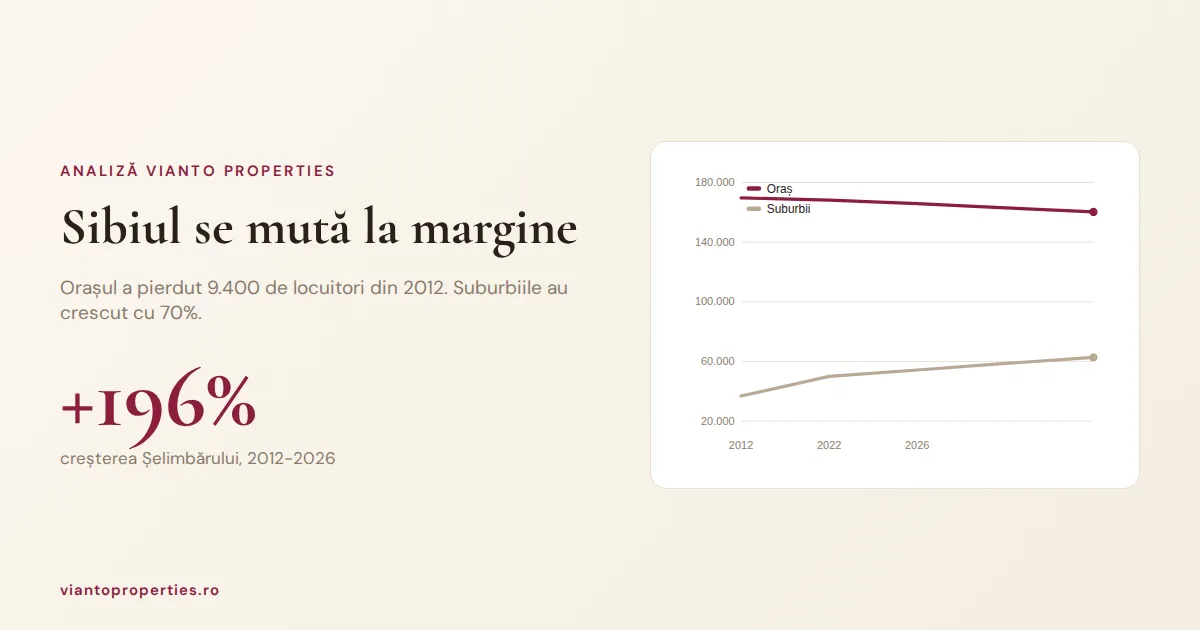
Sibiu Municipality has lost 9,400 residents since 2012. In the same period, Șelimbăr has nearly tripled, Cisnădie has grown by 48%, and Șura Mare and Șura Mică by over 30% each. It's not a demographic crisis - it's a shift of major proportions, reshaping the map of housing, prices and traffic across the entire area.
We extracted INS data over 14 years, locality by locality, to see exactly where Sibiu is heading. Here's what the numbers say.
In brief
- Sibiu Municipality: 169,634 → 160,228 residents by domicile (2012-2026), that is -5.5% (INS).
- The suburban ring - Șelimbăr, Cisnădie, Cristian, Șura Mare, Șura Mică - has grown by +70%: from 36,778 to 62,698 residents.
- The metropolitan area as a whole is growing (+6.6%). Housing demand is not disappearing - it's moving to the periphery.
- The hidden warning: the 25-29 age group has declined by 39% in ten years. The young buyer is becoming rare.
The big picture: the county is growing, the city is shrinking
We start with a paradox. The population by domicile in Sibiu County is growing: 394,963 residents on 1 January 2025 (INS), in steady growth compared to the 2022 low (388,896, after census correction). At the same time, the municipality is declining year after year, without exception, since 2015.
The two curves meet through a single mechanism: migration. On one hand, positive internal migration - Sibiu County has gained a net 2,979 people in 2023 from exchanges with the rest of the country (INS). People come here for salaries: Sibiu has the fourth highest average net salary in Romania (6,025 lei in March 2026) and the highest annual salary growth in the country (+9.5% in January 2026, according to INS data compiled by Ziarul Financiar).
On the other hand, internal residential migration within the area: Sibiu residents move from the city to neighbouring communes and towns, usually when the family grows and the apartment becomes too small. Birth rate does not compensate: the county's natural increase is constantly negative - in December 2025 alone there were 240 births and 409 deaths, a deficit of 169 people in a single month (INS, provisional data).
Interim conclusion: the Sibiu area is not losing people. It is redistributing them - from centre to periphery - and replenishing them with arrivals from other counties.
The map of the shift: who is growing and by how much
Sibiu Municipality vs. suburban ring: population by domicile, 2012-2026
Source: INS Tempo POP107D, population by domicile on 1 January. Suburban ring: Șelimbăr + Cisnădie + Cristian + Șura Mare + Șura Mică.
The city has lost 9,406 residents by domicile; the suburban ring has gained 25,920. The ratio has changed structurally: in 2012, 1 in 6.5 residents of the area lived in the suburban ring. Today: 1 in 4.
Șelimbăr: the phenomenon of the decade
No locality in the county - and few in Romania - has transformed like Șelimbăr. From 6,970 residents by domicile in 2012 to 20,651 in 2026: almost a tripling in 14 years. The commune has surpassed Cisnădie in growth rate and has become, in effect, the third population centre in the area, after the municipality and Cisnădie.
The engine was simple: available land next to the city, intensive real estate development and prices that, for years, were visibly below those in the municipality. That discount has since closed - we'll come back to that below - but demographic momentum continues: over 1,000 new residents per year, year after year. For anyone evaluating the area as a place to live, we have written a separate guide to apartments in Șelimbăr.
Cisnădie: steady growth
Cisnădie tells a different story: not an explosion, but constant and sustainable growth. From 18,560 residents in 2012 to 27,484 in 2026 - a gain of almost 9,000 people (+48%), with over 400 new residents in the last year alone. Unlike Șelimbăr, which was built almost from scratch, Cisnădie was already an established town, with its own centre, schools, services and identity - and new neighbourhoods were added to an existing structure.
For the real estate market, Cisnădie has today a perception advantage: it is still seen as the "more affordable and quieter" alternative, even though price figures have come closer to the city. For 2-room apartments, the median is almost identical to Sibiu; the real difference is seen in houses and land, where supply is more generous.
The western front: Cristian, Șura Mică, Șura Mare
The second phase of suburbanisation is now unfolding on the west and north axis. Cristian: +20% (from 4,126 to 4,959). Șura Mică: +33% (2,890 → 3,835). Șura Mare: +36% (4,232 → 5,769). The absolute figures seem small compared to Șelimbăr, but the recent pace is accelerating - and the logic is the same that ignited Șelimbăr 10-12 years ago: cheaper land, quick access (A1, DN1, airport), proximity to the western industrial zone, where an important part of the county's 145,581 employees work.
If Șelimbăr's history is a guide, this is exactly where development pressure will shift in the coming years - with everything that comes with it: housing demand, land price increases, then house prices.
Localities that are standing still - and why
Not everything next to Sibiu is growing. Tălmaciu, Avrig, Rășinari and Ocna Sibiului have, together, 2% fewer residents than in 2012. The explanation is commute distance and geography: Avrig and Tălmaciu are 20-25 kilometres down the Olt Valley, Rășinari is limited by terrain, Ocna has a spa profile, not residential.
The lesson for anyone buying "next to Sibiu": growth is not distributed evenly across the county. It follows strictly the commute time to jobs in the city and the industrial zone. Under 15 minutes - it grows. Over 25 - it stagnates. This simple rule explains almost the entire map above.
The change within: the age pyramid narrows at the base
Behind the geographic shift lies a deeper transformation with longer-term effects. We compared the age structure from 2016 with that from 2026, in the Sibiu + Șelimbăr + Cisnădie area:
Population by age group, Sibiu + Șelimbăr + Cisnădie area
Source: INS Tempo POP107D, population by domicile. 2016 vs. 2026.
The 25-29 age group has declined by 39%. The 30-34 group by 29%. This is not a local phenomenon, but generational arithmetic: the large cohorts born in the 1980s have aged and been replaced by small generations after 1995. And the wave that follows brings no relief - today's 20-24 age group numbers only 8,210 people, less than half of what the 25-29 group meant a decade ago.
The only solid part of the pyramid is 35-44 years old: stable at 35-39, growing by 17% at 40-44, also fueled by internal migration (those who move to Sibiu for a good job are typically over 30 and have a family).
A note of methodological honesty: population by residence does not count students and workers staying in Sibiu without registration - the actual young population is somewhat larger than in statistics. The trend of cohorts remains valid regardless of method: the generations now entering the age of first purchase are, quite simply, much smaller.
Who exactly is moving: families aged 30-44
Data by age groups, broken down by locality, show with surgical precision who is leaving the city and who is arriving in the suburbs. In Șelimbăr, the 35-39 age group grew by 153% in ten years, and the 40-44 group by 208% - it tripled. In Cisnădie: +78% at 35-39 years old, +50% at 40-44. In mirror image, the municipality lost 43% of the 30-34 group and 18% of the 35-39 group.
The picture is unequivocal: it is not "young people" in general who move to the suburbs, but established families aged 30-45, usually with children and a block apartment to sell. Sibiu's suburbanization is driven by exactly the segment that buys houses and 3-room apartments - and that explains why prices in the suburban ring have risen to parity with the city.
For sellers in the municipality, this migration has a direct consequence: the main buyer of your 2-3 room city apartment is, statistically, a younger family or a newcomer to Sibiu - and your competition is no longer just the neighbouring block, but also the house with a yard 10 minutes' drive away.
Construction confirms: building sites have moved too
The population shift is also visible in construction figures. At county level, 734 building permits for residential buildings were issued in 2025, and deliveries fell to 1,908 completed dwellings in 2024 - the lowest in recent years (INS). Against this modest overall pace, the bulk of active construction sites has concentrated precisely in the localities from the tables above: developments in Șelimbăr and Cisnădie, house plots in Șura Mică, Șura Mare and Cristian.
The county's total housing stock - approximately 210,000 units (INS, 2024) - grows by less than 1% per year. Limited new supply, combined with growing demographic demand in the metropolitan area, is one of the structural explanations for why prices have held up even in years with low transaction volumes.
A sign of maturity: suburbs now have their own rental market
A detail that shows how much the suburban ring has transformed: Șelimbăr today has the second rental market in the area after the municipality, with rents practically identical to the city (Vianto Properties analysis of active listings).
Ten years ago, people came to the suburbs only with the intention to buy. The existence of a liquid rental market changes the calculation for everyone: renters can test the area before buying, investors find returns comparable to the city, and owners have a real option for partial exit. It is the signature of a mature market, not an improvised dormitory neighbourhood.
The invisible background: ageing
Over all these shifts lies a slow and relentless trend: the county has 98,794 pensioners to only 145,581 employees - a ratio of 1.47 employees for each pensioner (INS, data at the end of 2025). The local average pension, 2,856 lei, is less than half the average salary.
For the real estate market, ageing brings in the next decade a phenomenon still underestimated: the generation that massively bought block apartments in the 1990s will begin to release them - through downsizing, moving to their children or inheritance. Part of this stock will feed exactly the affordable segment that is missing today. It is a process of years, not months, but the direction is worth noting by anyone making long-term plans in the local market.
What does all this mean for the real estate market
1. The first-time home buyer is becoming rare. The classic buyer pool for studios and 2-room apartments - young people aged 25-34 - has shrunk by a third in a decade. Demand in this segment will increasingly come from investors (studios have the best rental yield, 5.9% gross, Vianto Properties calculation, September 2026) and those coming from other counties.
2. The centre of gravity of demand: 35-44 years old, second home. The most numerous and solvent group seeks an upgrade: from 2 to 3 rooms, from block to house with a yard, from city to suburbs. Exactly the direction confirmed by population figures. Whoever sells a 2-room apartment in the city is most likely selling to exactly this wave - which, however, negotiates differently than the desperate buyer from 2021.
3. Suburbs are no longer the "cheap option". Demand has closed the discount: a 2-room apartment costs in Șelimbăr practically the same as in Sibiu, where the estimated price is around 101,700 € (September 2026, Imobiliare.ro). The real remaining advantage of the suburbs is space - more square metres and a yard for the same budget - not the price per square metre.
4. Pressure shifts to infrastructure. 26,000 more people in the suburban ring means schools, kindergartens and roads that need to keep pace - and daily commuting to the city. Travel time becomes the number one criterion when choosing a home, ahead of price. It's worth checking at any viewing, at 8 in the morning, not on Sunday.
How these shifts translate into lei and euros - who can afford what, with what income - we have calculated in detail in the complete accessibility analysis for Sibiu. And the general picture of the market - prices, transactions, rents - is in the article on the market in figures.
Practical guide: which locality suits you
Șelimbăr - for those who want a new apartment with quick access to the city. The largest suburban offer, mature commercial infrastructure, but also the most congested entry to Sibiu at peak hours. Prices on par with the city: it's a lifestyle choice, not a budget one.
Cisnădie - for families seeking balance: a developed town with its own schools and services, 15 minutes from Sibiu. Apartments have risen to nearly city level, but houses and land offer more generous supply than in Șelimbăr.
Cristian, Șura Mică - for those who want a house with a yard and can accept a horizon of a few years until the area fully matures. This is now the price-to-quality ratio that Șelimbăr offered a decade ago; access to the A1 and airport is a real advantage for those working in the west industrial zone.
Șura Mare - the most accessible entry point into the house market in the nearby ring, on the north axis. Social infrastructure is still being built - to be honestly assessed for families with small children.
Tălmaciu, Avrig, Ocna Sibiului, Rășinari - visibly lower prices, but also 25-40 minutes commute and thin local market. Usually chosen by those who work locally or from home; as pure real estate investment, low liquidity is a risk to weigh.
Conclusion
Sibiu is not emptying - it is rearranging. The city loses residents in statistics, but the metropolitan area gains, and the local economy (salaries rank 4 nationally, unemployment at 3.1%) continues to attract people from across the country. For residents, moving means more space at the city's edge and more traffic to the centre. For owners and buyers, it means a market where value shifts - slowly, but measurably - towards localities with good access and growing infrastructure.
And for anyone wanting to understand where the market is heading in the next five years, the demographic figures above are the best available indicator: people have already moved. Prices are just following them.
Looking for an apartment in Sibiu or want a realistic assessment of your budget? The Vianto Properties team works with these figures daily. Call us at +40 791 710 606, email us at office@vianto.ro or see available properties.
Frequently Asked Questions
Is Sibiu's population declining?
The municipality, yes: from 169,634 (2012) to 160,228 residents with domicile (2026), that is -5.5% (INS). The metropolitan area, however, grows by +6.6% in the same interval, because suburbs have absorbed departures from the city and migration from other counties.
Which is the most dynamic locality near Sibiu?
Șelimbăr: from 6,970 residents in 2012 to 20,651 in 2026, a growth of 196% (INS). Followed by Cisnădie (+48%, almost 9,000 more residents), Șura Mare (+36%), Șura Mică (+33%) and Cristian (+20%).
Why are there fewer and fewer young buyers on the real estate market in Sibiu?
The 25-29 age group in the Sibiu-Șelimbăr-Cisnădie area has declined by 39% between 2016 and 2026, and the 30-34 group by 29% (INS). Small generations born after 1995 have replaced large generations from the 1980s, and the following cohorts are equally thin.
Are Sibiu's suburbs still cheaper than the city?
Less and less. Demand has pushed prices: in Șelimbăr, a 2-room apartment costs practically the same as in the city, where the estimated price is around 101,700 € (September 2026, Imobiliare.ro). The real advantage of suburbs remains space - more square metres and a yard for the same budget.
Which localities near Sibiu will grow in the coming years?
Based on current trend: Cristian, Șura Mică and Șura Mare - the same recipe that transformed Șelimbăr (available land, quick access to A1/DN1 and the west industrial zone). Localities over 20-25 minutes commute away (Avrig, Tălmaciu, Ocna Sibiului) are stagnating demographically.
The correct selling price is determined by comparable transactions in your area, not by the asking prices in nearby listings. You can request a free property evaluation, with a response within 24 hours, or you can discuss with the Vianto Properties team before you decide.
Useful links