At the average price of 2,034 EUR/sqm (September 2026, Imobiliare.ro), a 2-room apartment of approximately 50 sqm costs around 101,700 EUR, a 3-room apartment of 70 sqm 142,400 EUR, and a studio apartment of 30 sqm 61,000 EUR.
At the average price of 2,034 €/sqm (September 2026, Imobiliare.ro), a 2-room apartment of approximately 50 sqm in Sibiu costs around 101,700 euros. The average net salary in the county is 6,025 lei, and the median one - the typical Sibiu resident's salary - is almost a quarter lower. We put all these figures side by side with real lending rules, to answer the question that almost all our clients ask us: who can actually afford to buy in Sibiu?
Short answer: couples. Long answer, with all the calculations, below.
In brief
- A 2-room apartment in Sibiu costs around 101,700 €, a 3-room apartment 142,400 € (2,034 €/sqm, September 2026, Imobiliare.ro).
- For a loan on 2 rooms you need a net income of ~6,730 lei/month - above the average salary in the county (6,025 lei, INS).
- A single median salary is not enough for 2 rooms. Two median salaries unlock it. The Sibiu market is a couples' market.
- Affordability is deteriorating: a 70 sqm apartment cost 8.8 years of salary in 2024 - now it costs 10.3 years.
How much does an apartment cost in Sibiu in 2026?
We analyzed all active sale listings in Sibiu, Șelimbăr, Cisnădie and Cristian - 3,705 unique apartments, after removing duplicates across platforms. Here's the complete picture:
Median asking price, by apartment type (Sibiu area, June 2026)
Source: Vianto Properties analysis of 3,705 active listings (Sibiu, Șelimbăr, Cisnădie, Cristian), June 2026. Asking prices, not transaction prices.
A few nuances that matter. First, these are asking prices - transactions typically close 2-5% below the listing price, depending on how realistic it was set.
The average price per square meter in Sibiu reached 2,034 € in September 2026, 7.4% above last year (Imobiliare.ro). For context: in 2019, the annual average was 963 €/sqm. Prices have doubled in seven years - an average rate of approximately 11% per year, faster than any form of classical savings.
Salaries in Sibiu: the average looks good, the median tells the truth
Sibiu is doing well on salaries - on paper, very well indeed. The average net salary in the county reached 6,025 lei, above the national average of 5,820 lei (July 2026, INS). Moreover, in January 2026 Sibiu recorded the largest annual salary increase in Romania: +9.5%, in a year when four counties had nominal declines. Only five economic centers in the country exceed the national average: București, Cluj, Timiș, Sibiu and Ilfov.
Now the less comfortable part. The average salary is a statistical figure that most employees don't reach. At the national level, the distribution of basic salaries looks like this (Ministry of Labour, December 31, 2025):
Distribution of employees by net basic salary (Romania, Dec. 2025)
Source: Ministry of Labour, basic salaries from contracts as of Dec. 31, 2025. Total earnings (with bonuses and allowances) are somewhat higher.
Correct reading: 58% of employees in Romania have a basic salary below 4,150 lei net, and 76% earn below the average salary. Only 3% exceed 15,000 lei net - but these rare salaries pull the average up for everyone else.
Applied to Sibiu, the national ratio between median and average leads to an estimated median salary of approximately 4,570 lei net. In other words: the typical Sibiu resident - not the one in the statistics, but the one in the middle of the distribution - takes home about three quarters of the "average salary" written about in the press.
There's one more detail that anyone doing their shopping feels: nominal salary increases have been eaten by inflation. With annual inflation at 6.17% (August 2026, INS), the Sibiu resident has more lei in their account, but buys less with them. On the real estate market, this means the down payment is harder to save, even if the numbers on the payslip increase.
What income do you need to buy with a loan?
Lending rules are fixed and don't account for enthusiasm: the total rate cannot exceed 40% of the household's net income (BNR regulation), the minimum down payment is 15% for a first home, and loans are given for a maximum of 30 years. Promotional fixed interest rates (first 3-5 years) start at around 5.9% per year; IRCC, the index for variable interest rates, is 5.57% (BNR), to which the bank adds a margin usually around 2 percentage points.
We calculated the net income required for each apartment type, for a 30-year loan with a fixed interest rate of 5.9%:
The number that says it all: for a 2-room apartment you need over 6.730 lei net per month - about 12% above the average salary and almost 50% above the median salary. The only category accessible on a single median salary remains the 1-room apartment: the required income, 4.037 lei, is below the estimated median. It's no coincidence that studio apartments and small apartments sell the fastest.
Interest rates dramatically change the thresholds. The same 2-room apartment, at various interest rates:
The difference between the promotional fixed rate and the variable rate means 503 lei per month on the same apartment - and an income threshold almost 1.260 lei higher. That's why the standard practical recommendation is: lock in a fixed rate for the maximum available period and refinance when the market allows. I've explained the detailed mechanics of mortgages in the mortgage guide for Sibiu.
Who can afford what: the real map of affordability
This is the heart of the analysis. For six income profiles I calculated the maximum acquisition budget (credit at the BNR limit plus a 15% down payment) and checked what type of apartment fits that budget:
Percentage of listings accessible to each income profile (5.9% fixed interest rate)
Vianto calculation: 30-year credit, max. 40% of income as payment, 15% down payment, no other loans. Stock: 3.705 active listings, June 2026.
Let's translate each level into real life.
Minimum wage (2.574 lei net): maximum budget of approximately 39.000 €. Practically only studio apartments needing renovation in peripheral areas. For this segment, buying is blocked; rent is the only housing option.
One median salary (~4.570 lei): budget of about 69.000 €. Covers studio apartments and occasionally small 2-room apartments needing renovation in less sought-after areas. Above the estimated price of a studio apartment (61.000 €). The market's message is clear: a single person with ordinary income buys one room, not two.
One average salary (6.025 lei): budget of about 91.000 €. Opens up 2-room apartments from the lower segment, in established but not premium neighbourhoods. Still insufficient for a 2-room apartment at the average price (101.700 €).
A couple with two median salaries (~9.130 lei): here the barrier breaks. Budget of about 138.000 €, which covers the 2-room apartment at the average price and approaches the 3-room apartment (142.400 €). Two ordinary incomes buy; one alone does not. This is the sentence that defines the Sibiu market in 2026.
A couple with median + average salary (~10.590 lei): also covers the 3-room apartment. A couple with two average salaries (12.050 lei): practically everything except the premium segment.
The barrier nobody talks about: the down payment
All public discussion is about payments and interest rates. In practice, the obstacle that decides who buys is the down payment. For a 2-room apartment of 101.700 €, the 15% means 15.255 € - approximately 80.000 lei. For 3 rooms: 21.360 € (112.100 lei).
How long does it take to save that amount? A couple with two median incomes who save disciplined 20% of their income sets aside about 1.830 lei per month. The down payment for 2 rooms accumulates in approximately 3.6 years. For 3 rooms, a couple with median + average salary needs about 4.4 years.
Here the tenant's vicious circle appears: during these years of saving, the household pays rent - the median for 2 rooms is 400 € per month (2.100 lei). Exactly the money that would otherwise have accelerated saving. Those who get help with the down payment (from parents, an inheritance, from abroad) skip these years; those who don't remain behind not because of the payment - which they could often afford - but because of the entry threshold.
Rough comparison of payment vs. rent, today: the payment for a 2-room apartment of 101.700 € is 2.692 lei, the median rent for the same type is 2.100 lei. The payment is 28% higher. You pay the difference to become an owner - but only if you've already passed the down payment barrier.
The worrying trend: affordability has been declining for two years
Sibiu remains a city where salaries still keep pace with prices better than in most of the country. But the direction has visibly changed:
*Average of January-May 2026. Source: INS (salaries), Imobiliare.ro (prices), Vianto calculation.
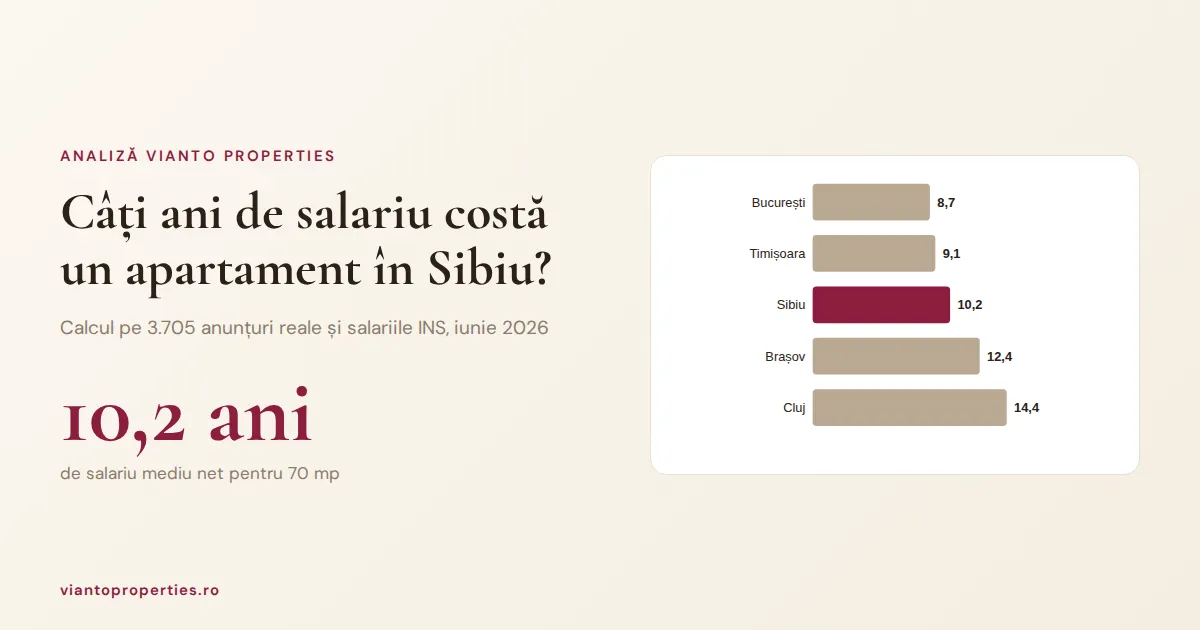
In 2023 and 2024, an average salary bought 0.66 square meters of housing. In 2026 it buys 0.57. It seems like a small difference—until you multiply it by the 70 square meters of a family apartment: from 8.8 to 10.3 years of work, in just two years. Prices are rising 7.4% per year, while inflation of 6.17% (August 2026) erodes the real purchasing power of salaries. If the pace continues, Sibiu will lose within two to three years the affordability advantage that sets it apart today.
Sibiu vs. the rest of the country: 3rd place, with caveats
How many years of average local net salary a 70 sqm apartment costs (2026)
Vianto calculation: 70 sqm × average price €/sqm (Imobiliare.ro, May 2026) ÷ average local net annual salary (INS, March 2026).
Relative to local salaries, Sibiu is the third most affordable major city in Romania. Concrete comparisons speak volumes. A Cluj resident who sells their 70 sqm apartment (around €232,000 at Cluj prices) can buy an equivalent one in Sibiu and have approximately €90,000 left over. A Brașov resident pays 13% more per square meter at home, on salaries 6% lower than in Sibiu.
Why does this matter to a local buyer? Because relative affordability attracts internal migration—and Sibiu County gains net approximately 3,000 people per year from the rest of the country (INS, 2023). These people buy or rent, sustaining demand. It's one of the structural reasons why a severe price correction is unlikely here, even if transaction volumes fall—we detailed the phenomenon in the complete market analysis.
"I'm waiting for prices to drop"—is it worth it?
The legitimate question anyone looking at these figures asks. We ran the scenario: what if prices dropped 10% tomorrow?
For the couple with median incomes, access would improve—a real improvement, but not a transformation: the couple already had access to most of the market. For the single with median income, access would improve only marginally. Even a 10% correction—a rare event that in real estate markets usually comes packaged with recession and job insecurity—wouldn't fundamentally change the single buyer's position.
Meanwhile, history is merciless with those who waited: Sibiu prices have risen an average of approximately 11% per year since 2019. Anyone who delayed buying from 2021 for "the correction coming" pays 40-50% more today, at comparable interest rates. This isn't a guarantee for the future—it's just the measured cost, so far, of waiting.
Practical guide, by situation
You're single, with income around the median: a realistic target is the 1-room segment (around €61,000) or compact 2-room apartments under €90,000. Rental yield on studio apartments is the best on the market (5.9% gross)—if in a few years you move to something larger, the studio rents easily. Down payment over 15% = significantly lower monthly payment.
You're two, with ordinary incomes: you have access to two-thirds of the market. Don't rush at the first viewing—your negotiating power is good precisely in the €95,000-150,000 segment. Check the fixed vs. variable difference on the bank's actual offer: at €101,700, it means 503 lei per month.
Growing family, looking for 3 rooms: the required income is 9,423 lei net per household at fixed interest. If you already own a 2-room apartment, selling it covers the down payment in full and part of the loan—a chain transaction (sale + purchase) is the standard scenario we manage most often.
Buying for rental: gross yields: 5.9% for a 1-room apartment, 4.7% for 2-room, 4.2% for 3-room. Plus capital appreciation, which over the last 7 years has been ~11% per year - but which no serious person guarantees in advance. The full yield calculation I've detailed in the rental yield calculator.
Conclusion
The Sibiu market is not closed - it's selective. It rewards dual-income households, buyers with savings ready, and those who understand the difference between average salary statistics and their actual money. For them, Sibiu remains one of the most rational large cities in Romania to buy in: the third most affordable relative to salaries, with solid demographic demand and limited new supply.
For everyone else, the honest news is that the window narrows with each year prices grow by 7.4% while real wages stagnate. Updated monthly figures - prices, transactions, interest rates - you'll find on our real estate market analysis page. And about the direction demand is shifting - towards Șelimbăr, Cisnădie and the rest of the suburban ring - we've written in the demographic analysis of the area.
Looking for an apartment in Sibiu or want a realistic assessment of your budget? The Vianto Properties team works with these figures daily. Call us at +40 791 710 606, email us at office@vianto.ro or see available properties.
Vianto Properties offers in Sibiu:
Frequently Asked Questions
How much does a 2-room apartment cost in Sibiu in 2026?
At the average price of 2.034 €/sqm (September 2026, Imobiliare.ro), a 2-room apartment of around 50 sqm costs approximately 101.700 €.
What income do I need for a mortgage on a 2-room apartment?
Approximately 6.730 lei net per month, at a fixed interest rate of 5.9%, loan over 30 years, 15% down payment and maximum rate of 40% of income (BNR rule). At variable interest rate (IRCC 5.57% + margin), the required income rises to around 7.988 lei.
Is Sibiu an expensive city for apartments compared to the rest of the country?
Relative to local salaries, no: a 70 sqm apartment costs 10.3 years of average net salary, compared to 14.3 years in Cluj-Napoca and 12.5 in Brașov. Only București (8.8) and Timișoara (9.3) are better off. Affordability is deteriorating though: in 2024 it was 8.8 years.
How much down payment do I need for an apartment in Sibiu?
Minimum 15% of the price. For a 2-room apartment of 101.700 € that means 15.255 €, or approximately 80.000 lei. A couple saving 20% of their income accumulates this amount in around 3.6 years.
Is it worth waiting for prices to drop in Sibiu?
History has not rewarded waiting: prices have grown on average by ~11% per year since 2019. Even a 10% correction would only marginally improve access for a single buyer with median income. Demographic demand and limited new supply support prices.
The correct selling price is determined by comparable transactions in your area, not by the asking prices in nearby listings. You can request a free property evaluation, with a response within 24 hours, or you can discuss with the Vianto Properties team before you decide.