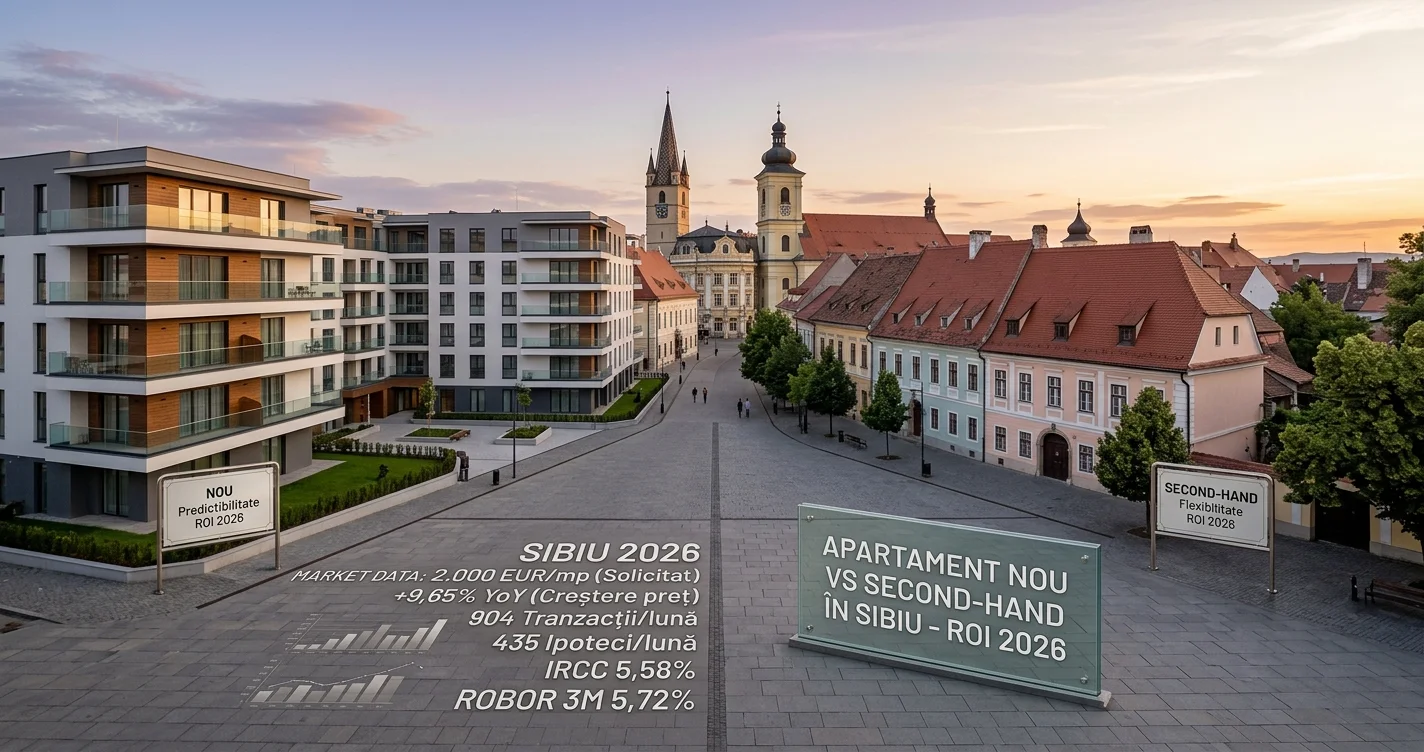
The question "new or second-hand?" is not just about finishes. It's about peace of mind, time and money. In 2026, new vs second-hand apartment Sibiu means choosing between predictability and flexibility. The local market is still in an appreciating market, and the decision shows directly in ROI. According to Imobiliare.ro, the average asking price in Sibiu is 2,034 EUR/sqm in September 2026. And the momentum is significant: +7.4% in one year. On the activity side, ANCPI data shows 936 transactions in Sibiu County in June 2026, with +26.7% compared to June 2025. That tells you one simple thing: there is sustained demand, and good stock moves quickly. Let's put the numbers and real scenarios on the table.
- 2,034 EUR/sqm average asking price in Sibiu (September 2026), according to Imobiliare.ro.
- +7.4% annual variation in average asking price, according to Imobiliare.ro (September 2026).
- 936 transactions in Sibiu County in June 2026, +26.7% compared to June 2025, according to ANCPI - transaction statistics.
- 500 new mortgages in Sibiu County in June 2026, according to ANCPI - mortgages.
- IRCC 5.57% and ROBOR 3M 5.84% (August 2026), according to BNR - interest rate indicators.
Contents
- 1) New vs second-hand apartment Sibiu - how we define ROI in 2026
- 2) Asking price, transaction price and liquidity - what matters in Sibiu
- 3) Sibiu neighbourhoods: lifestyle, location and buyer type
- 4) Mortgage, debt service and first-rank mortgage - impact on ROI
- 5) Risks, due diligence and checklist: new vs second-hand
- 6) Practical strategies for positive ROI in 2026
- FAQ
1) New vs second-hand apartment Sibiu - how we define ROI in 2026
ROI is not just rent. It's also your time
When you compare new vs second-hand apartment Sibiu, ROI doesn't just mean gross yield. It also means how many hours you lose to repairs, how quickly you rent it out and how easily you sell. A new apartment can reduce technical surprises. A good second-hand property can offer a clearer negotiation margin. In both cases, ROI should be viewed as a mix between cashflow and capital appreciation on resale.
In practice, you have three objectives. The first is good gross yield, without long vacancy periods. The second is stable net yield, after costs and taxes. The third is capital gain, that is the difference between the transaction price at purchase and the transaction price at sale. In an appreciating market, capital gain can weigh heavily. But it's not guaranteed, especially if the market shows signs of cooling.
Why 2026 is a year of "calculations", not impulse
In 2026, interest rates matter more than in years with cheap money. According to BNR, IRCC is 5.57% and ROBOR 3M is 5.84% (August 2026). This shows directly in debt service. If you take a mortgage, the difference between an efficient property and one that's "just beautiful" becomes large. That's why comparing the apartment segment must be done with clear scenarios.
There's one more element: market activity. According to ANCPI, in Sibiu County there were 936 transactions and 500 new mortgages in June 2026. When transactions increase, you usually have sustained demand. But that doesn't mean every asking price is correct. It means that well-positioned properties, in areas with high liquidity, sell faster.
A simple decision framework: 4 questions
- What is the market price for your chosen location, not for "Sibiu" generically?
- Do you need limited available stock in your area, or do you have alternatives?
- Do you want quick cashflow or capital appreciation over the medium term?
- Can you sustain debt service if the market shows signs of cooling?
If you answer clearly, the choice between new and second-hand becomes logical. It's no longer emotion. It's strategy. And good strategy starts with the right price: realistic asking price and a target transaction price.
| Indicator (Sibiu / National) | Value | Source |
|---|---|---|
| Average asking price Sibiu (September 2026) | 2,034 EUR/sqm | Imobiliare.ro |
| Annual variation in average asking price Sibiu | +7.4% compared to September 2025 | Real estate portals |
| Transactions Sibiu county (June 2026) | 936 (+26.7% compared to June 2025) | ANCPI |
| New mortgages Sibiu county (June 2026) | 500 | ANCPI |
| IRCC / ROBOR 3M | 5,57% / 5,84% | BNR |
For local context, you can also see the city profile on Wikipedia - Sibiu. It helps when explaining to a tenant or buyer why the area matters.
2) Asking price, transaction price and liquidity - what matters in Sibiu
Asking price vs transaction price: where ROI gets lost
In the apartment market discussion, the biggest mistake is taking the asking price as truth. The asking price is a signal. The transaction price is reality. The difference between them is negotiation discount. And the discount can make your ROI positive or eat up your yield.
Generally, with new apartments, the asking price is more "fixed". The developer has grids and timelines. With second-hand, you more often have a negotiation margin, especially if the owner wants a quick sale. However, in high-liquidity areas, the discount compresses. There, sustained demand keeps the transacted price close to the asking price.
What does "high-liquidity area" mean in practice
A high-liquidity area has three signs. One: it sells constantly, not just "by luck". Two: it has demand for rent, not just for purchase. Three: it has infrastructure and services at short distance. In Sibiu, this shows in neighbourhoods with good access to the centre, to office areas and to quick exits.
In 2026, market activity is clear. According to ANCPI, 936 transactions in Sibiu county in June 2026 show turnover. And 500 new mortgages show that financing still works. In such a market, correctly positioned properties move. But watch out: turnover does not mean that every asking price is justified.
Compared to other cities: Sibiu is in the middle of the ranking
Many buyers compare Sibiu with more expensive cities. It's useful, but must be done correctly. According to Imobiliare.ro (September 2026), Sibiu has 2,034 EUR/sqm average asking price. Cluj-Napoca has 3,316 EUR/sqm. Brașov has 2,309 EUR/sqm. Bucharest has 2,312 EUR/sqm. Constanța has 2,020 EUR/sqm. Iași has 2,000 EUR/sqm. Timișoara has 1,984 EUR/sqm. Oradea has 1,885 EUR/sqm.
What does this mean for the apartment discussion? It means Sibiu is not "cheap", but not at the top either. This attracts buyers looking for balance: quality of life, tourism, university, industry. In an appreciating market, this mix supports market price.
| City | Average asking price (EUR/sqm, September 2026) | Source |
|---|---|---|
| Cluj-Napoca | 3.316 | Real estate portals |
| Brașov | 2.309 | Real estate portals |
| București | 2.312 | Real estate portals |
| Sibiu | 2.034 | Real estate portals |
| Constanța | 2.020 | Real estate portals |
| Iași | 2.000 | Real estate portals |
| Timișoara | 1.984 | Real estate portals |
| Oradea | 1.885 | Real estate portals |
Market Pulse: how to use it without fooling yourself
In the local snapshot, Sibiu has Market Pulse 29/100 (June 2026). I read it as a temperature indicator, not as a verdict. When the pulse is moderate, you usually have an active market, but with selection. That is, good properties sell, and overvalued ones sit. Here opportunity appears: with second-hand you can negotiate, and with new you can get better terms, if you choose the right project.
If you want to constantly track the context, go to Vianto Properties' page on the real estate market. It's where we put analyses in everyone's terms, without noise.
3) Neighbourhoods in Sibiu: lifestyle, location and buyer type
Why the neighbourhood completely changes the new vs second-hand equation
In the apartment topic, neighbourhood is filter number one. The same apartment, with the same area, can have a different market price just from location. Moreover, the neighbourhood dictates the type of tenant or final buyer. This changes your gross yield, net yield and resale speed.
In Sibiu, you have areas with urban vibe, quiet family areas and mixed areas, where you have both old blocks and new projects. The key is to choose a reference area that fits your plan. If you want rent, you look for constant demand. If you want appreciation, you look for areas in transformation, but with solid foundations.
Centre and Ultra-Centre: walking, cafés, tourism
The central area is about lifestyle. You have restaurants, events, quick access to everything. For a tenant, this means comfort. For an investor, this means demand. But there are also compromises: parking, noise, renovation restrictions in certain buildings. With second-hand, you check installations and structure carefully. With new, supply is rarer, so limited available stock appears.
In the centre, a well-renovated second-hand can compete with a new apartment. But it must be done correctly, not "cosmetically". Otherwise, net yield drops from repairs. Here, clean land register and land register extract without encumbrances are mandatory, especially for properties with history.
Strand: green, sports, relaxed pace
Strand is a neighbourhood many choose for balance. You have green areas, good access, a calmer pace. For families, proximity to schools and playgrounds matters. For investors, it matters that it's a high-liquidity area in many segments. Here you find both solid old blocks and new projects nearby.
In the apartment segment logic, Strand is good for both. New, if you want efficiency and predictable costs. Second-hand, if you want to enter at a good transacted price, with negotiation discount. Important is to compare correctly: floor, orientation, parking spot, storage, access.
Hipodrom: urban, connected, good for rent
Hipodrom has density and services. You have shops, transport, schools. For rent, it's an advantage. For resale, it matters that there is sustained demand. At the same time, with second-hand you must be careful about installations, insulation and maintenance costs. With new, projects are more punctual, and differences between developers are large.
In Hipodrom, ROI can be good if you enter at market price, not at inflated asking price. This is where experience shows: knowing when an asking price is just a "market test". And knowing when an apartment has appreciation potential through smart renovation.
Turnișor: good access, mix of old and new
Turnișor is attractive for those who want quick access to industrial areas and exits. It has an interesting mix: old blocks, but also new projects. The lifestyle is practical. It's not "for show", but it's efficient. For an investor, this can mean good occupancy, if the apartment is correctly positioned.
In the apartment market, Turnișor is a good place for direct comparisons. You can clearly see the cost difference between new and old. You can also see the difference in tenant perception. Many prefer new for comfort. But second-hand can win on areas and layouts.
Sub Arini: quiet, panorama, discreet premium
Sub Arini is for those who want quiet and a more "settled" air. It's a lifestyle with walks, views and less hustle. Here, supply can be more select, and supply shortage appears more often on certain types. For investments, the tenant profile matters: usually people looking for comfort and willing to pay for it.
In Sub Arini, a new apartment can have an advantage in efficiency and comfort. A good second-hand can have an advantage in location and area. But it must be evaluated carefully: finishes, installations, insulation, parking spot. Here, small differences show in transacted price.
Valea Aurie: green, close to nature, good for family
Valea Aurie is the kind of area you choose for lifestyle. You have access to nature and a slower pace. For families, it's a major plus. For investors, it's good if you target stable, long-term tenants. That helps net yield, because turnover decreases.
When discussing apartments, Valea Aurie can favor second-hand, if you find good layout and a well-maintained building. New can be rarer, so available stock is limited. When supply is small, asking price can go up. Here you need a market price analysis, not impressions.
If you want to read other buying guides, visit Vianto Properties blog. You'll find applied articles with local examples.
4) Credit, debt service and first-rank mortgage - impact on ROI
Interest can "eat" your return
In 2026, apartment comparison must be made with interest rates on the table. According to BNR, IRCC is 5.57% and ROBOR 3M is 5.84% (August 2026). I won't go into rate calculations, because they depend on down payment, period and bank. But the principle is simple: with higher interest rates, you need a better transaction price or a property that rents more easily.
That's why, for new, the advantage can be predictability of initial costs. For second-hand, the advantage can be negotiation discount. If you get a transaction price below asking price, it reduces pressure on debt service. That can bring your investment towards positive ROI.
First-rank mortgage and mortgage guarantee: what you check
For credit, the bank wants clear mortgage guarantee. Usually, first-rank mortgage is registered. For you, that means the documents must be flawless. Before signing, check land register extract without encumbrances. If there are encumbrances, they must be clarified. Don't rely on verbal promises. Ask for documents and confirmations.
For new apartments, also check the developer's situation. For second-hand, check the property's history. In both cases, the final document is notarial authentic deed. That's where the transaction closes. Until then, everything is negotiation and verification.
Transactions and mortgages: what the market tells us about financing
According to ANCPI, Sibiu county had 936 transactions and 500 new mortgages in June 2026. That suggests financing has significant weight. For you, that means two things. One: if you sell, you'll meet buyers with credit. Two: if you buy, competition can be real for good properties.
In a market with sustained demand, properties in high-liquidity areas transact faster. That reduces the risk of being "stuck" with a hard-to-sell asset. In apartment segment logic, liquidity is a criterion as important as finishes.
Net salary and affordability: how to relate realistically
According to local data, average net salary in Sibiu county is 6,025 RON. At national level, net salary is 5,820 RON (July 2026), according to INS. I don't use these figures to "prove" it's easy or hard. I use them to help you be realistic with your budget. If debt service eats too much of your income, investment becomes stress, not strategy.
There's also the exchange rate. According to BNR, EUR/RON monthly average is 5.2498 (August 2026). If you save in lei and buy in euro, the rate difference matters. Especially for down payment and initial costs.
| Financial indicator | Value | Source |
|---|---|---|
| IRCC | 5,57% | BNR |
| ROBOR 3M (August 2026) | 5,84% | BNR |
| EUR/RON monthly average (August 2026) | 5,2498 | BNR |
| Average net salary Sibiu | 6.025 RON | Local snapshot |
| National average net salary | 5.820 RON | INS |
For official indicators, check directly BNR website for interest rates and exchange rates and INS website for salaries and inflation.
5) Risks, due diligence and checklist: new vs second-hand
Risks with new apartment: not all projects are the same
In the apartment market, new seems simple. But it has specific risks. The first is execution quality. The second is delay. The third is the difference between "promise" and "delivery". That's why you check the developer, history and documentation. You look at handover, technical book, warranties. You ask about administration costs and parking.
There's another aspect: in new projects, asking price can include premium for "new". If that premium doesn't reflect in transaction price at resale, ROI drops. Location matters here. A new project in an area without high liquidity can be harder to sell. Even if it looks good.
Risks with second-hand: surprises are in the details
Second-hand can be an excellent opportunity. But it must be checked carefully. Installations, infiltrations, insulation, neighbours, association, funds. Plus, you check the documents. Ask for land register extract without encumbrances and make sure you have clean land register. If there's a mortgage, it can be paid off at transaction, but procedure must be clear.
In many cases, second-hand gives you an advantage: negotiation discount. That can bring you a good transaction price. But don't buy just because it's "cheaper". Buy if it's below market price, relative to location and condition.
Viewing checklist: questions that save you money
- What is the asking price and what justification does it have against market price?
- What is your transaction price target and what negotiation margin do you have?
- Is land register extract without encumbrances available, recently issued?
- For new: is there handover report and written warranties?
- For second-hand: when were installations changed and what evidence exists?
- What are the recurring costs that affect your net yield?
- Is there clear parking space, registered or contractual?
Correct negotiation: how to get discount without losing the property
Good negotiation is not aggressive. It's argued. In apartment discussion, negotiation differs. For new, you negotiate terms: parking space, finishes, deadline, payment method. For second-hand, you negotiate asking price directly, based on real defects and comparables.
In high-liquidity areas, negotiation margin is smaller. In areas with weaker demand, margin grows. But don't forget: if you ask for unrealistic discount, you waste time. And in 2026, time costs. The market has sustained demand, and good properties don't wait long.
Documents and steps: from offer to notarial authentic deed
The correct process has clear steps. First, you verify the property and documents. Then, you establish the conditions and terms. Next comes the preliminary sale agreement, if applicable. Finally, you sign the notarial deed. In parallel, if there's a mortgage, the bank conducts its appraisal and registers a first-rank mortgage.
Don't skip verifications. Good ROI comes from discipline. Not luck. If you want to see how we work, visit the Vianto Properties website. See properties, services, and our way of working.
6) Practical strategies for positive ROI in 2026
Strategy 1: Buy in a high-liquidity area
If you want positive ROI, start with liquidity. In Sibiu, areas with services, access, and steady demand are safer. That doesn't mean there are no opportunities in emerging areas. It means the risk is higher. In 2026, with IRCC at 5.57% according to BNR, risk must be paid through a better negotiated price.
In apartment logic, new properties in a high-liquidity area rent easily. Good second-hand properties there also sell easily. This protects your capital. And it increases your chances of capital gain in an appreciating market.
Strategy 2: Target a negotiated price, don't fall in love with the asking price
Set a target negotiated price before viewings. Otherwise, you get swept away. The asking price is often a "negotiation space". Especially for second-hand. If you go in without a plan, you pay a premium. And the premium reduces your gross yield.
In the apartment segment, the difference is clear. For new properties, the asking price is more standardized. For second-hand, you have large variations. This gives you a chance to buy below market price, if you have patience and firm criteria.
Strategy 3: Optimize for net yield, not just gross return
Gross return looks good on paper. But net yield shows you reality. Maintenance costs, repairs, vacant periods, commissions, taxes. With a new apartment, you usually have fewer repairs at first. With second-hand, you may have higher initial costs, but a better negotiated price.
In 2026, inflation is 6.17% (August 2026), according to INS. That means many costs are rising. If you don't factor them in, your ROI becomes a nice story. Not an investment.
Strategy 4: Use the appreciating market, but prepare for an orderly correction
According to Imobiliare.ro, Sibiu has +7.4% in one year at the average asking price (September 2026). This shows an appreciating market. However, don't assume it will be the same every year. It's healthy to assume that the market shows signs of cooling at some point. Not as a crisis, but as an orderly correction.
What do you do practically? Buy at market price or below. Choose good location. Avoid major compromises. And make sure fundamentals remain solid: real demand, access, services, quality. That's the difference between speculation and investment.
Strategy 5: Choose the right product for your plan (living vs investment)
If you want to live there, ROI also means comfort. A new apartment can be a good choice if you want efficiency and low maintenance. If you want investment, second-hand can be better if you get a negotiation discount and optimize it through renovation. But renovation must be calculated, not emotional.
In the apartment market, there is no universal answer. There is the right answer for your budget, your time, and your risk tolerance.
| Criterion | New apartment | Second-hand apartment |
|---|---|---|
| Asking price | Usually more rigid, clear pricing | More variable, depends on owner |
| Negotiation margin | More on conditions, less on amount | Often better, if real reasons exist |
| Technical risks | Smaller at first, but depend on execution | Larger, require checks and budget |
| Liquidity on resale | Good in a high-liquidity area | Good if well-maintained and correctly positioned |
| ROI (approach) | Stability, predictable net yield | Opportunity through negotiated price and renovation |
Quick 10-minute decision checklist
- Is the property in a high-liquidity area?
- Is the asking price aligned with market price?
- What are your chances of getting a better negotiated price?
- Do you have a land register extract with no encumbrances or can you get one quickly?
- Can you support debt service at IRCC 5.57%?
If you want to see concrete options, you can start directly from the Vianto Properties platform. It's easier to compare when you have filtered listings and clear information.
FAQ - New vs Second-hand Apartment in Sibiu
1) In 2026, which choice has better ROI chances: new or second-hand apartment?
It depends on your goal. For apartments, new wins on predictability and reduced maintenance. Second-hand can win on negotiated price, if you get a discount. In 2026, with IRCC 5.57% according to BNR, any reduction at purchase helps. Choose based on location and how much time you have for management.
2) How do I know if the asking price is realistic?
Compare with the market price in your reference area, not the city average. In Sibiu, the average asking price is 2,034 EUR/sqm, according to Imobiliare.ro (September 2026). But the average doesn't tell the neighbourhood story. Ask for recent comparables and track how long listings stay up. Target a transaction price, don't anchor to the asking price.
3) What role do ANCPI transactions play in my decision?
ANCPI data don't give prices, but show activity. In Sibiu County there were 936 transactions in June 2026, +26.7% vs June 2025, and 500 new mortgages. That suggests sustained demand and active financing. For you, it's a sign that good properties move. In a zone with high liquidity, resale blockage risk drops.
4) What checks are mandatory for second-hand to avoid surprises?
Start with documents: ask for a clean land register extract and verify you have a clear land register. Then move to technical: installations, leaks, insulation, maintenance costs and association status. For apartments, second-hand requires more attention. But it can offer added value if you optimize it correctly, without unnecessary renovations.
5) How does the EUR/RON rate affect my investment in Sibiu?
If you save in lei and buy in euro, the rate matters for down payment and initial costs. According to BNR, EUR/RON monthly average is 5.2498 (August 2026). The difference can change your available budget. In the apartment segment, this can decide whether you choose new with a larger down payment or second-hand with negotiation.
6) When does it make sense to choose a new apartment, even if it seems more expensive?
It makes sense when you want time saved and predictable costs. If you have a demanding job or live in another city, new can reduce interventions. Plus, in well-positioned projects, in a zone with high liquidity, resale can be easier. Still, check documentation and conditions carefully, to reach a correct transaction price.
Conclusion: how to choose wisely in 2026
In 2026, new vs second-hand apartment Sibiu is not a matter of taste. It's a strategy decision. The local market shows activity, with 936 transactions and 500 new mortgages in June 2026, according to ANCPI. The average asking price is 2,034 EUR/sqm, up 7.4% in a year, according to Imobiliare.ro (September 2026). This indicates an appreciating market, but also tougher selection. Good properties sell, overvalued ones stay.
If you want an easier path, a new apartment can bring you predictability and a start without repairs. If you want to optimize, second-hand can bring you negotiation margin and added value through calculated renovation. In both cases, the key is the same: good location, correct market price, clean land register extract and a realistic debt service plan, especially with IRCC 5.57% according to BNR.
Want a recommendation by neighbourhood and budget, without wasting time? You can start with a short conversation on Vianto Properties contact page or explore directly Vianto Properties properties and services. We'll tell you straight what makes sense and what doesn't, based on your goal.
Looking for advice on buying or investing in Sibiu? The Vianto Properties team is available to help with personalized recommendations. Contact us at +40 791 710 606 or office@vianto.ro, or explore our available properties directly on the site.
Vianto Properties offers in Sibiu:
The correct selling price is determined by comparable transactions in your area, not by the asking prices in nearby listings. You can request a free property evaluation, with a response within 24 hours, or you can discuss with the Vianto Properties team before you decide.