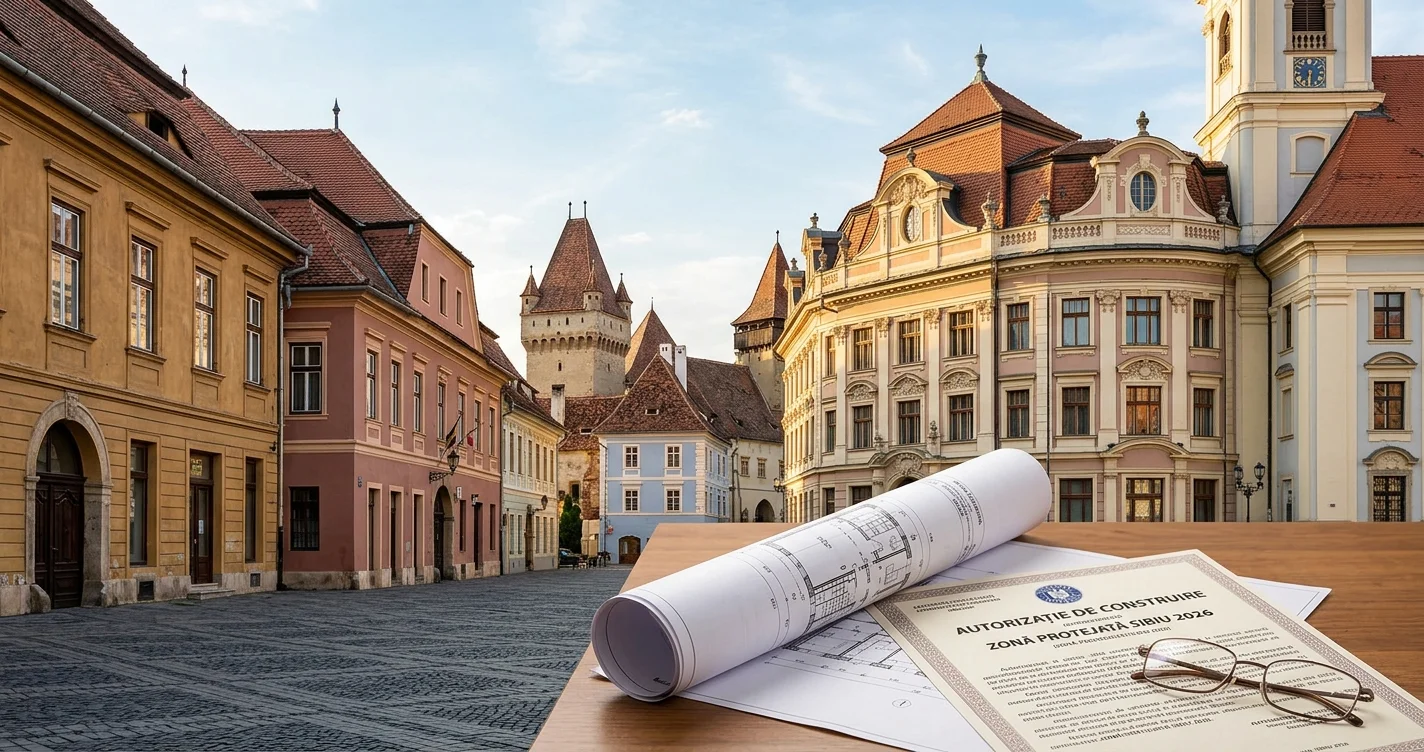
You've found a property you like, maybe in a quiet courtyard in the Historic Centre (Cetate). Or an apartment with old-world charm, near Sub Arini. In protected areas, however, "I like it" is not enough. Here, documents matter, the protection regime, and what you're allowed to change. In 2026, the Sibiu market remains active: according to ANCPI data, in June 2026 there were 936 transactions (+26.7% compared to June 2025) and 500 mortgages. When turnover is high, rushing happens. And rushing in protected areas costs time and money. In this guide I explain clearly what documentation and authorizations are needed to buy a property in a protected area in Sibiu, so you don't buy surprises.
- Check the protection regime before making an offer: protected area, historic monument, ensemble, site.
- Request land register extract without encumbrances and verify easements, mortgages, disputes, notations.
- Request building documents: building permit, inspection reports, acceptance, correlated land registration.
- Confirm legality of interventions (façade, roof, windows, partitions), especially for renovations.
- Don't confuse buying with renovating: when buying you have a set of documents; for work you have separate permits and authorizations.
- Work with a professional who knows the permit process, to avoid delays.
Contents
- 1) What "protected area" means in Sibiu and why it matters when buying
- 2) Minimum documentation when buying: what to request, what to verify, what to compare
- 3) Authorizations and permits in protected areas: when you need them and what they cover
- 4) Risk checklist: red flags and how to manage them
- 5) Areas and lifestyle in Sibiu: where protection situations occur most often
- 6) 2026 market and impact on negotiation in protected areas
- Frequently Asked Questions
1) What "protected area" means in Sibiu and why it matters when buying
The difference between protected area and historic monument
In practice, "protected area" means a perimeter with special rules. The purpose is to preserve architectural and urban character. This doesn't automatically mean your building is a historic monument. It can be an ordinary building, but within a protected area. In protected areas, some work may be permitted more easily, but still with rules. When buying, the difference matters for your plans: renovation, extension, change of use.
A historic monument has an even stricter regime. Interventions are done with dedicated permits. In a protected area, some work may be permitted more easily, but still with rules. When buying, the difference matters for your plans: renovation, extension, change of use.
Why it directly affects your transaction
When buying, you don't just "take the walls". You take on the legal and technical history. In protected areas, the history of renovations matters a lot. A façade redone without authorization can mean problems when selling later. Or costs to bring it into compliance.
There's another aspect: the bank. If you take a loan, the appraiser and bank look at risk. A property with unclear authorization status can complicate financing. Here it's useful to know from the start what documentation and authorizations are needed to buy a property in a protected area in Sibiu, so you don't waste time.
Who are the main actors, briefly
In a correct transaction, there are a few "players" who need to be aligned. The owner, the agent, the notary, the bank (if applicable), the appraiser, sometimes an architect. If work follows, the permit institutions enter the scene.
You don't need to become an urban planning expert. You need a clear process. And the process starts with checking documents, not promises. If you want to follow the local context, you have an overview on our page about the market: analysis of the real estate market in Sibiu.
2) Minimum documentation when buying: what to request, what to verify, what to compare
Land register: extract without encumbrances and what you read in it
The first document is the land register extract. Ideally, you want land register extract without encumbrances or, if there are encumbrances, it should be clear how they are removed at sale. In the extract you verify the owner, area, share, mortgages, easements, litigation notations.
In protected areas, easements or restrictions may appear. Not all are "bad", but they need to be understood. If it's a shared courtyard, verify the exact shares and access rights. If it's a shared bridge, verify the right of use. A "clean land register" reduces your risk of surprises.
The deed of ownership and transfer history
You need the deed of ownership: authentic notarial deed, sales contract, donation, inheritance, partition. In old areas, the history can be longer. This is not a problem, but requires attention.
Check if there are unfinalized successions or co-owners. In the Historic Centre (Cetate), you often encounter properties with multiple heirs. Here, the transaction is done only when everyone signs or valid powers of attorney exist.
Cadastral documentation and concordance with reality
In 2026, many properties have cadastre and land registration. However, in protected areas, differences appear between plan and reality. For example, a storage room converted into a bathroom. Or a door moved. Sometimes it seems minor, but it can matter for appraisal and sale.
Request the cadastral plan and survey, if it exists. Compare areas, layout and annexes. If you have doubts, call a specialist for a technical check. It's cheaper than fixing it later.
Building permit, acceptance and land registration of work
Many buyers ask for "permit" only for houses. In protected areas, it's useful for apartments too, especially if there have been interventions. If structural or façade changes were made, there must be documents.
Ask directly: is there a building permit for major renovations? Is there an acceptance report? Has the land register been updated after work? If the answer is vague, treat it as a risk.
Energy performance certificate and utilities
The energy certificate is required at transaction. It doesn't tell you everything, but it gives you a signal about consumption. In old buildings, windows, insulation, heating matter. In protected areas, changing windows may have rules, so verify what's already been done.
For utilities, ask for proof of metering and up-to-date payments. In older buildings, shared installations are common. Ask clearly: what is individual, what is shared, what recurring costs exist.
Practical table: documents for purchase vs documents for renovation
| Stage | Which documents are "must-have" | What you check concretely |
|---|---|---|
| Buying | Land register extract, deed of ownership, cadastral record, energy certificate | Owner, encumbrances, areas, match with reality |
| Purchase with mortgage | Bank documents, appraisal, insurance | Eligibility, risk, financing conditions |
| Renovation in protected area | Urban certificate, permits, building authorization | What you can modify, materials, volume, façade |
If you want to explore the general purchase process further, you'll find useful articles in Vianto Properties' blog. There we explain the steps clearly, without jargon.
3) Permits and approvals in protected areas: when you need them and what they cover
Buying does not require "authorization", but your plans might
A common confusion: "do I need authorization to buy?". No. Purchase is done through a notarial deed, based on deeds of ownership and the land register. But if you want to modify something afterwards, you enter the permit zone.
That's why the right question becomes: what documentation and authorizations are necessary to purchase a property in a protected area in Sibiu, so you know if your plan is realistic. If you only want to live there and change nothing, it's simpler. If you want renovation, you need to prepare.
Urban certificate: the "map" of rules
The urban certificate does not give you the right to build. It tells you what you can do and what permits you need. In protected areas, the certificate may require additional permits. For example, for façade, roof, windows, colors, signs.
A simple tip: before you buy for a "project", ask the seller to obtain an urban certificate for your intention. Or get it yourself, if you have the necessary approval. This way you avoid buying a property that cannot be adapted as you wish.
Permits: why they take time and how to manage them
In protected areas, permits are about protecting the context. It's not "bureaucracy for its own sake". It's a filter. If you want to change windows to an unsuitable model, you can damage the façade of an entire street.
In practice, permits require technical documentation: surveys, photographs, material proposals, details. A good architect makes a difference here. You, as owner, need clarity: what gets approved, what doesn't, and in what realistic timeframe.
Building authorization and handover: the correct end of works
Building authorization is the document that legally allows you to execute works. In protected areas, even apparently small works may require authorization, depending on impact. After works, handover and documentation update are essential.
Why does it matter for the buyer? Because at resale, the next buyer will ask the same things. If you do works without permits, you reduce liquidity. In an area with high liquidity, complete permits keep your advantage.
Link to financing: interest rates and caution in 2026
In 2026, financing remains sensitive to interest rates. According to BNR, IRCC is 5.57%, and ROBOR 3M is 5.84% (August 2026). You can check them directly on the National Bank of Romania website.
In this context, banks are more careful about risk. A property with unclear authorization status may mean extra questions. It's not impossible, but it's slower. If you want a quick transaction, prepare a complete file.
4) Risk checklist: red flags and how to manage them
Red flags in the listing and at viewing
In protected areas, listings can sound nice: "fully renovated", "premium design", "in the heart of the city". I look at details. If the owner avoids questions about permits, that's a signal.
- "Renovated" without documents for major interventions.
- Changed partitions, but without cadastral update.
- PVC windows on historic façades, without clarifications.
- Roof changed, but without handover or proof of authorization.
- "Shared courtyard" without clear boundaries and without access rules.
Red flags in documents
The documents tell you the truth, even if sometimes it's uncomfortable. In the land register extract, look at encumbrances and notations. In the deed of ownership, look at the description. In the cadastre, look at the areas.
- Mortgages that cannot be discharged at signing.
- Litigation notices or restrictions.
- Discrepancies between area in documents and reality.
- Annexes that exist physically but are missing from the deeds.
How to negotiate correctly when problems arise
Problems don't automatically mean "don't buy". They mean pricing the risk correctly. This is where negotiation margin and negotiation discount come in. If you need to regularize deeds or bring them into compliance, that has a cost and a timeline.
Good negotiation is calm and documented. It's not about "let it slide". It's about: what's missing, who fixes it, by when, and how that reflects in the asking price versus the transaction price.
Checklist before preliminary sale agreement
Before you pay a deposit, make a short list. If you tick everything, you'll sleep better.
- Current land register extract, verified, no surprises.
- Clear deed of ownership, no "invisible" co-owners.
- Correct cadastre and land registration, including annexes.
- Renovation history clarified, with documents where applicable.
- Your usage plan is realistic under protected regime.
Where to verify official information about transactions
For transaction volume and mortgages, the relevant source is ANCPI. You can consult the institution on the official ANCPI website. Remember: ANCPI publishes number of transactions and mortgages, not prices.
If you want context about the city and areas, including historical landmarks, you have a general overview on the Wikipedia page about Sibiu. It's useful for orientation, not for legal decisions.
5) Areas and lifestyle in Sibiu: where protection situations appear most often
Historic Centre (Cetate): charm, tourism, strict rules
Historic Centre (Cetate) is for people who want to be close to cafés, events and short walks. You have cobbled streets, old buildings and a vibe that can't be copied. At the same time, this is where façade rules, windows, roofs and permits appear most often.
If you're wondering what documentation and permits are needed to buy a property in a protected area in Sibiu, in Cetate the answer starts with checking the intervention history. Many buildings have been renovated. Some impeccably, others "in a rush".
Sub Arini (premium area): quiet, green, buildings with character
Sub Arini (premium area) is for those who want green space, running, walks and a calmer pace. It's a prestigious area with buildings that often have architectural details. That means exterior changes need to be thought through carefully.
In Sub Arini, buyers often look for long-term appreciation. To preserve it, you need complete documentation. A properly done renovation, with deeds, protects your capital gain on resale.
Trei Stejari and Valea Aurie: residential, close to nature
Trei Stejari and Valea Aurie are for families and those who want quick access to green areas. You have apartment blocks, but also houses, and a balanced lifestyle. Here, the protection regime can appear occasionally, depending on location and building.
Basically, don't assume that "if it's not in the centre, it's not protected". Always check. Ask the agent and request confirmation in the deeds and in the urban certificate, if you have plans to modify.
Calea Dumbrăvii: access, services, mix of old and new
Calea Dumbrăvii is a reference area for those who want good access, services, schools and a mix of properties. The lifestyle is urban, comfortable, without necessarily being in the hustle of the centre. In certain sections, you can find buildings with architectural value.
If you want to explore properties in the area, you can start here: Vianto Properties - properties and consultancy in Sibiu. We tell you directly what deeds exist and what's missing.
Ștrand and Hipodrom: practical, with high liquidity
Ștrand is balanced, good for families. You have parks, good access and neighbourhood life. Hipodrom has high turnover and, as a rule, an area with high liquidity. Here, "protected area" situations are rarer than in Cetate, but can exist in buildings with special regime.
The advantage in these areas is predictability. Deeds are usually more standardized. Still, verification remains mandatory, especially for renovated apartments.
Turnișor, Terezian, Lazaret: affordable, good for controlled budgets
Turnișor is affordable and practical. Terezian and Lazaret are areas with identity, with a mix of houses and apartment blocks. The lifestyle is simple, neighbourhood-based, with reasonable distances to the centre. In these areas, the risk of protection appears mainly in old buildings or properties with a long history.
Regardless of neighbourhood, the rule is the same: before you sign, clarify what documentation and permits are needed to buy a property in a protected area in Sibiu, relative to your specific case.
6) Market 2026 and impact on negotiation in protected areas
Market context: asking prices and transaction dynamics
In September 2026, the average asking price in Sibiu is 2,034 EUR/sqm, according to Imobiliare.ro. Year-on-year change is +7.4%, also according to Imobiliare.ro. By volume, according to ANCPI data, Sibiu county has 936 transactions in June 2026 and 500 mortgages.
What does this mean for protected areas? Demand exists, and limited available stock appears frequently in "storied" properties, especially in Historic Centre (Cetate) and Sub Arini. When supply deficit combines with sustained demand, sellers are less flexible.
Table: Sibiu compared to other cities (average asking price)
| City | Average asking price (EUR/sqm) | Source |
|---|---|---|
| Cluj-Napoca | 3.316 | Imobiliare.ro, September 2026 |
| București | 2.312 | Imobiliare.ro, September 2026 |
| Brașov | 2.309 | Imobiliare.ro, September 2026 |
| Sibiu | 2.034 | Imobiliare.ro, September 2026 |
| Constanța | 2.020 | Imobiliare.ro, September 2026 |
| Iași | 2.000 | Imobiliare.ro, September 2026 |
| Timișoara | 1.984 | Imobiliare.ro, September 2026 |
| Oradea | 1.885 | Imobiliare.ro, September 2026 |
Negotiation in protected areas: how to think about margin
In protected areas, negotiation margin depends heavily on deed quality. If the file is complete, negotiation discount tends to be smaller. If documents are missing or there are discrepancies, you have real arguments.
I recommend a simple approach: separate "property value" from "risk cost". If you need to regularize, quantify in time and money. Then negotiate calmly. No promises, no assumptions.
Interest rates, exchange rates and budget: what to track in 2026
If you pay in lei and negotiate in euro, the exchange rate matters. According to BNR, the average EUR/RON in August 2026 is 5.2498. Plus, the average net salary in Sibiu county is 6,025 RON, and the national average net salary is 5,820 RON (July 2026).
I'm not telling you this to scare you. I'm telling you so you can make a realistic budget. In an appreciating market, good decisions are calculated ones. And when you buy in a protected area, calculations also include the documentation side.
Mini-guide: how to prepare your file to buy quickly
- Decide clearly whether you want to live there or invest.
- Prepare proof of funds or bank pre-approval.
- Ask for all documents from the start, not "after we shake hands".
- Check the land register extract and renovation history.
- Schedule the notary only after you have clarity.
If you want to discuss your case, go directly to Vianto Properties contact page. We'll tell you what's missing and how to solve it, no beating around the bush.
Frequently Asked Questions
1) Do I need permits to buy in a protected area?
You don't need a permit to buy. You need standard transaction documents: land register extract, deed of ownership, cadastral plan, energy certificate, plus documents required by the notary and bank. Permits appear if you want to do work after purchase. In protected areas, even seemingly small work can require approvals.
2) What do I check in the land register extract for an old building?
You check the owner, area, share, charges and notes. You're interested in mortgages, easements, restrictions, disputes, rights of way. In old buildings, common areas and shared courtyards often appear. Ideally, you want a land register extract with no charges or a clear plan for removal at signing.
3) If the property has been renovated, what documents should exist?
It depends on the type of renovation. For major work, there should be a building permit and acceptance certificate. For changes affecting the façade or structure, missing documents are a risk. In protected areas, façade, roof and windows are sensitive. Ask for documents and check if the cadastral plan and land register have been updated.
4) Can I change windows in a protected area in Sibiu?
Often yes, but not just any way. In protected areas, the exterior appearance matters: division, colour, material, details. Sometimes you need approvals and a suitable technical solution. I recommend not buying with the assumption that "I'll change everything right away". Better to clarify first, through an urban planning certificate.
5) How does a protected area affect mortgage financing?
A protected area doesn't automatically block a loan. But the bank and appraiser may ask for clarifications, especially if there are discrepancies between documents and reality. If documents for work are missing, the process can take longer. In 2026, with IRCC at 5.57% and ROBOR 3M at 5.84% (according to BNR), banks are more cautious with risks.
6) What's the best strategy to not lose a good property in Cetate?
Prepare in advance: budget, pre-approval, list of required documents. Ask for the land register extract and ownership documents from the start. If the property is in a protected area, ask directly about renovation history. Then quickly decide if the risk is acceptable. That way you can make a firm offer without getting blocked later.
Conclusion: buy informed, not "on impulse"
Protected areas in Sibiu are special. They have atmosphere, architecture and a lifestyle you won't find in new developments. The Historic Centre (Cetate) gives you energy and access to everything. Sub Arini gives you greenery and peace. Calea Dumbrăvii gives you urban comfort. But precisely because they're special, they come with rules.
In 2026, with sustained demand and limited stock of character properties, it's easy to rush. I recommend the opposite: slow down on documents, speed up on decision. If you know clearly what documentation and permits are needed to buy a property in a protected area in Sibiu, you'll negotiate better and avoid delays. And at resale, you'll have a real advantage: a complete file that inspires confidence.
Want a quick check of your documents before you make an offer? Go to Vianto Properties and tell us which property you have in mind. We'll give you a practical opinion, based on documents, not impressions.
Looking for buying advice in Sibiu? The Vianto Properties team is available to help with personalized recommendations. Contact us at +40 791 710 606 or office@vianto.ro, or explore our available properties directly on the website.
Vianto Properties offers in Sibiu:
Before putting down a deposit, it's worth checking the land register extract, the price against comparable apartments and notary costs. See apartments for sale in Sibiu or write to us, and the Vianto Properties team will reply within 2 hours, during business hours.