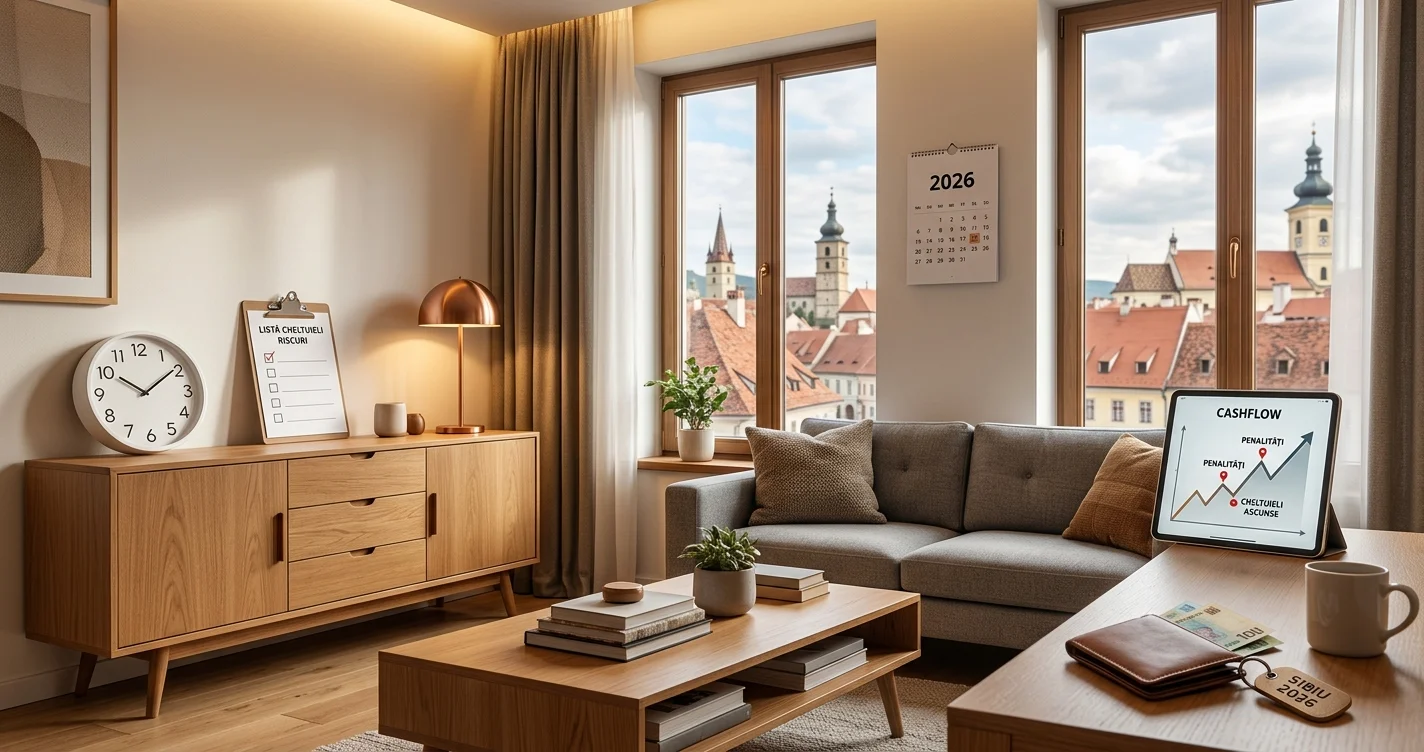
What penalties and hidden costs to avoid when renting a property in Sibiu short-term is the question that can save you money, time and stress. In 2026, the local market looks good on the surface, but has many traps in the details. In September 2026, the average asking price in Sibiu was 2,034 EUR/sqm, according to Imobiliare.ro, and transactions reached 936 in June 2026, according to ANCPI data. When you have sustained demand and limited available stock, more "small fees" appear that add up. And for short-term rentals, every unoccupied day or every penalty from a poorly written contract is felt immediately in cashflow. Let's go through them one by one, simply and practically.
- Check cancellation penalties from platforms and from your contract, not just from messages with guests.
- Control cleaning and consumables costs with a checklist and monthly budget, otherwise they eat into your net yield.
- Don't ignore compliance costs: building rules, neighbours, records, invoices, clear procedures.
- Calculate vacancy risk correctly and avoid unrealistic asking prices, which lower your gross return.
- Set deposits and usage rules to reduce damage and disputes, without scaring away good clients.
- Work with a local partner for check-in, maintenance and control, especially if you're away.
Contents
- 1) 2026 Context in Sibiu: why penalties and hidden costs appear
- 2) Contractual penalties: where you get burned most often
- 3) Hidden operational costs: cleaning, consumables, maintenance
- 4) Financial costs: interest, fees, exchange rate, cashflow
- 5) Areas and lifestyle in Sibiu: how they affect costs and risks
- 6) 2026 Checklist: how to avoid penalties and hidden costs
- Frequently Asked Questions
1) 2026 Context in Sibiu: why penalties and hidden costs appear
The market moves, but doesn't forgive small mistakes
In Sibiu, the market is appreciating, with an annual variation of +7.4%, according to Imobiliare.ro (September 2026). In parallel, transactions have grown to 936 monthly, and new mortgages are 500 monthly, according to ANCPI data. This tells you two things. One, there is sustained demand. Two, there is pressure on limited available stock and supply deficit in areas with high liquidity.
For short-term rentals, however, you don't win just from "demand". You win from control. Control of costs, schedule, rules and quality. If you lose control, penalties and hidden costs quickly eat into your gross return and can turn your ROI from positive to negative.
Interest rates and inflation change the rules of the game
In 2026, IRCC is 5.57%, and ROBOR 3M is 5.84%, according to BNR - interest rate and exchange rate indicators. Inflation is 6.17% (August 2026), according to INS - CPI indicators. This means higher costs for services, repairs, consumables and labour. If you set your rates only after "what the neighbour charges", you'll feel the difference in net yield.
There's also the exchange rate: average monthly EUR/RON is 5.2498 (August 2026), according to BNR. If you have payments, services or investments in lei, but collect in euros or vice versa, differences appear. They're not dramatic in a day, but they add up over months.
Why short-term rentals have "invisible taxes"
Short-term rentals have high turnover. Turnover means repeated cleaning, check-in, check-out, consumables, laundry, maintenance and time. If you outsource, you pay for services. If you do it yourself, you pay with your hours. In both cases, there are real costs, only some don't appear in the first conversation.
From here comes the key question: what penalties and hidden costs to avoid when renting a property in Sibiu short-term? The answer is a mix of contract, operational and financial. In the following sections we put them in a simple system.
For local context, it's worth following our page with updates: Sibiu Real Estate Market - Vianto Properties Analysis.
2) Contractual penalties: where you get burned most often
Cancellation and modification penalties: platform vs your rules
The first trap is to believe that "the platform solves everything". The platform has rules, but you need written rules for your property too. Penalties appear in two places: in the cancellation policy and in the house rules. If you don't write them clearly, you enter into tiresome negotiations, and the result is usually a forced negotiation discount.
A simple example: guests ask to change dates, then ask for cancellation at no cost. If you don't have a firm policy, you lose good calendar days. For short-term rentals, lost days are direct cost. Plus, if you have services scheduled, you pay for cleaning or check-in for nothing.
- Write clearly the minimum notice interval for cancellation.
- Define what "no-show" means and what happens then.
- Set rules for last-minute changes.
- Explicitly mention check-in and check-out times.
Penalties from supplier contracts: cleaning, laundry, maintenance
Many owners only look at commission. But serious penalties come from supplier contracts. If you have outsourced cleaning, ask directly: is there an emergency fee? is there a Sunday fee? is there a travel cost? is there a penalty if you cancel with less than 24 hours' notice?
Same with maintenance. If you have a "trusted" installer, but without clear terms, you end up paying expensive weekend interventions. This is a classic hidden cost. You don't see it in the first month. You see it when you have three check-outs in a row and a bathroom problem.
Penalties from building rules and relationship with neighbours
In Sibiu, many good short-term rental apartments are in buildings with strict rules. Here hidden costs appear: internal fines, repeated complaints, pressure to give up short-term rentals. I'm not being dramatic. I'm just stating reality: if neighbours can't sleep, you don't have peace either.
In the Historic Center (Citadel), for example, you have charm, but also sensitivity to noise. In Sub Arini, you have a premium lifestyle, but also high expectations for quiet and quality. In Strand, you have a family rhythm, so tolerance for parties is low. In Hipodrom, you have high turnover and good access, but also density, so cohabitation rules matter a lot.
- Communicate quiet rules and maximum number of people from the start.
- Install simple protections: door dampers, rugs, discreet signage.
- Use a house guide, printed and digital.
- Have a local contact for quick interventions.
Penalties related to documents and clarity of property rights
It is not a "platform penalty", but it is a major risk. If you have co-owners, unfinalized successions or encumbrances, you can end up with blockages. In real estate, the rule is simple: you want a CF extract without encumbrances and a clean land register before you seriously invest in improvements.
If you have a loan, also discuss first-rank mortgage and what that means in practice. Don't be scared, just clarify. When you have legal clarity, you reduce the risk of interruptions and unexpected costs.
If you want to deepen the market side and decisions, you'll find useful articles here: Vianto Properties Blog.
3) Hidden operational costs: cleaning, consumables, maintenance
Cleaning: low cost per booking, high cost per month
Cleaning is the first cost that gets out of control. In the short term, you don't have a "general" cleaning per month. You have cleaning after each guest. If you have good turnover, you also have repeated cost. If you have poor turnover, you have preparation cost and then unoccupied days. In both scenarios, you need to budget realistically.
My recommendation is to treat cleaning as a process, not as an expense. That is: checklist, photos after cleaning, linen control, consumables inventory. If you don't have control, complaints appear, and complaints lead to negotiation discounts or refunds.
- Checklist per room: bathroom, kitchen, bedroom, hallway, balcony.
- Minimum inventory: paper, soap, detergent, garbage bags.
- Standard photos: same angles, after each cleaning.
- Simple rule: "leave it better than you found it".
Consumables and "small things" that become budget
At first, consumables seem negligible. Then you start buying: coffee capsules, tea, water, paper, soap, sponges, solutions, air freshener, batteries, light bulbs. If you don't have a standard list, you buy chaotically and expensively. This lowers your net yield without you realizing it.
The trick is standardization. Choose 2-3 products per category and stick with them. Plus, set up a simple "welcome package". It doesn't have to be luxury. It has to be consistent and clean.
Maintenance: small interventions are the most expensive
In the short term, wear is faster. Not because guests are "bad", but because you have more usage cycles. Door handles, hinges, chairs, pull-out sofas, sanitary fittings. If you don't have a preventive maintenance plan, you end up with emergency interventions.
Emergency interventions are expensive for two reasons. One, you pay for speed. Two, you lose nights of accommodation. This is where the major hidden cost appears: forced vacancy. You don't see it in the invoice, you see it in the calendar.
- Monthly review: leaks, outlets, light bulbs, Wi-Fi, remote controls.
- Quarterly review: bathroom caulk, fittings, hardware.
- Set of spare parts: light bulbs, batteries, shower hose.
- Emergency contacts: plumber, electrician, cleaner.
Damage and disputes: how to reduce risk without becoming rigid
Damage is rare, but when it happens, it costs. The solution is not to be aggressive. The solution is to be clear. Short rules, displayed. Deposit or guarantee, where possible. Simple inventory, with photos. If you have a process, discussions are shortened.
Once again, I return to the central question: what penalties and hidden costs should I avoid when renting a property in Sibiu short-term? On the operational side, the answer is: repeated, unplanned costs, plus time lost in disputes. This is where profit is won or lost.
4) Financial costs: interest, fees, exchange rate, cashflow
Mortgage loan and debt service: don't just look at the rate
If you bought with a loan, you have monthly debt service. In 2026, IRCC is 5.57% and ROBOR 3M is 5.84%, according to BNR. I won't go into rate calculations, because they depend on amount and period. But I'll tell you what matters: cash reserve.
In the short term, revenues are variable. You have good months and weak months. If debt service is fixed and revenue varies, you need a buffer. Otherwise, you end up making negotiation discounts in weak periods, just to cover the rate. This is a classic trap.
- Keep a cash reserve for weaker months.
- Don't set rates below cost just to "keep it occupied".
- Track net yield, not just gross return.
Platform commissions and fees: small, but constant
Platform commissions are predictable, but many ignore them in calculations. Same with payment processing fees. I won't give percentages, because they differ between platforms and packages. The idea is to put them in a cost table and subtract them before you enjoy "profit".
There's also the cost of currency conversion, if you collect in one currency and pay in another. In August 2026, the EUR/RON average is 5.2498, according to BNR. Exchange rate differences and bank fees can slowly but surely erode your margin.
Insurance and risks: low cost, great protection
Good insurance is not a luxury. It is a risk management tool. In the short term, the risk of incidents increases with volume. It does not mean it happens often. It means that cumulative probability is higher.
Insurance does not eliminate costs, but it limits your maximum loss. And that protects your ROI. If you want peace of mind, this is a simple step.
Asking price vs transaction price: how optimism tricks you
In real estate, there is a difference between asking price and transaction price. In the short term, there is a similar difference between "listed rate" and "collected rate" after discounts, cancellations and vacant nights.
That is why, when you make your plan, work with scenarios. An optimistic scenario, a realistic one and a conservative one. This way you see if you have positive ROI and when you reach break-even in years, without lying to yourself.
| 2026 Indicator | Value | Source | Why it matters in the short term |
|---|---|---|---|
| Average asking price Sibiu | 2.034 EUR/sqm (September 2026) | Imobiliare.ro | It shows you the entry level and yield pressure. |
| Annual variation | +7,4% | Imobiliare.ro | Market sign of appreciation, but higher acquisition costs. |
| Monthly transactions Sibiu | 936 (+26.66% YoY) | ANCPI | Shows liquidity and interest, useful for exit and capital gains. |
| New mortgages per month | 500 | ANCPI | Shows appetite for credit and sensitivity to interest rates. |
| IRCC | 5,57% | BNR | Affects debt service on loans with variable interest rates. |
| Inflation | 6.17% (August 2026) | INS | It raises your operating costs and maintenance. |
You can check official data here: ANCPI - transaction and mortgage statistics and BNR - exchange rate and interest rates.
5) Areas and lifestyle in Sibiu: how they affect costs and risks
Historic Centre (Cetate): tourism, charm, but also strict rules
The Historic Centre (Cetate) is a magnet for visitors. You have walks, restaurants, events, all within reach. The lifestyle is urban, cultural, with lots of activity. But you also have challenges: limited car access, few parking spaces, noise sensitivity and attentive neighbours.
Hidden costs here come from logistics. Check-in is harder. Cleaning can take longer. If you do not have a system, you lose time and money. Plus, any noise complaint can lead to cancellations and indirect penalties.
Sub Arini (premium area): quiet, green, high expectations
Sub Arini is a premium area for many Sibiu residents. You have greenery, walks, a calmer pace. Guests who choose Sub Arini seek comfort, impeccable cleanliness and attention to detail. That means the standard must be consistent.
Hidden costs here are linked to quality. If you have cheap furniture or worn finishes, you will pay in reviews and in negotiation discounts. In an area with high liquidity, comparison is tough. Guests have alternatives.
Strand: balance for families, stable demand
Strand is balanced and family-friendly. You have good access, services, a normal pace. For the short term, it can work very well if you target families or people on business trips who want quiet.
Hidden costs appear when you do not define your audience. If you try to attract both parties and families, you will have conflicts. Better to choose a clear profile and optimize your rules and amenities for it.
Hipodrom: high turnover, access, but watch management
Hipodrom has high turnover and lots of demand, being a dense and well-connected area. The lifestyle is practical. People want quick access, nearby shops, transport. For the short term, it can mean good occupancy, but also more wear and tear.
Here hidden costs are maintenance and turnover. If you have many bookings, you have many cleanings and many chances of small defects. The solution is a strict process and a local person who checks.
Turnișor and Terezian: affordable, authentic, good for controlled budgets
Turnișor is accessible and has a more settled feel. Terezian is older, more authentic, with neighbourhood life. For the short term, they can be good options if you have a correct market price and good presentation.
Hidden costs here come from wrong expectations. If you promote as "premium", you will attract guests who demand premium. If you deliver correctly for the area's level, reviews are good and disputes drop.
Valea Aurie and Calea Dumbrăvii: green, comfort, detail-conscious public
Valea Aurie has lots of green and a quiet vibe. Calea Dumbrăvii is a reference area, with good access and good perception. Here the public is attentive to details and comfort. If you have a well-maintained apartment, you can have sustained demand.
Hidden costs are linked to standard: good linens, good mattress, stable Wi-Fi, impeccable cleanliness. If you cut corners, you pay through reviews and through lower collected rate.
If you want to better understand the city as a destination, also see Wikipedia - Sibiu (context, tourism, geography).
| Area (Sibiu) | Lifestyle | Typical short-term risks | Frequent hidden costs |
|---|---|---|---|
| Historic Center (Citadel) | Urban, touristy, everything within walking distance | Noise, access, parking | Check-in logistics, time, complaints |
| Sub Arini (premium area) | Green, peace, premium | High expectations | Upgrades, quality, reviews |
| Strand | Family-friendly, balanced | Conflicts if targeting is wrong | Minor damage, communication time |
| Hipodrom | Practical, connected, dense | Wear, high turnover | Maintenance, repeated cleaning |
| Turnișor | Accessible, well-located | Wrong positioning | Discounts, vacant nights |
| Valea Aurie / Calea Dumbrăvii | Comfort, green space, landmark area | High standard | Consumables, upgrades, quality control |
6) 2026 Checklist: how to avoid penalties and hidden costs
Contract and rules checklist: short, clear, enforceable
If you want to avoid endless discussions, you need short rules. Not a novel. One page, two at most. And the rules must be enforceable. If you write "no noise" but accept 6 people in a studio, you have a problem.
- Cancellation policy: clear, no "mercy" exceptions.
- Check-in and check-out times, plus late check-out fee.
- Maximum number of guests, no overnight "visitors".
- Quiet hours rules and consequences if breached.
- Simple prohibitions: smoking, parties, pets, if applicable.
Operational checklist: standardization and control
Operations is where most money is lost. Not all at once. But through small leaks. If you want good net yield, standardize. That means the same products, the same procedures, the same photos, the same reports.
- Cleaning with checklist and photos after each booking.
- Consumables inventory, updated weekly.
- Monthly review: leaks, Wi-Fi, appliances.
- Emergency plan: who enters the apartment in 30 minutes.
- Template messages: check-in, rules, thank you, review.
Financial checklist: calculate net yield, not just gross return
Gross return looks good on paper. Net yield pays your real life. In calculations, subtract everything: commissions, cleaning, consumables, maintenance, vacant periods, taxes, insurance. If you're still in the black after all that, you have positive ROI.
- Monthly budget for recurring costs, not "by ear".
- Cash reserve for slow months.
- Track the difference between listed rate and collected rate.
- Don't confuse asking price with transaction price, not even for rentals.
Acquisition checklist: avoid problems before they appear
If you're still in the buying phase, you have an advantage. You can choose the right property for short-term rental. That means good location, access, layout, and a building that tolerates this use. In areas with high liquidity, you'll also have better exit options, meaning easier capital gains.
- Check land register extract with no liens before deposit.
- Ask about homeowners association rules before signing.
- Calculate debt service at current interest rates (IRCC, ROBOR).
- Think in scenarios, not promises.
And once more, for clarity: what penalties and hidden costs should I avoid when renting a property in Sibiu short-term? Avoid uncontrolled cancellation penalties, unbudgeted cleaning costs, reactive maintenance, disputes without evidence, and cashflow without reserves.
If you want a discussion tailored to your case, go to Vianto Properties contact page and tell us what property you have and in what area.
Frequently Asked Questions
1) What are the most common short-term penalties in practice?
Most often, penalties or losses come from late cancellations, no-shows, and last-minute changes. Then indirect costs appear: cleaning scheduled for nothing, wasted time, unoccupied nights. If you don't have clear rules and a confirmation process, you end up offering negotiation discounts to "smooth things over".
2) How do I know if I have hidden costs eating into my profit?
Look at net yield, not just revenue. Make a list of all recurring costs: cleaning, supplies, maintenance, commissions, taxes, insurance. Then add the cost of vacancy as lost opportunity. If the gap between your advertised rate and actual rate collected is large, you have leaks in the system.
3) What role does the area in Sibiu play in the risk of penalties and complaints?
The area influences guest profile and neighbour tolerance. In the Historic Centre (Cetate) you have tourism and noise sensitivity. In Sub Arini you have premium expectations. In Strand you have family pace. In Hipodrom you have high turnover and wear. If you position your property wrong, you'll have more disputes and hidden costs.
4) If I have a mortgage, how do I protect myself from weak months?
In 2026, interest rates are high, with IRCC 5.57% and ROBOR 3M 5.84%, according to BNR. Real protection is cash reserves and scenarios. Don't rely on "perfect occupancy". Calculate debt service and see if you can cover the payment even in a conservative scenario. If not, adjust your strategy or budget.
5) Is it worth working with a local firm for management?
Yes, especially if you're not in Sibiu. Good management reduces hidden costs: controlled cleaning, quick interventions, guest communication, damage prevention. Plus, it lowers the risk of bad reviews, which cut your actual rate. Basically, you pay for a service to protect your net yield and keep ROI positive.
6) Where do I find official market data and indicators?
For transactions and mortgages, use ANCPI website. For interest rates and exchange rates, use BNR website. For city and tourism context, Wikipedia - Sibiu is also useful. For local analysis, follow the Real Estate Market section.
Conclusion: how to stay in profit for short-term in 2026
In 2026, Sibiu remains attractive, with an appreciating market and sustained demand. But short-term is not "easy money". It's a small business with many details. If you want to avoid losses, the right question is always the same: what penalties and hidden costs should I avoid when renting a property in Sibiu short-term?
The practical answer is to bring order to three areas. Clear contract and rules, to reduce cancellations and disputes. Standardized operations, to control cleaning, supplies, and maintenance. Realistic finances, to protect your cashflow, especially if you have debt service. Plus, choose the area that fits your management style. Historic Centre (Cetate) requires good logistics. Sub Arini requires premium standards. Hipodrom requires process and speed. Strand requires quiet and predictability.
If you want to build a simple strategy, without improvisation, go to Vianto Properties and see our resources. For analysis and guides, check Vianto Properties blog. For a discussion tailored to your property, use the contact page.
Looking for management or consulting for short-term rental in Sibiu? The Vianto Properties team is available to help with personalized recommendations. Contact us at +40 791 710 606 or office@vianto.ro, or explore our available properties directly on the site.
Vianto Properties offers in Sibiu:
For rentals, a realistic price and tenant verification before signing matter more than speed. See apartments for rent in Sibiu or, if you have a property to rent out, contact us for a free consultation with the Vianto Properties team.