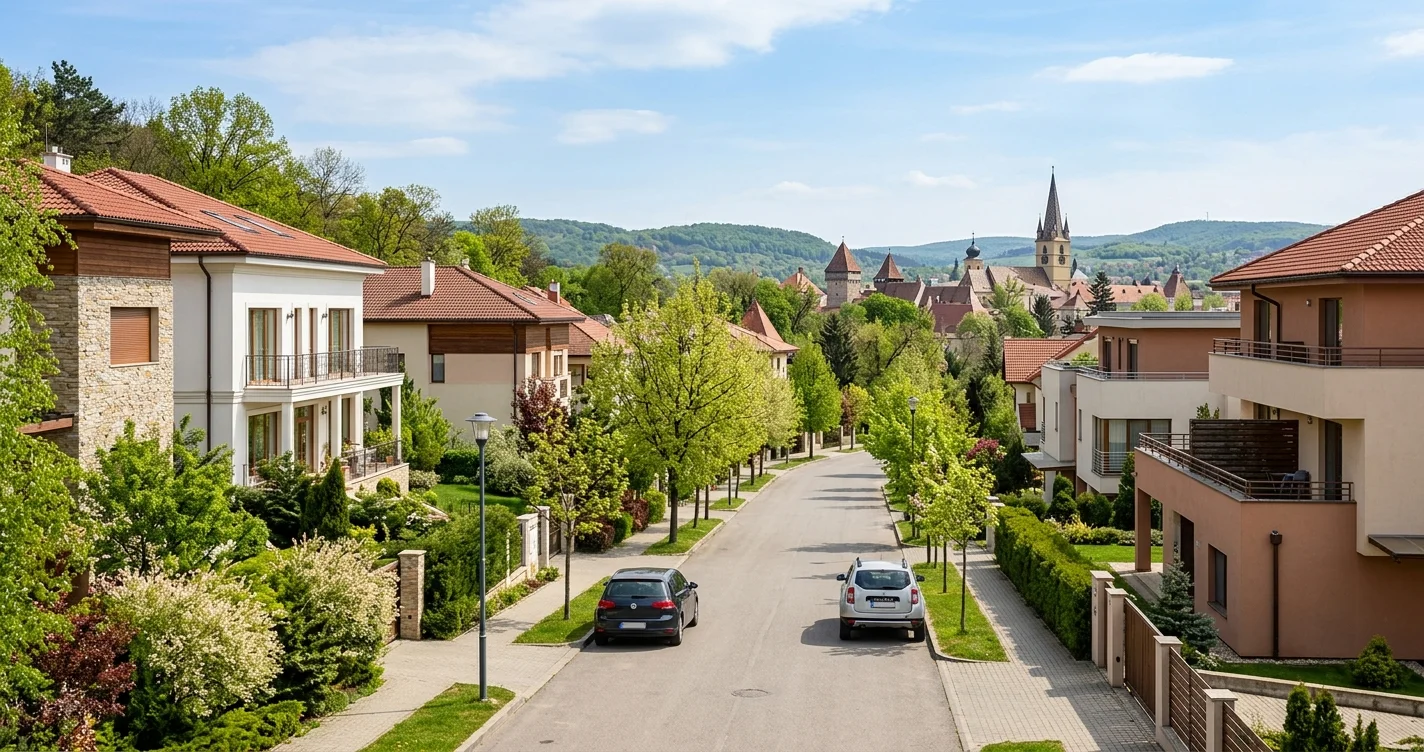
When you're looking for a home, peace and quiet is not a luxury. It's a criterion that changes your daily routine. You want to sleep well, work without noise, take short walks. In Sibiu, that means choosing your location carefully. And understanding the difference between "seems quiet" and "is a zone with high liquidity". In September 2026, the average asking price is 2,034 EUR/sqm, according to Imobiliare.ro. And transactions reached 936 in June 2026, according to ANCPI. That tells you something simple: demand is strong, and limited available stock is felt. In this guide, I show you the quietest neighbourhoods in Sibiu in 2026, with benchmarks, lifestyle and buying tips.
- average asking price Sibiu: 2,034 EUR/sqm (September 2026, according to Imobiliare.ro)
- year-on-year change: +7.4% compared to September 2025 (according to Imobiliare.ro)
- transactions in June 2026: 936 (+26.7% compared to June 2025) (data ANCPI - transaction statistics)
- mortgages in June 2026: 500 (data ANCPI - mortgages)
- IRCC: 5.57% and ROBOR 3M: 5.84% (August 2026, according to BNR - reference rates)
Contents
- 1) How we define "quiet" in Sibiu, in 2026
- 2) Top 7: the quietest neighbourhoods in Sibiu (with lifestyle and benchmarks)
- 3) Prices, demand and negotiation: how to read the market in quiet zones
- 4) Buying checklist: documents, neighbourhoods, noise, traffic
- 5) Quiet and investment: gross yield, net yield, appreciation
- 6) Vianto strategy: how to choose quickly, without compromise
- FAQ
1) How we define "quiet" in Sibiu, in 2026
Quiet is not just the absence of noise
Many search for the quietest neighbourhoods in Sibiu and only look at traffic. It's a good start, but not enough. Real quiet also means stable neighbourhoods. It means distance from busy roads. The type of building matters. An old block with thin walls can be noisier. A house next to a shared courtyard can have surprises. That's why evaluation must be done by location, not just by address.
Why "high-liquidity zone" matters
A quiet neighbourhood can be excellent to live in. But if it's too "closed off", you risk selling slowly. In 2026, in Sibiu we see strong demand and a market in appreciation, confirmed by the year-on-year change of +7.4% in the average asking price, according to Imobiliare.ro (September 2026). In a zone with high liquidity, the difference between asking price and transaction price tends to be smaller. That protects your time and money, if you sell.
Simple indicators you can check
You don't need complicated tools. You need a clear routine. Start with market dynamics. In June 2026, there were 936 transactions and 500 mortgages in the county, according to ANCPI. That shows you the market is moving. Then, look at the cost of money. IRCC is 5.57%, and ROBOR 3M is 5.84% (August 2026), according to BNR. Interest rates affect debt service. And debt service dictates your real budget.
A useful benchmark: the city context
Sibiu has a clear urban profile. It's a tourist and university city. It has historic zones and new residential areas. If you want context, it's worth reading Sibiu's presentation on Wikipedia. It helps you understand how the city expanded. And why some neighbourhoods stayed quieter. In practice, quiet appears where transit traffic doesn't "cut through" the neighbourhood.
Mini-checklist: how to test quiet in 30 minutes
- Walk around at different times, including in the evening.
- Listen: traffic, dogs, construction sites, commercial deliveries.
- Check parking: if it's chaotic, stress appears daily.
- Look at green spaces and courtyards, not just the block.
- Ask neighbours about rules and administration.
If you want a broader picture of context, visit the real estate market in Sibiu. And for practical guides, see Vianto Properties blog.
2) Top 7: the quietest neighbourhoods in Sibiu (with lifestyle and benchmarks)
Below you have a realistic selection. There is no "perfect". There is good fit between your style and the neighbourhood. In each zone, I tell you what type of quiet you get. And what compromises appear. If you want residential zones, take the list as a starting point. Then we validate together, at viewings.
1) Sub Arini - hill quiet, slow pace
Sub Arini is the kind of neighbourhood where an evening walk really unwinds you. You have more secluded streets and lots of greenery. It's a reference zone for families who want fresh air. And for people who work from home a lot. The quiet comes from lower density and location. The compromise can be related to access, depending on the street. In certain spots, slope and winter matter.
- Suitable for: families, work-from-home, people who want a yard.
- To check: winter access, street lighting, distance to shops.
- Type of properties: houses, villas, and some small blocks.
2) Valea Aurie - green, sport, stable neighbourhoods
Valea Aurie has a calm vibe. It's a zone where you see people running. And children on their way to school. The quiet is good, especially on interior streets. You also have the advantage of a relatively stable community. That helps with maintenance of common spaces. If you track options in the area, Valea Aurie often makes the list. The compromise can be related to parking spots, in certain micro-zones.
- Suitable for: active families, nature lovers, runners.
- To check: parking, distance to public transport.
- Property types: apartments, some houses in adjacent areas.
3) Ștrand - good balance between quiet and accessibility
Ștrand is a neighbourhood with good infrastructure. You have quick access to important points. But at the same time, you can find quiet streets. Especially if you're away from main roads. For many clients, Ștrand is the "smart compromise". It's not isolated, but not hectic everywhere either. If you want neighbourhood analysis without losing connectivity, Ștrand is worth viewing.
- Suitable for: families, couples, people who want quick access.
- To check: apartment orientation, floor, commercial surroundings.
- Property types: apartments, medium-rise buildings.
4) Sub Arini - premium calm, close to the park
Sub Arini has a clear advantage: proximity to the park. That changes your lifestyle. You have short walks, better air, and a more relaxed pace. It's a reference area with sustained demand. In such areas, limited available stock appears frequently. This can reduce your negotiating margin. But it increases your chances of long-term appreciation. If you want discussion on premium-profile areas, Sub Arini ranks high.
- Suitable for: families, professionals, people who want a park nearby.
- To check: parking space, noise from main streets.
- Property types: apartments, villas, properties with yards.
5) Turnișor - residential, with surprisingly quiet areas
Turnișor is large and heterogeneous. That's the key. You have more crowded areas, but also quiet streets with houses. For those looking for residential areas on a careful budget, Turnișor can be a good choice. Especially if you want a yard but don't want to leave the city. The compromise depends on traffic, depending on the road you choose. When viewing, the time of day matters a lot.
- Suitable for: families, people who want a house, balanced budgets.
- To check: traffic routes, proximity to industrial areas.
- Property types: houses, apartments, mix of old and new.
6) Gușterița - edge-of-town quiet, air and space
Gușterița is for those who want more space. And who accept that they're not a stone's throw from the centre. The quiet is good, especially in house areas. You have a feeling of "small community". For some, that's ideal. For others, it's too remote. If you're exploring area options and want a yard, Gușterița comes into play. The compromise may be related to commuting and services.
- Suitable for: families, people who want a yard and fresh air.
- To check: transport, secondary roads, lighting.
- Property types: houses, land, spot developments.
7) Cartierul Arhitecților (Sibiu - Cisnădie) - selective quiet, depends on the street
Cartierul Arhitecților is a special case. It can be quiet, but not everywhere. It depends a lot on the street, density and parking. For some, it's a good choice because you have newer homes. For others, morning traffic spoils the experience. If you want neighbourhood analysis in the metropolitan area, Arhitecților deserves careful analysis. Here, the exact location makes all the difference.
- Suitable for: young families, people who want new homes.
- To check: parking, access during peak hours, construction noise.
- Property types: new apartments, townhouses, new developments.
Comparative table: lifestyle profile for top 7
| Neighbourhood | Type of quiet | Resident profile | Typical risk |
|---|---|---|---|
| Sub Arini | Calm, green, low density | Families, work-from-home | Winter access, slopes |
| Valea Aurie | Green, stable community | Active families | Parking in micro-zones |
| Ștrand | Balance access-quiet | Families, couples | Traffic on main roads |
| Sub Arini | Premium, close to the park | Professionals, families | Limited available stock |
| Turnișor | Selective quiet, residential streets | Families, mixed budgets | Traffic on main routes |
| Gușterița | Edge, air, space | Families, courtyard lovers | Commute, fewer services |
| Arhitecților | New, depends on street | Young families | Traffic and construction |
If you want to see real, updated options, visit Vianto Properties website. For quick discussions, there's also the contact page.
3) Prices, demand and negotiation: how to read the market in quiet areas
What the average asking price tells you from September 2026
In September 2026, the average asking price in Sibiu is 2.034 EUR/sqm, according to Imobiliare.ro. It's an average, not a promise. In the zone-by-zone discussion, you'll see variations. It depends on age, finishes, floor, parking, and especially location. An apartment overlooking an interior courtyard may have a different perception. One facing a boulevard may seem "cheap" and still cost you in comfort.
Asking price vs transaction price: how to think about negotiation margin
In discussions with owners, the difference between asking price and transaction price plays out in details. In areas with strong demand, negotiation margin tightens. Especially when limited available stock is obvious. In quiet areas, this happens often. Because good supply is rare. The right strategy is to negotiate on arguments. Not on "that's what I heard". Arguments are: positioning, orientation, renovation costs, and timelines.
Transactions and mortgages: the market signal from ANCPI
In June 2026, transactions were 936, and mortgages were 500, according to ANCPI. These aren't prices, they're volumes. But volumes matter. They show the market is moving. And that there are bank-financed buyers. In a quiet area, this means competition for good properties. If you want residential zones, prepare to react quickly to correct listings.
BNR interest rates and debt service
IRCC is 5.57%, and ROBOR 3M is 5.84% (August 2026), according to BNR. I won't go into rate calculations, because they depend on the bank and your profile. But I'll tell you what matters: debt service must be comfortable. Quiet from the neighbourhood doesn't help if you're stressed every month. In 2026, many buyers choose their home also for flexibility. That is: being able to rent easily, if plans change.
Compared to other cities: where Sibiu stands
At price per sqm level, Sibiu is at 2.034 EUR/sqm. Cluj-Napoca is at 3.316 EUR/sqm, Bucharest at 2.312 EUR/sqm, Brașov at 2.309 EUR/sqm, and Constanța at 2.020 EUR/sqm, according to Imobiliare.ro (September 2026). This shows you that Sibiu is in a competitive zone. Not the most expensive, but not "cheap" either. In zone-by-zone options, the difference is justified by quality of life.
Table: price comparison per sqm in 8 cities (Imobiliare.ro, September 2026)
| City | Average asking price (EUR/sqm) |
|---|---|
| Cluj-Napoca | 3.316 |
| București | 2.312 |
| Brașov | 2.309 |
| Sibiu | 2.034 |
| Constanța | 2.020 |
| Iași | 2.000 |
| Timișoara | 1.984 |
| Oradea | 1.885 |
Practical tip: how to set your budget in EUR, without stress
In August 2026, the average EUR/RON exchange rate was 5.2498, according to BNR. If you negotiate in EUR, you need a reserve. Not large, but realistic. Otherwise, you lose opportunities in neighbourhoods with high liquidity. And in zone-by-zone analysis, good opportunities don't wait long.
For an updated picture of local dynamics, see Vianto's analyses of the real estate market. If you want to learn from examples, visit the blog.
4) Buying checklist: documents, neighbourhoods, noise, traffic
Documents: start with a clean land register extract
Whether you choose Sub Arini or Gușterița, you start with documents. Request a land register extract without encumbrances or confirm a clean land register. If there's a mortgage, it's not a dead end. But the discharge mechanism must be clarified. In the end, you want an authentic notarial deed without surprises. In quiet neighbourhoods, transactions are often quick. That's why document preparation gives you an advantage.
Real noise: how to check it without equipment
In zone-by-zone discussion, the differences are subtle. Sometimes noise comes from common courtyards. Other times, from an auto service two streets away. Do two viewings. One at noon, one in the evening. Sit for 5 minutes with the window open. Listen. Watch the traffic flow. If you see many deliveries, it's a sign of a commercial area nearby. That can mean morning noise.
Traffic and parking: the stress that eats away your peace
Peace at home is useless if you argue daily about parking. In areas like Arhitecților, parking can be a sensitive point. In Ștrand, it depends on the micro-zone. In Sub Arini, a parking spot can be rare. Ask clearly what you get: registered spot, free spot, or garage. In a zone with high liquidity, a parking spot can influence transaction price.
Neighbours and administration: the detail that makes the difference
In apartment buildings, ask about the homeowners' association. Ask about funds and repairs. In houses, ask about boundaries and easements. Sometimes peace breaks down from neighbour conflicts. In residential zones, people seek stability. That means clear rules. And communication. If you feel tension at the first discussion, take it as a signal.
Complete viewing checklist (mentally printable)
- Location: is it on a main street or on an interior street?
- Orientation: towards courtyard or towards traffic?
- Parking: dedicated space or on-street?
- Noise: do you hear dogs, construction, deliveries, bars?
- Surroundings: are there commercial spaces adjacent to the building?
- Documents: land register extract without encumbrances, land registration, cadastre.
- Maintenance: costs, repairs, reserves, administration.
- Access: how quickly do you reach your daily destinations?
Credit and mortgage: what to ask before making an offer
If you're going for a mortgage, discuss early about first-rank mortgage and bank conditions. Not all properties are equally "bankable". Some have technical issues that cause delays. In 2026, with IRCC at 5.57% and ROBOR 3M at 5.84% (August 2026), according to BNR, timing matters. If you find something good in your area options, you want to be able to move fast.
If you want to discuss a specific property, go to contact. Or follow the guides in blog for clear steps.
5) Quiet and investment: gross yield, net yield, capital appreciation
Why quiet can mean positive ROI
Many think quiet is only for living. In reality, quiet sells and rents. Good tenants seek comfort. And comfort includes decent surroundings and low traffic. This can bring you a positive ROI, if you bought right. I won't give rent figures, because they depend on property type and micro-location. But I'll tell you the principle: in neighbourhood analysis, tenant stability tends to be better.
Gross yield vs net yield: how to use them correctly
Gross yield is a simple snapshot. Estimated annual income divided by purchase price. Net yield is reality. You subtract taxes, vacancy periods, repairs, management. In quiet areas, net yield can be more stable. Because you have lower turnover. But it depends on the product. A poorly laid-out apartment, even in a good area, can sit empty.
Capital appreciation and capital gain: where it appears most often
Capital appreciation comes from two sources. First is market appreciation. In Sibiu, the annual variation in average asking price is +7.4% (September 2026), according to Imobiliare.ro. Second is property improvement. Renovation, efficiency, parking, layout. In neighbourhood discussions, capital gain can be easier to sustain. Because demand is constant, and supply is rarer.
Cooling vs orderly correction: how to read the risk
In 2026, the market may show signs of cooling on certain segments. That doesn't mean crisis. It means selection. Overvalued properties sit. Correctly priced ones sell. An orderly correction means targeted adjustments, not crashes. And in areas with high liquidity, fundamentals remain solid. Especially when we talk about residential zones, where demand is more "qualitative".
Table: how quiet connects to investment (without invented figures)
| Factor | Impact on gross yield | Impact on net yield | Impact on capital appreciation |
|---|---|---|---|
| Interior street, low traffic | Neutral | Usually positive, lower turnover | Positive, more stable demand |
| Dedicated parking | Slightly positive | Positive, lower complaint costs | Positive, differentiates at resale |
| Limited stock available in area | May reduce entry yield | Stabilizes net yield through demand | Positive, supports capital gain |
| Good access to city | Positive | Positive, better occupancy | Positive, high liquidity |
Practical tip: how to choose between "quiet" and "access"
Make a list of three daily routes. School, office, shopping. Then see what "close" means to you. For some, close means walking. For others, 10 minutes by car. In Sub Arini and Gușterița, quiet is more "natural". In Ștrand and Valea Aurie, you have balance. In Sub Arini, you pay for a reference zone. That's how you choose the right area options, not just popular ones.
If you want to see properties that fit an investment plan, start on Vianto Properties. And follow updates from the real estate market.
6) Vianto Strategy: how to choose quickly, without compromise
Step 1: define what "peace and quiet" means to you
A client tells me: "I want peace and quiet". I ask right away: peace from what? Traffic? Neighbours? Bars? Construction sites? In neighbourhood analysis, the problem is rarely just one thing. Usually, it's a mix. If you have a small child, sleep matters. If you work remotely, sound insulation matters. If you have a dog, green space matters. Your definition narrows the search.
Step 2: choose 2-3 neighbourhoods, not 10
Many waste time with long lists. In 2026, with sustained demand and many transactions, time is a cost. In June 2026, there were 936 transactions in the county, according to ANCPI. That means competition. If you want to discuss zones, pick 2-3 and become very good at them. You learn the streets, parking, micro-zones. And you make decisions faster.
Step 3: look at the property itself, not just the neighbourhood
In a quiet neighbourhood, you can buy a noisy apartment. If it's next to the lift, next to the rubbish bin, or has windows facing a busy car park. Conversely, in a more mixed area, you can find an excellent interior street. That's why I work on the right "triangle": location, building, apartment. That's how you find residential zones in practice, not in theory.
Step 4: prepare your offer and documents in advance
In areas with limited available stock, good properties sell fast. If you have a mortgage, talk to the bank in advance. If you have cash, prepare proof of funds. Then, with your offer, be clear. Timeline, deposit, conditions. This can increase your chances even when the negotiation margin is small. In neighbourhoods like Sub Arini, this matters a lot.
Step 5: negotiate smartly, on verifiable criteria
Good negotiation isn't aggressive. It's logical. You look at real defects and real costs. You look at the handover timeline. You look at furniture, if it stays. And at what repairs are urgent. Then you propose a realistic negotiation discount. In zone options, owners get interest. If you come with weak arguments, you lose. If you come with solid arguments, you have a chance.
Table: signs that a "quiet" property is well positioned
| Signal | What you check | Why it matters |
|---|---|---|
| Secondary street | Traffic at peak hours | Reduces noise and dust |
| View towards courtyard | Window orientation | Increases daily comfort |
| Residential surroundings | What functions are nearby | Reduces risk of night noise |
| Clear parking | Dedicated space or free regime | Reduces stress and conflicts |
| Documents prepared | Land register extract without encumbrances | Shortens the path to notarial deed |
How Vianto helps you, concretely
- We filter properties by micro-zone, not just by neighbourhood.
- We tell you realistically about asking price and market price.
- We help you estimate the negotiation margin, based on arguments.
- We verify the documents, including land register extract without encumbrances.
- We guide you until the notarial deed.
For a quick chat, visit the Vianto Properties contact page. If you want to read analyses, check the real estate market and blog.
FAQ - frequently asked questions about the quietest neighbourhoods in Sibiu
1) What are the quietest neighbourhoods in Sibiu for families with children?
For families, the combination of quiet and access matters. Sub Arini and Valea Aurie are sought after for greenery and calm pace. Sub Arini is excellent for walks, being a reference zone. Strand can be a balanced choice, if you pick interior streets. I recommend visiting at different times. And check parking, as it's a daily stress.
2) In 2026, is there still room for negotiation in quiet neighbourhoods?
There is, but it depends on context. In areas with limited available stock and sustained demand, the negotiation margin shrinks. Negotiation is done on verifiable arguments. For example, renovation costs or handover timelines. In June 2026, there were 936 transactions in the county, according to ANCPI. This shows an active market, where good properties move fast.
3) How do IRCC and ROBOR data help me when choosing a quiet neighbourhood?
IRCC and ROBOR influence debt service, meaning monthly pressure. In 2026, IRCC is 5.57% and ROBOR 3M is 5.84% (August 2026), according to BNR. If your rate goes up, the peace of the neighbourhood no longer compensates for the stress. That's why your budget must be set conservatively. Then you choose the neighbourhood. Not the other way around. In Sibiu's quietest neighbourhoods, quick response matters, but not at risk.
4) What documents should I check before buying in Sibiu?
Start with a land register extract without encumbrances or confirm a clean land register. Check land registration and cadastre. If there is a mortgage, clarify its discharge and deadlines. Finally, you want an authentic notarial deed with no hidden conditions. In quiet neighbourhoods, good properties sell fast. If the documents aren't ready, you lose time and sometimes you lose the deal.
5) What's the difference between asking price and transaction price in Sibiu?
The asking price is the one in listings. In September 2026, the average asking price in Sibiu is 2.034 EUR/sqm, according to Imobiliare.ro. The transaction price is the one in the deed. The difference between them depends on the negotiation margin, the seller's urgency, and the property's quality. In areas with high liquidity, the difference tends to be smaller. Especially in Sibiu's quietest neighbourhoods.
6) How do I choose between Sub Arini and Valea Aurie if I want peace?
Sub Arini has a premium profile and the advantage of proximity to the park. That brings a very pleasant lifestyle. Valea Aurie has lots of green space and a stable community, with a good pace. The real difference shows in the micro-zone and the product. In Sub Arini, limited available stock can reduce your options. In Valea Aurie, parking can be a point to check. In both, viewing at different times is a must.
Conclusion: how to choose the right peace without losing opportunities
In 2026, Sibiu remains an appreciating market with sustained demand. We have an average asking price of 2.034 EUR/sqm in September 2026, according to Imobiliare.ro. And we have 936 transactions in June 2026, according to ANCPI. That means competition for good properties. If you want Sibiu's quietest neighbourhoods, don't stop at the neighbourhood name. Look for interior streets, good views, clear parking and stable surroundings. Check the documents, ask for a land register extract without encumbrances and prepare your financing in advance. That way you keep your options and negotiate correctly, with a realistic negotiation margin.
Want a personalized recommendation, tailored to your lifestyle? Go to Vianto Properties and tell us what "peace" means to you. We suggest micro-zones, not just neighbourhoods. And we tell you directly what's worth viewing now.
Looking for advice on choosing a home in Sibiu? The Vianto Properties team is available to help you with personalized recommendations. Contact us at +40 791 710 606 or office@vianto.ro, or explore our available properties directly on the website.
Vianto Properties offers in Sibiu:
The correct selling price is determined by comparable transactions in your area, not by the asking prices in nearby listings. You can request a free property evaluation, with a response within 24 hours, or you can discuss with the Vianto Properties team before you decide.