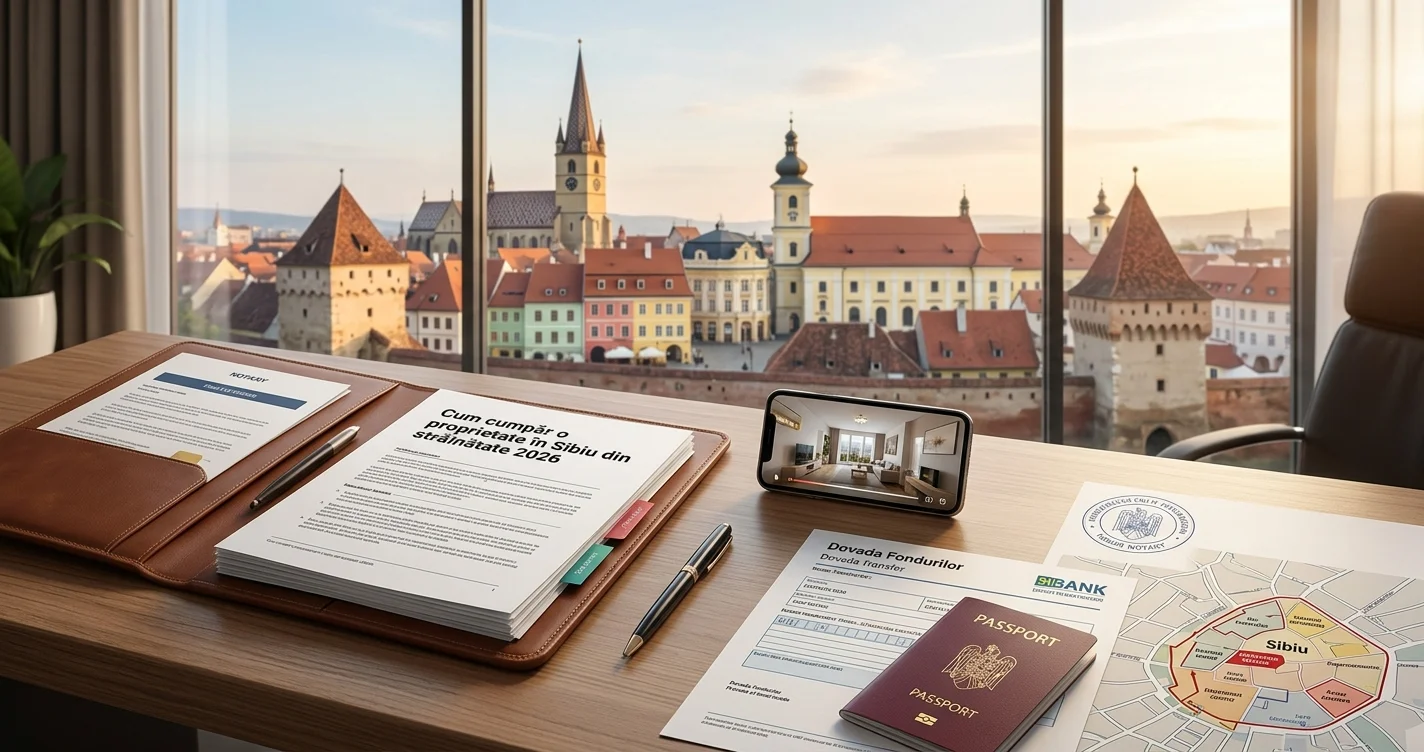
You can buy a property in Sibiu from abroad if you set up a clear notarial power of attorney in advance, request a land register check for an extract without encumbrances, and use video viewings with a technical checklist before making a deposit. According to Vianto Properties, negotiating based on real comparables, not emotion, brings a realistic negotiation margin.
If you want to buy in Sibiu, but live abroad, it's possible. Without unnecessary trips and without improvisation. The key is to put the process on track: clear authorization, legal checks done on time, and a realistic financing plan. Many from the diaspora lose money from a simple mistake: they fall in love with a property from photos and skip the control steps. Then surprises appear: differences between survey and reality, encumbrances in the land register, or missed deadlines at the bank and notary. In this guide, I show you, step by step, how to make a safe purchase, from zone selection to the notarial deed, even if you're thousands of kilometres away.
- Establish from the start who represents you and what they can sign, through notarial power of attorney.
- Request legal verification before deposit: land register extract without encumbrances, owner, document history.
- Use video viewings and a technical checklist to avoid "surprises" at handover.
- Negotiate based on data and comparables, to get a realistic negotiation margin.
- Plan payment and exchange rate: transfers, bank deadlines, proof of funds.
- Target neighbourhoods with high liquidity if you want easy resale or quick rental.
Contents
- 1) Correct steps for buying from abroad
- 2) Documents, power of attorney, land register and legal checks
- 3) Choosing a zone in Sibiu: lifestyle, liquidity, appreciation
- 4) Market price, asking price, transaction price and negotiation
- 5) Financing, payments, bank and exchange rate risks
- 6) After purchase: moving, renting, management and maintenance
- Frequently Asked Questions
1) Correct steps for buying from abroad
1.1. Clarify your purpose: residence, investment, or mixed plan
Before you search for listings, decide what you're buying for. If you want to live there, daily routine matters: school, park, traffic, quiet. If you want investment, the zone with high liquidity and ease of renting matters. If you want a mixed plan, meaning you rent it out now and move in 2-3 years, you need a "flexible" property. That is, a layout easy to rent and easy to resell.
In practice, the diaspora often ends up with a mixed plan. Buy now to lock in a market price, then rent it out. When they return to the country, they already have a base. In this scenario, the quality of the building and maintenance costs matter a lot. How the stairwell, parking and surroundings look also matters.
1.2. Set a realistic budget and timeline
Budget doesn't just mean the asking price in the listing. It also means transaction costs, possible renovations and furnishing. It also means time: how long it takes to gather documents, get bank approval, schedule the notary. When you're abroad, timelines get longer if you don't have a local person pushing things forward.
I recommend you work with a simple calendar, by weeks. Know when you do the selection, when you do video viewings, when you enter negotiation, when you sign the preliminary agreement and when you reach the notarial deed. If you have a mortgage, add time for the bank and appraisal.
1.3. Property filtering: how to avoid "pretty photos"
In a property purchase from abroad in Sibiu, correct filtering saves you money. Photos can hide a lot: noise, smell, neighbours, lack of light, worn finishes. Also, some listings are old or incomplete. That's why filtering must include technical and legal criteria, not just aesthetic ones.
Quick filtering checklist, before any viewing:
- Layout and orientation, as much as possible from the plan.
- Floor, lift, access, parking space, storage unit.
- Heating, insulation, estimated maintenance costs.
- New or old building, approximate year, stairwell condition.
- Availability for land register extract and up-to-date documents.
1.4. Viewing from a distance: video, guided tour and checks
Video viewing must be done as a guided tour, not as a walk. You ask to see: the building entrance, mailboxes, stairwell, lift, apartment door, each room, windows, visible installations, balcony, view and surroundings. You also ask for a tour around the building to understand traffic and parking.
A simple trick: ask for filming at different times. Morning and evening. That way you catch light, noise and traffic flow. If the property is in the Historic Centre (Cetate), you want to understand the tourist dynamics. If it's in Hipodrom, you want to see parking and access to shops.
1.5. Offer, negotiation and preliminary agreement
After you have 1-2 good options, you enter negotiation. Here it matters to separate the asking price from the market price. In many cases, the asking price includes a negotiation margin. But the margin varies greatly, depending on limited available stock and sustained demand in that area.
The preliminary agreement is useful when you need to lock in the property. But don't sign it until you have minimum legal checks. The preliminary agreement must clearly state: price, deposit, deadline for the notarial deed, withdrawal conditions and what happens if either party misses the deadline.
1.6. Notarial deed and handover
The end is the notarial deed. Here the property is transferred and payment is made, according to the agreement. Handover must be documented: report, indexes, keys, remote controls, access cards. If you're abroad, handover can be done by your representative, but it must be provided for in the power of attorney.
In a property purchase from abroad in Sibiu, handover is when most discussions arise. That's why everything must be in writing. What stays in the apartment, what is taken, what repairs are done before handover, who pays utilities until the handover date.
2) Documents, Power of Attorney, Land Register and Legal Checks
2.1. Notarial Power of Attorney: what it must contain
If you cannot come to the country, you need a power of attorney. The power of attorney is drawn up at a notary in the country where you are or at a consulate, depending on the situation. What matters is that it is accepted in Romania. In practice, the power of attorney must be very clear, so you don't get blocked at the bank or at the notary.
What I recommend you include, typically:
- The right to sign a preliminary sale agreement and notarial deed.
- The right to pay the deposit and balance, according to your instructions.
- The right to collect and request documents, including land register extract.
- The right to sign the handover protocol.
- The right to take steps with utilities and the homeowners' association.
Don't leave vague wording. An incomplete power of attorney means rescheduling, costs and wasted time. If you have a mortgage, the bank may require specific wording. It's worth checking this in advance with the bank and the notary.
2.2. Land Register: extract without encumbrances and what you check
Before money changes hands, you check the land register. Ideally, you want a land register extract without encumbrances. If there is a mortgage, a promise, prohibitions or litigation, it must be clarified. Sometimes, the mortgage is discharged at sale, but there must be a clear plan: how it is paid, how the discharge is done, what documents are presented.
What you check in the extract:
- The owner and share, to be who signs.
- Description of the property: area, cadastral number.
- Encumbrances: mortgages, attachments, prohibitions, easements.
- Remarks that may signal problems.
For institutional context, you can consult the ANCPI website, the institution that manages cadastre and land register. Not for prices, but for the legal framework and services.
2.3. The chain of documents: how you avoid a "missing link"
Along with the land register, you want to see the documents that led to ownership: previous contracts, heir certificate, partition, permits, acceptance. I won't go into heavy legal details. The idea is simple: if there is a missing link, the notary can stop the transaction.
Real example, encountered often: apartment inherited, but the succession is not finalized. The "actual" owner cannot legally sell. Another example: interior modifications that don't appear in the documents, and the bank asks for clarification.
2.4. Minimum technical checks, even if you're not in the country
You don't need to be an engineer to avoid problems. But you need a minimum technical check. If the apartment is in an old building, you check the installations, infiltrations, windows, condition of the bathroom and kitchen. If it's in a new building, you check the acceptance, finishes, ventilation and quality of installations.
Practical checklist for the video tour:
- Check exterior walls, corners and ceiling for signs of moisture.
- Open and close windows, check the sealing.
- Turn on hot and cold water, check the pressure.
- Check the electrical panel and outlets, at least visually.
- Listen to the noise: street, neighbours, installations.
2.5. The preliminary sale agreement: clauses that protect you at a distance
The preliminary sale agreement is where you set things in order. If you're in the diaspora, you need clear clauses. Especially about deadlines, documents and financing conditions. If you have a mortgage, include the condition of obtaining financing. If you pay cash, include the condition of presenting an updated land register extract at signing.
Don't forget the inventory. If it's sold furnished, list it. If it's sold unfurnished, write what stays: light fixtures, built-in appliances, curtains, air conditioning. This reduces discussions at handover.
2.6. The notary and the notarial deed: how you prepare for signing
The notary will ask you for documents and will make checks. If you are abroad, you prepare in advance: passport copy, civil status documents, power of attorney, possibly translations. I recommend you ask the notary for a written list before scheduling. This way you avoid rescheduling.
On signing day, check once more: the data in the deed, the amount, the accounts, the handover deadline. If you pay by transfer, confirm with the bank the processing times. If you pay from an external account, check the bank's compliance requirements.
3) Choosing an area in Sibiu: lifestyle, liquidity, appreciation
3.1. How you choose the neighbourhood when you don't live daily in Sibiu
From the diaspora, choosing an area is harder. You don't feel the city on foot. That's why I recommend you choose based on lifestyle and your scenario: living, investment or mixed. In Sibiu, the differences between neighbourhoods are clear: pace, traffic, access to parks, type of buildings, tenant profile.
For a general picture of the city, you can see the presentation of Sibiu on Wikipedia. It's useful for landmarks, history and areas, not for price decisions.
3.2. Neighbourhood with urban vibe: Historic Centre (Cetate)
The Historic Centre (Citadel) is for people who want to be close to everything. Cafés, events, evening walks, tourism. The lifestyle is intense, especially in season. For investment, it can be interesting, but you need a clear strategy. Some properties gain value through location, but may have limitations: car access, parking, renovation rules, noise.
If you want to live here, check sound insulation and orientation carefully. If you want to rent it out, think about the tenant profile: expats, professionals, people who want central location. In many cases, it's an area with high liquidity, but limited available stock of "correct" properties.
3.3. Premium and green neighbourhood: Sub Arini and Valea Aurie
Sub Arini is the premium area for those who want peace and greenery. It's close to the park and has a "settled" feel. It's suitable for families and those who want a good quality of life. In such areas, market price can be sustained by constant demand. But the condition of the building and parking space matter a lot.
Valea Aurie also has a green and quiet profile. It's appreciated by families and those who want walks and fresh air. If you're in the diaspora and want to return in a few years, such areas are comfortable for living. For investment, you select carefully, so you have sustained rental demand.
3.4. Balanced neighbourhood for families: Ștrand and Trei Stejari
Ștrand is a balanced neighbourhood. You have good access to the city, services, schools, shops. It's the kind of area where you move easily and adapt quickly. For the diaspora, that matters. You don't want to return to the country and discover you're "far from everything".
Trei Stejari has a quiet feel and good positioning. It's appreciated for access and for the fact that it's not as crowded as other areas. If you want an apartment for living, but also easy to resell, such areas can be a good choice.
3.5. High-turnover areas: Hipodrom, Vasile Aaron, Mihai Viteazu
Hipodrom is known for high turnover. That means properties are traded and rented frequently. For investment, it can be an area with high liquidity. You have many blocks, many types, access to services. At the same time, you need to be careful about floor, orientation and parking around.
Vasile Aaron is often chosen by young families. You have good access and a mix of blocks. Mihai Viteazu is an area with traffic and services, suitable for those who want connectivity. For the diaspora, these areas are practical: you find tenants more easily and have an active resale market.
3.6. Accessible and transforming areas: Turnișor, Terezian, Lazaret, Țiglari
Turnișor is often perceived as accessible. It has areas with houses and areas with blocks. It's suitable if you want more space on a controlled budget. For investment, you select the location carefully, so you have sustained demand.
Terezian and Lazaret have a mixed profile. You find varied prices and properties that can gain value after renovation. Țiglari is an area where the street and micro-location matter a lot. If you're in the diaspora, don't buy "just by name". Buy after serious video viewing and after checking the neighbourhoods.
3.7. Areas with neighbourhood feel: Tineretului, Gușterița, Trei Stejari, Calea Dumbrăvii
Tineretului is suitable for those who want a calmer pace. Gușterița has areas with houses and a more "edge" atmosphere, but with potential for those who want space. Calea Dumbrăvii is a reference area, with good access and services. Here, exact positioning and property condition matter a lot.
In a diaspora property purchase in Sibiu, neighbourhood choice is also about your life plan. If you want to return with family, you prioritize schools, park, peace. If you want to rent it out, you prioritize access, transport and constant demand.
3.8. Comparative table: lifestyle and fit by objective
| Area | Lifestyle | Suitable for | Practical note |
|---|---|---|---|
| Historic Center (Citadel) | Urban, tourist, events | Central living, selective investment | Check noise and car access |
| Sub Arini | Premium, green, quiet | Living, mixed plan | Limited available stock of good properties |
| Ștrand | Balanced, practical | Families, easy resale | Check parking and proximity |
| Hipodrom | Dynamic, many services | Investment, rental | High turnover, but micro-area matters |
| Turnișor | Accessible, mixed | Controlled budget, space | Analyse location carefully |
| Calea Dumbrăvii | Reference area, connected | Living, mixed plan | Large differences between properties |
For more context on local dynamics, you can check our dedicated page: Sibiu real estate market. And for similar practical guides, visit the Vianto Properties blog.
4) Market price, asking price, transaction price and negotiation
4.1. How to separate asking price from market price
In listings you see the asking price. That's the seller's ambition, not necessarily reality. Market price is the level at which comparable properties can sell in a reasonable timeframe. Transaction price is the final result, after negotiation, conditions and timing.
In Sibiu, in September 2026, the average asking price is 2.034 EUR/sqm, according to Imobiliare.ro. That doesn't mean every apartment is worth that much. It means the market has a benchmark. Differences come from neighbourhood, floor, condition, parking, view and building quality.
4.2. Market appreciation, but with stricter selection
In September 2026, the year-on-year change is +7.4% compared to September 2025, according to Imobiliare.ro. This suggests a market in appreciation. At the same time, buyers are more careful. They want clear documents, properties without major compromises. Here a supply deficit appears for "correct" properties in sought-after areas.
As a diaspora buyer, you face two risks: paying too much in a rush, or losing a good property through indecision. The solution is a quick verification process and an offer strategy.
4.3. How to use comparables without being in the city
Comparables are similar properties in the same area with similar features. You don't need dozens. You need 5–7 relevant examples. Look at: area, floor, condition, parking, building year. Then you set a realistic market price range.
In a diaspora property purchase in Sibiu, comparables are your "compass". Without them, you negotiate on emotion. With them, you negotiate on logic. And you get better negotiating leverage, because your arguments are clear.
4.4. Negotiation: what works in Sibiu in 2026
Good negotiation doesn't mean asking for a random discount. It means identifying real reasons: need for renovation, lack of parking, unfavourable floor, poor orientation, incomplete documents, long handover period. Then you make a firm offer with a short response deadline and clear steps.
What works well:
- Written offer with clear terms and acceptance deadline.
- Quick deposit, but only after minimal legal checks.
- Flexibility on signing date if the price drops.
- Simple and secure payment, no "tricks".
4.5. Table: Sibiu compared to other cities (asking price benchmark)
| City | Average asking price (EUR/sqm) | Note |
|---|---|---|
| Cluj-Napoca | 3.316 | Highest in sample |
| București | 2.312 | Competitive position in top 8 |
| Brașov | 2.309 | Tourism, sustained demand |
| Sibiu | 2.034 | Good benchmark for Transylvania |
| Constanța | 2.020 | Seasonal, coastal influence |
| Iași | 2.000 | Strong regional centre |
| Timișoara | 1.984 | Varied stock, active market |
| Oradea | 1.885 | Growth, but still below Sibiu |
The figures above are average asking price benchmarks, September 2026, according to Imobiliare.ro. They are not ANCPI prices.
4.6. When to rush and when to wait
If you find a property with good location, clear documents and correct market price, don't delay. In areas with high liquidity, good properties move fast. Here available stock is limited. If, on the other hand, the property has clear drawbacks, you have time to negotiate or look elsewhere.
Market volume: transactions and new mortgages
Beyond prices, market liquidity shows in volume. In June 2026, Sibiu county had 936 transactions and 500 new mortgages, according to ANCPI. From these figures you draw two practical conclusions: the market has real buyers, not just nice listings, and lending continues to support a significant part of transactions. For diaspora buyers, this means real competition for well-positioned properties, but also easier resale when you want to sell.
A good sign is when the seller can deliver documents quickly and accepts a transparent process. A bad sign is when the land register extract is avoided or the story changes from one conversation to another.
5) Financing, payments, bank and currency risks
5.1. Cash vs credit: how to choose from abroad
Cash payment is simpler, but still requires discipline. You must prove the source of funds, depending on the bank. A mortgage can be an option, but involves more steps: pre-approval, appraisal, documents, deadlines. From abroad, credit is possible, but you need good coordination.
If you choose credit, monitor interest rate indicators. In 2026, IRCC is 5.57%, and ROBOR 3M is 5.84%, according to BNR, the central bank of Romania. I won't go into payment calculations, as they vary widely. But the idea is to test your budget against a prudent scenario.
5.2. Debt service: how to protect your budget
Debt service means how much the monthly credit payment weighs on your income. If you're abroad, your income may be in another currency. This adds currency risk. I recommend leaving yourself room. Don't go to the limit. Especially if your plan is to rent and cover the payment from rent. Rent can have periods without occupancy.
A healthy plan includes:
- Reserve of 3–6 months of expenses, separate from the deposit.
- Budget for repairs and maintenance.
- Insurance and estimated recurring costs.
5.3. Exchange rate and transfers: what to check first
If you have savings in euros and buy in euros, it's simpler. If you have savings in another currency, check the conversion timing. In August 2026, the EUR/RON average is 5.2498, according to BNR. I'm not telling you when to exchange. I'm just telling you not to ignore the impact.
In practice, you check:
- International transfer fees and processing times.
- Daily limits and documents required by the bank.
- Correct accounts from the deed, to avoid errors.
5.4. Paying the deposit: when it is safe to do it
The deposit is usually paid at the preliminary sale agreement. But do not pay it until you have an updated land register extract and a minimum verification of the deeds. If there are liens, you must have a clear plan. If the seller asks for a large deposit "to hold it", but avoids the deeds, that is a red flag.
In a property purchase from diaspora in Sibiu, the deposit must be a blocking tool, not a ticket to risk. If you work with a good agent and a careful notary, you will have clear steps.
5.5. First-rank mortgage and bank conditions
If you take a loan, the bank will ask for mortgage collateral, usually a first-rank mortgage. This means the bank has priority over the property until repayment. It is standard. But it involves documents and deadlines. From diaspora, it helps a lot to have a proxy who can sign and file documents.
Do not rely on "it will work anyway". Banks are strict on documents. If a deed or signature is missing, it is postponed. And postponement can ruin the transaction if the seller has another buyer.
5.6. Table: cash vs credit, from the diaspora perspective
| Aspect | Cash | Mortgage |
|---|---|---|
| Speed | Usually faster | Slower, depends on the bank |
| Documents | Fewer, but with proof of funds | More: appraisal, approvals, mortgage |
| Negotiation | Can help with negotiation discount | Harder, because of deadlines |
| Risk | Lower risk of rejection | Risk of delay or non-approval |
6) After purchase: handover, rent, management and maintenance
6.1. Handover and changing utility contracts
After the notarial deed, comes the "neglected" part: utilities, homeowners association, records. If you are abroad, you need someone to do the paperwork. Ideally, you have a file with: handover report, meter readings, copies of the deed, your contact details.
Handover checklist:
- Handover report signed, with date and time.
- Meter readings: water, gas, electricity, if readable.
- Keys, remote controls, cards, access codes.
- List of goods left, according to the preliminary sale agreement.
- Confirmation that there are no arrears on maintenance fees.
6.2. If you want to rent: preparing the property
If you do not move in immediately, renting is a natural option. Here it matters to prepare the property for a good tenant. We are not just talking about furniture. We are talking about functionality: appliances that work, faucets without leaks, doors that close, proper lighting.
A properly prepared apartment reduces the risk of problems and protects your net yield. If you want a positive ROI, you need constant occupancy and controlled maintenance costs. This starts with good preparation.
6.3. Remote management: how to keep control
Remote management means procedures. Not "we will see". You need: clear contract, handover report, payment rules, written communication. If you have a tenant, you set how problems are reported and how quickly they are resolved. You also set who approves expenses.
Simple recommendations:
- Use written communication for requests and approvals.
- Keep a separate repair fund for emergencies.
- Schedule a periodic inspection, with photos and report.
6.4. Renovation and added value: when it is worth it and when it is not
Renovation can add value, but not every renovation. If you are in diaspora, you have a risk of poor execution. So if you renovate, make a simple plan, with budget and standard. Do not change the project as you go. That explodes costs.
In general, it is worth investing in things that are seen and felt: bathroom, kitchen, flooring, lighting, painting. It is not worth investing excessively in luxury finishes if the area and building do not support the market price. That is the difference between taste and strategy.
6.5. Resale: how a high-liquidity area helps you
If your plan includes resale, location choice matters enormously. In areas with high liquidity, you have more potential buyers. That means shorter selling time and more balanced negotiation. In areas with lower demand, you'll depend more on finding the "right" buyer.
Gross yield vs net yield: how to calculate correctly
Gross yield is annual rent divided by purchase price. Net yield deducts real expenses: taxes, vacant periods, repairs, property management, insurance. If you're abroad, management costs increase, so factor them in from the start. Also keep in mind two practical details: cheap furnishings break quickly and erode net yield, and good tenants come from good presentation and a proper contract.
Property transfer tax and transaction costs
On resale, account for property transfer tax, which applies under certain conditions, depending on current legislation and your specific situation. Don't treat it as a detail: it can change your ROI calculation and the timing of when it makes sense to sell. Check with the notary in advance what applies to your case, before you plan your exit strategy.
In Sibiu, neighbourhoods with high turnover, such as Hipodrom, can be easier to transact, if the property is in good condition. Premium areas, such as Sub Arini, may have good demand, but limited available stock and strict selection. The Historic Centre (Cetate) has its own dynamics, influenced by tourism and the specifics of the buildings.
6.6. A local mini-scenario: what a successful purchase from abroad looks like
Typical scenario: a couple from abroad wants an apartment for mixed use. They choose a balanced area, close to services, so it's easy to rent and comfortable on return. They do 6 video viewings with a checklist. They select two options. For the first, issues appear in the documents and they withdraw. For the second, they request a land register extract without encumbrances, verify the documents, negotiate based on comparables and sign the preliminary agreement.
At the notarial deed, the attorney-in-fact signs, based on the power of attorney. Handover is done with a protocol and utility readings. The property is prepared for rental, with minimal repairs and professional cleaning. Within 30 days, they have a tenant. It's not magic. It's process.
Frequently Asked Questions
Can I buy in Sibiu if I don't have a Romanian ID card, only a passport?
In many situations, yes, but it depends on your citizenship and the identification documents accepted by the notary and bank. If you're a Romanian citizen with a passport, it's usually fine. If you're a foreign citizen, there may be additional requirements. The safest approach is to discuss this with the notary in advance and prepare translations if needed.
Do I have to be present in person to sign?
No, it's not required if you have a proper notarial power of attorney. The power of attorney must explicitly include the right to sign the notarial deed and make related payments. In practice, most delays come from incomplete powers of attorney. That's why check the notary's requirements in advance and, if you have a mortgage, the bank's requirements.
How do I check if the property has maintenance arrears or issues with the homeowners' association?
Request a certificate or confirmation from the homeowners' association before signing. Also, at handover, note in the protocol the status of payments and utility readings. If there are arrears, make it clear who pays them and by when. Don't leave it as "we'll sort it out". Everything must be in writing, so you don't inherit old debts.
What exactly does "land register extract without encumbrances" mean and why does it matter?
It means that in the land register, there are no mortgages, garnishments, prohibitions or other entries that could block the sale. It matters because it shows you whether the property can be transferred without risk. If there are encumbrances, it doesn't automatically mean you don't buy, but it means you need a clear plan for their removal and firm conditions in the preliminary agreement.
How do I avoid overpaying if I'm not in the country?
Use comparables and ask for a professional opinion on market price. Separate the asking price from the likely transaction price. Negotiate on arguments: condition, location, parking, documents, handover date. Also, choose areas with high liquidity, where the market is more transparent and you have more reference points.
Is it worth buying for rental if I live abroad?
It can be worth it, but only with good management. You need a plan for the tenant, contract, maintenance and vacant periods. Gross yield and net yield depend on many variables, including costs and tenant quality. If you don't have time, the solution is to work with a team that can manage the process and choose a property that's easy to rent.
Conclusion
Buying in Sibiu from abroad is not complicated if you treat it as a project. You need three things: proper representation through power of attorney, legal checks done in time and a realistic area selection. If you tick those boxes, the rest becomes logistics: video viewings, negotiation, preliminary agreement, notarial deed, handover. Plus, if you choose neighbourhoods that suit your style, such as Ștrand for balance, Sub Arini for greenery and quiet, Hipodrom for high turnover or the Historic Centre (Cetate) for urban life, you increase your chances of satisfaction and appreciation over time.
In 2026, buying property in Sibiu from abroad is best done with clear steps and documents at hand. Don't rush the deposit. Don't sign without a land register extract without encumbrances or without a clear plan for their removal. And don't choose based on photos alone. Choose based on location, condition, documents and your life scenario.
Want us to prepare a short list of properties right for you, with video viewings and full checks? Go to Vianto Properties and tell us what you're looking for. You can also find useful resources on our blog and updated market insights on the real estate market.
Looking for advice on buying in Sibiu from abroad? The Vianto Properties team is available to help with personalized recommendations. Contact us at +40 791 710 606 or office@vianto.ro, or explore our available properties directly on the site. For a direct conversation, use our contact page.
Vianto Properties offers in Sibiu:
Before putting down a deposit, it's worth checking the land register extract, the price against comparable apartments and notary costs. See apartments for sale in Sibiu or write to us, and the Vianto Properties team will reply within 2 hours, during business hours.