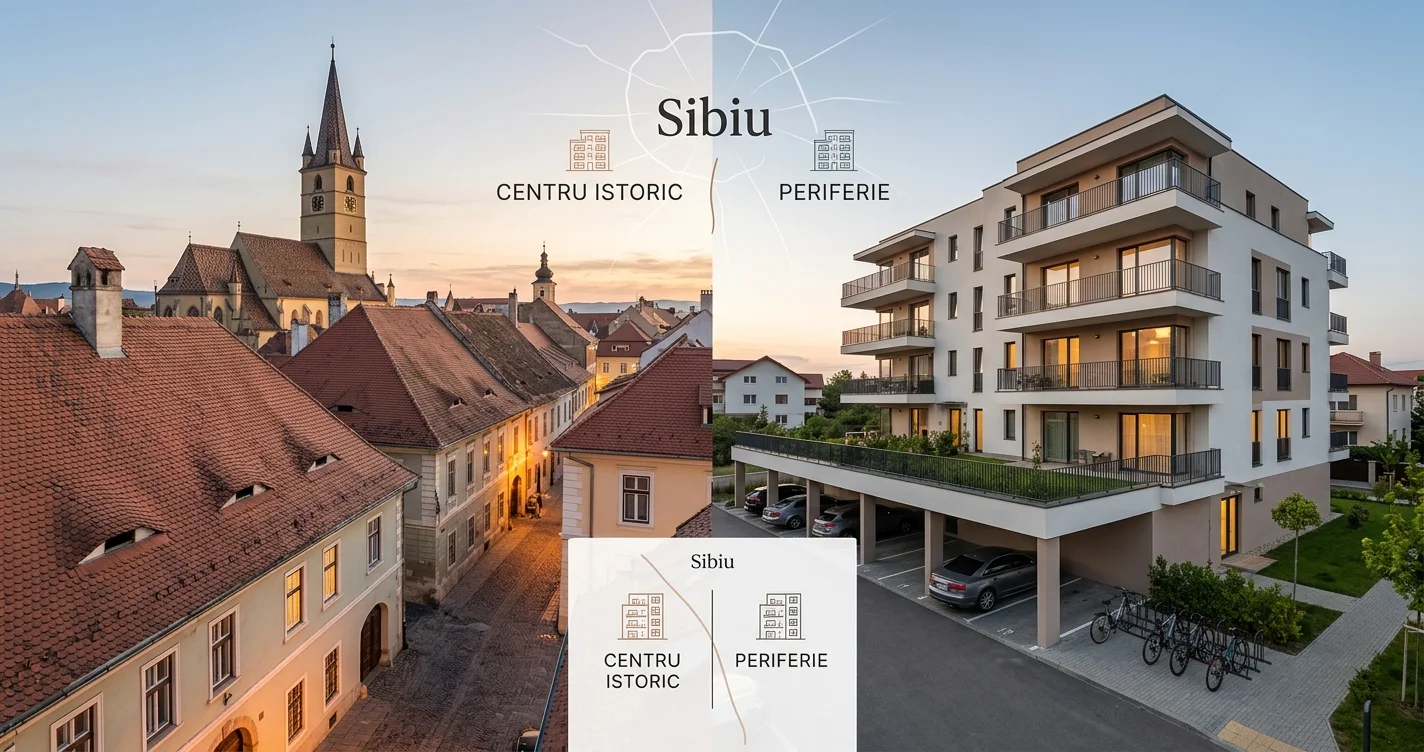
In 2026, the discussion about rent in Sibiu is no longer just about "how much does it cost". It's about lifestyle, time saved, peace and quiet, parking, and how quickly you find something good. The local market has sustained demand, and limited available stock is felt especially in high-liquidity areas. As a reference, in September 2026, the average asking price in Sibiu is 2.034 EUR/sqm, according to Imobiliare.ro. At the same time, ANCPI data shows 936 transactions (+26.7% YoY) and 500 mortgages in June 2026, a sign that interest remains high. In this context, the question "Historic Centre or periphery?" becomes very practical: do you pay more for location or optimise your budget and space?
- In the Historic Centre (Cetate) you pay first and foremost for location and pedestrian access to the city.
- In peripheral areas of Sibiu (e.g. Turnișor, Gușterița, Țiglari) you typically have more space and fewer parking compromises.
- The real cost difference is not just rent, but also the cost of time: commute, traffic, parking space.
- Negotiation is done on the margin for negotiation, not on "feel": contract duration and tenant profile matter.
- For investment you track gross yield and net yield, plus vacancy risk.
- In 2026, with IRCC at 5.57% and ROBOR 3M at 5.84% (BNR), many compare rent with debt service.
Contents
- 1) Context 2026: what pushes rents up or keeps them down
- 2) Rent in the Historic Centre: who it's worth it for and what you actually pay
- 3) Rent in peripheral areas: budget, space and compromises
- 4) Clear comparison: direct costs, hidden costs, lifestyle
- 5) Negotiation and contract: how to get fair rent in 2026
- 6) If you rent as a landlord: yield, risk and tenant selection
- Frequently Asked Questions
1) Context 2026: what pushes rents up or keeps them down
Sustained demand and limited available stock
In Sibiu, rents are influenced by the same simple mechanism: sustained demand and limited available stock. When good apartments appear, they go quickly. This applies especially in high-liquidity areas, where both tenants and landlords move fast.
In 2026, the local residential market remains in an appreciating market, with annual variation of +7.4% YoY in average asking price, according to Imobiliare.ro (September 2026). Even though we're talking about sale prices, the effect is also seen in rents: landlords calibrate their expectations based on opportunity cost and alternative investments.
What transactions and mortgages tell us (without confusing sources)
ANCPI data does not publish prices, but publishes volume. In June 2026, in Sibiu county there were 936 transactions (+26.7% YoY) and 500 mortgages, according to ANCPI. The high volume suggests real interest, and this translates into pressure on the rental market, especially when some buyers are waiting or comparing rent with debt service.
You can check the source directly on the ANCPI website for official statistics on transactions and mortgages.
Interest rates, inflation and the "rent vs credit" decision
In 2026, interest rates matter a lot. IRCC is 5.57% and ROBOR 3M is 5.84% (August 2026), according to BNR. In parallel, inflation is 6.17% (CPI INS YoY, August 2026), according to INS. In such an environment, some tenants prefer flexibility. Others seek stability and look at credit.
This is where the practical question arises: how do rental costs for an apartment in the historic centre differ from peripheral areas in Sibiu, if you also account for indirect costs?
You can check monetary indicators directly on the BNR website for IRCC, ROBOR and EUR/RON exchange rate and inflation data on the INS website for CPI.
A useful reference: Sibiu compared to other cities
As average asking price for sale, Sibiu is at 2.034 EUR/sqm, below Bucharest (2.312) and Brașov (2.309), but above Timișoara (1.984) and Oradea (1.885), according to Imobiliare.ro (September 2026). Normally, cities with higher sale prices also have higher rents, but not in the same proportion.
| City | Average asking price (EUR/sqm) | Source |
|---|---|---|
| Cluj-Napoca | 3.316 | Imobiliare.ro, September 2026 |
| București | 2.312 | Imobiliare.ro, September 2026 |
| Brașov | 2.309 | Imobiliare.ro, September 2026 |
| Sibiu | 2.034 | Imobiliare.ro, September 2026 |
| Constanța | 2.020 | Imobiliare.ro, September 2026 |
| Iași | 2.000 | Imobiliare.ro, September 2026 |
| Timișoara | 1.984 | Imobiliare.ro, September 2026 |
| Oradea | 1.885 | Imobiliare.ro, September 2026 |
If you want to track local developments, you'll find updated analyses on the Vianto Properties page about the real estate market and practical articles on the Vianto Properties blog.
2) Rent in the Historic Centre: who it's worth it for and what you actually pay
Lifestyle: the city at your doorstep, but with unwritten rules
The Historic Centre (Cetate) is about pace. You step out of your building and you're at a café, at a museum, at events. For many, that means quality of life. For others, it means crowds and compromises.
In the Historic Centre, you pay for location. You also pay for rarity. Supply is limited, and many buildings have particularities: atypical layouts, shared courtyards, difficult car access. That's not bad. You just need to accept it.
For urban and historical context, see the Wikipedia page about Sibiu.
What influences rent in Cetate
In practice, rent in the Historic Centre is formed from a few clear elements. Not all of them are about square metres. Some are about "how easy it is to live there".
- Access and parking - if you have a dedicated space, it's a major advantage.
- Floor and light - attics can be superb, but hot in summer.
- Sound insulation - matters a lot, especially on weekends.
- Heating and maintenance costs - old buildings have large variations.
- Furnishing and amenities - good tenants look for functional, not just "pretty".
Who Chooses the Historic Centre in 2026
From what we see in the market, the Historic Centre attracts three profiles. Each has a different cost tolerance and different expectations.
- Professionals who want to reduce time wasted commuting.
- Couples who want urban life and frequent outings.
- Expats and freelancers who want "authentic Sibiu".
In budget discussions, the question often comes up: how do rental costs differ for an apartment in the historic centre versus peripheral areas of Sibiu, if you have the same number of rooms? The realistic answer is that in the Centre you pay more for urban comfort, while in the periphery you pay more for logistical comfort.
Premium alternatives close to the Centre: Sub Arini, Trei Stejari, Calea Dumbrăvii
If you want close to the Centre, but without all the constraints of the Citadel, you have a few reference areas. Sub Arini is a premium area, with greenery and walks. Trei Stejari has a quiet feel and good access. Calea Dumbrăvii is a mix between urban and residential, with services at hand.
These areas usually have a high-liquidity rental zone. Things move fast, especially well-positioned and well-maintained apartments.
3) Rent in peripheral areas: budget, space and trade-offs
What "periphery" means in Sibiu, without confusion
When we say periphery, we mean neighbourhoods in Sibiu further from the Historic Centre, not communes. In Sibiu, typical examples are Turnișor, Țiglari, Gușterița, Lazaret or Tineretului. Each has a different profile.
Separately, there are localities in the county, such as Șelimbăr or Cisnădie. They are different markets, with different dynamics. In this article we stay with Sibiu, as a city.
Lifestyle on the periphery: more "at home", less "in town"
In Turnișor, for example, you have a more settled vibe. It's an accessible area, with a mix of houses and blocks. In Gușterița, you often have more quiet and the feeling of the edge of town. In Țiglari and Lazaret, the micro-area and street matter a lot. You can find decent apartments, but selection is important.
In Vasile Aaron and Tineretului, you meet many young families. There, schools, parks and access to shopping matter. In Hipodrom, you have high turnover and many options, but also traffic. In Strand, you have a good balance for families, with reasonable access to the centre.
Why, sometimes, the periphery ends up more expensive "in the end"
Monthly rent may be lower than in the Centre. But the total cost of living includes other elements. If you have two cars, if you pay for private parking, if you have a daily commute, the difference can shrink.
Here's a simple checklist we often use at viewings:
- Do you have safe parking included in the rent?
- How long does it take you to the Centre at rush hour?
- Do you have shops and services within 5-10 minutes on foot?
- Does the building have a working lift and good maintenance?
- Is the neighbourhood quiet in the evening and on weekends?
"In-between" areas that compete with the periphery
Valea Aurie is a sought-after area for quiet and greenery. Mihai Viteazu has good access and many services. Terezian is very practical for those who want a neighbourhood with local life, markets and good connections. These are not the Centre, but neither are they "classic" periphery.
That's why, when you ask how do rental costs differ for an apartment in the historic centre versus peripheral areas of Sibiu, it's worth including these buffer zones too. They can offer a good ratio between cost and comfort.
4) Clear comparison: direct costs, hidden costs, lifestyle
What we're actually comparing: rent, time, risk, flexibility
A good comparison doesn't just mean "how much is the rent". It means direct costs and hidden costs. It also means risk: how quickly you find another tenant, if you're a landlord. Or how quickly you find another apartment, if you're a tenant.
In 2026, with an appreciating market and fundamentals remaining solid, we also see situations where the market shows signs of cooling on certain segments. This translates into more attention to quality and expectations. Weak properties stay longer. Good properties sell fast.
Comparison table: Historic Centre vs periphery (qualitative, but applied)
| Criterion | Historic Center (Citadel) | Peripheral areas of Sibiu |
|---|---|---|
| Location | Ultra-central, pedestrian access to services | Further from the Centre, you depend more on transport |
| Available stock | Limited available stock, many atypical properties | More options, but quality varies greatly |
| Parking | Often difficult, major advantage if you have dedicated space | Usually easier, sometimes included |
| Quiet | Depends on the street, season, events | Usually quieter, depends on the micro-area |
| Lifestyle | Urban, social, "everything nearby" | Residential, family-oriented and routine-focused |
| Negotiation | Smaller negotiation margin on good properties | Larger negotiation margin possible, if supply is high |
Where do Strand, Hipodrom, Sub Arini fit into this equation
Strand is "balanced, families". You have good access and a calm lifestyle. Hipodrom has high turnover and many apartments, so you have better chances to find something quickly. Sub Arini is a premium area, with a walking and green lifestyle. There you pay for comfort and the area's reputation.
These neighbourhoods are useful as reference points. They show you that the difference is not just Centre vs periphery. It's a spectrum of options, with different budgets and priorities.
"Invisible" costs that many tenants ignore
In budget discussions, the same surprises always come up. They're not dramatic, but they add up. Here's what deserves to be on your list before you sign:
- Heating and insulation - especially in old buildings in the Centre.
- Furniture and appliances - "nice" doesn't mean "functional".
- Storage - storage box, pantry, space for a bicycle.
- Access to courtyard - useful for pets, but also for peace.
- Condominium rules - quiet hours, renovations, access.
In the end, the question remains the same and deserves to be asked correctly: how do rental costs differ for an apartment in the historic centre versus peripheral areas in Sibiu, if you put both time and comfort on paper?
5) Negotiation and contract: how to get a fair rent in 2026
Negotiation margin: what you really have a chance at
Negotiation is not a sport of pride. It's a discussion about risk and stability. The landlord wants predictability. The tenant wants a fair cost and good conditions. The negotiation margin exists, but depends on the apartment's quality and how quickly the area rents out.
In the Historic Centre, at well-positioned properties, the negotiation discount tends to be smaller. In peripheral areas, if there are many similar offers, you have better chances at an adjustment or included benefits.
Viewing checklist: short but decisive questions
- What is the minimum contract duration and termination conditions?
- What is included in the rent and what is paid separately?
- Is there a signed inventory, with photos and condition?
- Are pets accepted, and under what conditions?
- Who handles repairs and within what timeframe?
Contract, deposit, notarial deed
In rental, the standard is a written, clear contract with inventory. In certain situations, parties choose additional formalization. What matters is having clear clauses, not just "trust".
At sale, we discuss notarial deed and land register extract without encumbrances. In rental, it's not the same, but the principle remains: you verify ownership rights and the parties' identity. If the landlord has a first-rank mortgage, it's not a problem in itself, but you want clarity.
Rent vs mortgage: how you look at debt service
Many tenants compare it to a mortgage payment. It's normal. But a payment includes interest, and interest rates are high. IRCC 5.57% and ROBOR 3M 5.84% (BNR) make debt service sensitive to variations. Plus, with a mortgage you have a down payment, taxes, insurance and time.
If you're in the decision phase, I recommend you also read the analyses on Vianto Properties - real estate market. It clarifies the context, without unrealistic promises.
6) If you rent as a landlord: yield, risk and tenant selection
Gross yield and net yield: how to think realistically
If you're a landlord, the discussion is not just "what rent do I ask". It's about gross yield and net yield. Gross yield is a simple snapshot. Net yield is the full picture, with vacancy periods, repairs, commissions and taxes.
In 2026, in an appreciating market, you can also have appreciation, that is, capital gain, on resale. But don't rely on that alone. A good investment must also have positive ROI from operations, not just from hope.
Historic Centre as an investment: advantages and risks
In the Centre, the advantage is constant demand for urban lifestyle. The disadvantage is maintenance. Old buildings can require larger budgets for repairs. Plus, some apartments are hard to standardize. This can increase vacancy risk, if your target is too narrow.
Still, if you have a well-maintained apartment, in a reference area in Cetate, you have good chances to attract stable tenants. There, the question "how do rental costs differ for an apartment in the historic centre versus peripheral areas in Sibiu" is also seen from the landlord's perspective: higher maintenance costs, but also stronger positioning.
Periphery as investment: stability and scalability
In peripheral areas, you often find more 'standard' apartments. This helps with renting and maintenance. If you have parking space and good layout, you can attract families. Families tend to stay longer, so vacancy risk decreases.
In neighbourhoods like Strand, Vasile Aaron or Tineretului, the tenant profile is often oriented towards stability. In Hipodrom, you have high turnover, so you can rent quickly, but you also have greater rotation.
Tenant selection: the cheapest 'insurance'
A landlord makes money when they have a good tenant, not when they have 'high rent on paper'. That's why selection is essential. I recommend basic verification, without excess, but with minimum discipline.
- Clear discussion about income and stability.
- Rental history, if available.
- Usage rules: pets, smoking, subletting.
- Inventory and handover report.
If you want to see how we approach information and education, visit Vianto Properties' blog. You'll find guides written in Romanian, without tiresome 'marketing'.
Frequently Asked Questions
1) Is the Historic Centre more expensive only in rent, or also in maintenance?
Often, in maintenance too. In old buildings, insulation, heating and repairs can cost more. It's not an absolute rule, but it's a more frequent risk. When viewing, ask for information about heating and average costs. Also check the condition of windows, roof and installations.
2) Which neighbourhoods are 'balanced' between Centre and periphery?
In Sibiu, areas like Strand, Mihai Viteazu, Terezian or Valea Aurie can be a good compromise. You're not in Cetate, but not at the edge either. You have services, transport and a more settled lifestyle. What matters is choosing the micro-area, not just the neighbourhood name.
3) How do I negotiate rent correctly in 2026?
Negotiate on arguments: contract duration, move-in date, your profile as a tenant. If you offer stability, you can get a negotiation discount or benefits, such as included parking. In areas with high liquidity, for good apartments, the negotiation margin is smaller.
4) What sources can I follow for market context, without rumours?
For transaction volume and mortgages, follow ANCPI. For interest rates and exchange rates, follow BNR. For inflation, follow INS. For local context, you have analyses on Vianto Properties.
5) For investment, is the Historic Centre or periphery better?
It depends on your strategy. The Centre can attract tenants drawn to lifestyle and can support appreciation, but has more unpredictable maintenance costs. The periphery can offer stability and standardization, with lower repair risk. Calculate gross yield and net yield, not just monthly rent.
6) How do I quickly tell if an apartment is 'fairly' priced?
Compare with similar offers in the same area and with similar amenities. Look at floor, parking, heating, furnishing and access. If an apartment is much below market, ask yourself what's missing. If it's much above, ask for clear justifications. In 2026, quality matters a lot, not just location.
Conclusion: Historic Centre or periphery, the right choice is the one that fits your life
In 2026, the difference between Historic Centre and periphery doesn't come down to a monthly sum. It's a choice between two types of comfort. In Cetate, you gain time and atmosphere. In peripheral areas, you gain space and simpler logistics. If you're still wondering how rental costs differ for an apartment in the historic centre versus peripheral areas in Sibiu, the correct answer is to also put on your list the invisible costs: parking, commute, maintenance, quiet.
A good step is to clearly define your priorities: do you want to live 'in the city' or 'at home'? Do you want flexibility or stability? Do you want to optimize your budget or optimize your time? If you'd like, we can make a quick recommendation based on your lifestyle and budget.
Want a short selection of suitable apartments, without wasted time? Visit Vianto Properties and tell us what you're looking for. You can also follow our practical articles on blog or updated context on real estate market.
Looking for rental consultancy in Sibiu? The Vianto Properties team is available to help you with personalized recommendations. Contact us at +40 791 710 606 or office@vianto.ro, or explore our available properties directly on the website.
Schedule a discussion with Vianto Properties
Vianto Properties offers in Sibiu:
For rentals, a realistic price and tenant verification before signing matter more than speed. See apartments for rent in Sibiu or, if you have a property to rent out, contact us for a free consultation with the Vianto Properties team.