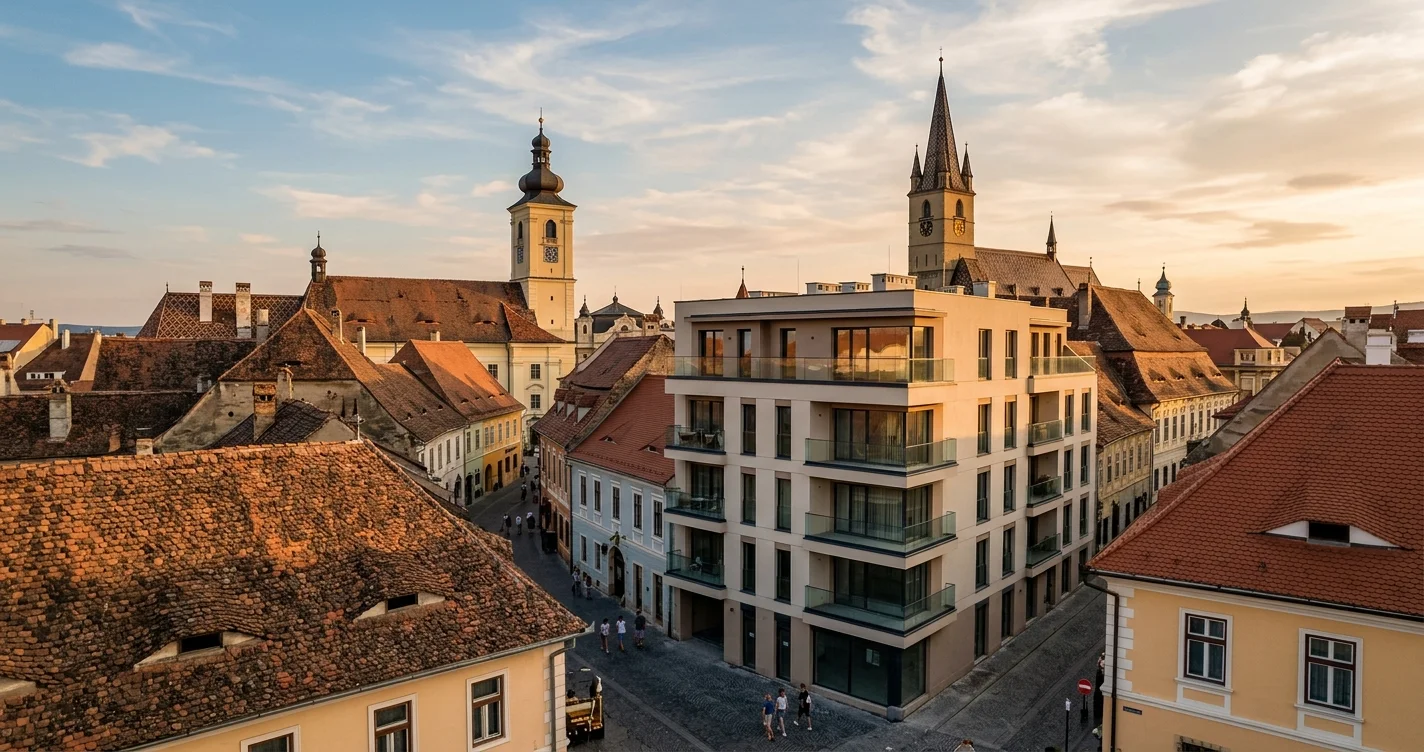
In Sibiu, tourism means more than full terraces in the Historic Centre. It means money flowing into the city, more stable jobs, and inevitably, pressure on housing. In September 2026, the average asking price reached 2,034 EUR/sqm, according to Imobiliare.ro. That's a year-on-year increase of +7.4%, also per Imobiliare.ro. In parallel, monthly transactions were 936, up +26.66% YoY, according to ANCPI data. When accommodation demand returns, investors appear. When investors return, owner expectations shift. And the question becomes practical: how does tourism recovery in Sibiu (post-pandemic) affect the residential real estate market in 2026, for buyers and sellers?
- Tourism recovery increases demand for small, well-located homes, especially in areas with high liquidity.
- Market price forms faster in neighbourhoods with good access to the Historic Centre and Calea Dumbrăvii.
- Limited available stock appears in renovated apartments ready for rent, which reduces negotiation margin.
- Investors look at gross yield and net yield, but also at seasonality risk.
- Financing remains sensitive to IRCC 5.57% and ROBOR 3M 5.84%, per BNR, so debt service matters more.
- The right strategy differs: one approach for living, another for appreciation and capital gain.
Contents
- 1) Context 2026: tourism, demand and market signals
- 2) Mechanisms through which tourism affects housing
- 3) Sibiu neighbourhoods: lifestyle, liquidity and types of demand
- 4) Investment vs living: yield, ROI and real risks
- 5) Practical guide 2026: buyer, seller, rental property owner
- 6) Scenarios 2026-2027: cooling, orderly correction, appreciation
- Frequently Asked Questions
- Conclusion and next steps
1) Context 2026: tourism, demand and market signals
Why tourism matters, even if you don't rent in hotel mode
Tourism works as an amplifier. When the city has visitor flow, service revenues grow. Jobs appear and salaries stabilize. This shows up in rental demand and purchase demand. Even if you don't buy for rental, investor competition can raise the asking price of similar properties.
In 2026, the conversation is no longer about timid recovery. It's about normalization and selection. Well-positioned properties sell faster. Weak properties stay on the market and ask for negotiation discounts. That's why, in the same neighbourhood, you see big differences between asking price and transaction price.
Indicators you can use without guessing
In September 2026, the average asking price in Sibiu is 2,034 EUR/sqm, according to Imobiliare.ro. Year-on-year change is +7.4% YoY, also per Imobiliare.ro. This indicates an appreciating market, but not uniform. Some segments have sustained demand. Others show the market cooling.
On activity, 936 transactions in Sibiu in June 2026 (latest published month), with +26.66% YoY, per ANCPI, shows there is turnover. Plus, 500 new mortgages monthly, also per ANCPI, suggests financing still supports the market. However, the cost of money remains high: IRCC 5.57% and ROBOR 3M 5.84%, per National Bank of Romania.
Tourism and the psychology of asking price
In tourist cities, owners tend to anchor asking price to potential, not reality. If they hear "it rents well", expectations rise. The problem is the market doesn't pay for potential, but for execution. What matters is finishes, location, access, parking and building quality.
This is where proper valuation comes in. If you want to understand how tourism recovery in Sibiu (post-pandemic) affects the residential real estate market, start with the gap between asking price and transaction price. In tourism, emotion rises fast. In transactions, numbers decide.
Where Sibiu positions itself compared to other cities
As a price level, Sibiu is in the upper-middle group. According to Imobiliare.ro (September 2026), comparison across 8 cities shows: Cluj-Napoca 3,316 EUR/sqm, Bucharest 2,312 EUR/sqm, Brașov 2,309 EUR/sqm, Sibiu 2,034 EUR/sqm, Constanța 2,020 EUR/sqm, Iași 2,000 EUR/sqm, Timișoara 1,984 EUR/sqm, Oradea 1,885 EUR/sqm.
| City | Average asking price (EUR/sqm) | Source |
|---|---|---|
| Cluj-Napoca | 3.316 | Real estate portals |
| București | 2.312 | Real estate portals |
| Brașov | 2.309 | Real estate portals |
| Sibiu | 2.034 | Real estate portals |
| Constanța | 2.020 | Real estate portals |
| Iași | 2.000 | Real estate portals |
| Timișoara | 1.984 | Real estate portals |
| Oradea | 1.885 | Real estate portals |
The gap to Brașov is small. The gap to Cluj is large. This makes Sibiu attractive to investors seeking a lower entry price but with sustained demand. And tourism is one reason why.
For an updated picture, you can follow the dedicated section on the real estate market in Sibiu. We publish periodic insights in plain language.
2) Mechanisms through which tourism affects housing
1) Competition between living and investment
The first mechanism is simple: the same studio apartment can be wanted by two types of buyers. One wants to live there. The other wants to rent it out. When tourism recovers, the investor becomes more active. He sometimes accepts a higher asking price if he sees good gross yield potential.
In practice, this reduces negotiation margin for "ready-to-use" properties. If the apartment is renovated, furnished and well-located, limited available stock is felt immediately. In contrast, for apartments needing renovation, negotiation discount stays larger.
2) The "showcase" effect of the Historic Centre
The Historic Centre (Cetate) is the city's showcase. That's where value perception forms. When tourists return, the area seems more "alive". Owners tend to believe any nearby property is worth more. Sometimes they're right. Often, they're not.
The difference comes from building quality, height regime, car access, parking, surroundings and maintenance costs. In an old building, common works can appear. This can affect net yield, even if gross return looks good on paper.
3) Seasonality and demand volatility
Tourism is not linear. There are peaks and quieter periods. That's why serious investors don't just look at potential income. They look at vacancy risk and administration costs. Here's where you see the difference between a realistic plan and a nice story.
If you want to understand how tourism recovery in Sibiu (post-pandemic) affects the residential real estate market, ask yourself this way: "If I have 2-3 weaker months, does debt service remain comfortable?". If the answer is no, you have a structural problem, not a tourism problem.
4) Financing and cost of money
In 2026, financing is an important filter. IRCC is 5.57%, and ROBOR 3M is 5.84%, according to BNR. This means rates more sensitive to income. In Sibiu, average net salary is 6.025 RON, according to aggregated local data, and national average net salary is 5.820 RON (July 2026).
In a market with high interest rates, buyers are more careful. They look at housing efficiency, monthly costs and repair risk. Tourism can push the asking price up, but the bank and family budget put the brakes on. This leads to firmer negotiations and more selective transactions.
5) Internal migration and rental demand
Tourism supports services, and services attract people. A city that moves gathers seasonal workers, freelancers, people testing Sibiu before buying. They first enter the rental market. Then, some become buyers.
This creates a chain: higher rental demand, greater interest in investments, pressure on stock, price growth in high-liquidity areas. It is not an instant mechanism, but it shows over time.
Checklist: signs that tourism directly influences your property
- You have a location 10-20 minutes' walk from the Historic Centre.
- You have good access to Calea Dumbrăvii or promenade areas.
- You have a small, efficient apartment, easy to furnish.
- You have clear parking or easy access to transport.
- You have modern finishes and good building maintenance.
- You receive more inquiries, even without aggressive promotion.
If you tick 3-4 points, it is very likely that tourism recovery will increase your demand. This does not automatically mean that any asking price is justified. It just means you have a market advantage.
3) Sibiu neighbourhoods: lifestyle, liquidity and types of demand
Historic Centre (Cetate): urban experience, but with rules and costs
In the Historic Centre, lifestyle is about walking, cafes, events and quick access to everything. For some, it is a dream. For others, it is tiring. As an investment, the area can have sustained demand, but also harder-to-control costs. Old buildings may require common repairs. Parking can be a challenge.
Moreover, the difference between asking price and transaction price can be large. Owners anchor to "tourism", buyers anchor to "risk". Here, a clean land register and a property extract without encumbrances are mandatory. Same with checking the legal status of common spaces.
Sub Arini (premium area): quiet, greenery, stable demand
Sub Arini is the premium area for those who want park, air and a calmer pace. It is the kind of neighbourhood where living beats investment in the short term. Still, tourism influences indirectly. People who come to Sibiu and fall in love with the city later seek quality areas. Sub Arini quickly makes the list.
Here, the market is often appreciating, but limited available stock matters. Good properties appear rarely. When they do, they move quickly. Negotiation margin tends to be smaller, if the property is correctly positioned at market price.
Strand: balance for families and good access
Strand is a balanced neighbourhood, suitable for families. You have schools, shops, good access to the city. It is not "touristy" in the classic sense, but it is very liquid. This means it sells and rents relatively easily, if the property is correctly presented.
In the context of how tourism recovery in Sibiu (post-pandemic) affects the residential real estate market, Strand gains through the spillover effect. When the Historic Centre becomes expensive or hard to manage, some demand moves to well-connected neighbourhoods.
Hipodrom: high turnover and constant demand
Hipodrom has high turnover. It is a neighbourhood with many apartments, so many transactions. This makes it interesting for investors who want high liquidity. You do not just buy "a home", you also buy an easier exit on resale.
Tourism influences here through medium-term rental demand. People coming with projects, trainings, events prefer functional apartments. If you have a well-maintained apartment, you can get positive ROI, but you need to calculate realistically and not overestimate occupancy.
Turnișor: accessible and practical
Turnișor is accessible, practical and in many cases more budget-friendly. Lifestyle is about utility: you get where you need quickly, you have developing residential areas, you have varied options. For first-time buyers, it can be a good choice.
In a market with high interest rates, accessible neighbourhoods can have sustained demand. This is seen when debt service becomes the main criterion. Tourism plays a secondary role, but can still push rental demand in certain periods.
Vasile Aaron and Tineretului: young families, functionality
Vasile Aaron is often associated with young families. Tineretului has similar energy, with emphasis on functionality. In these neighbourhoods, layout, light, floor and parking matter. Tourism influences less directly, but influences through the local economy.
When the city has activity, people stay. When people stay, renters become buyers. This supports market price, even if we are not talking about hotel regime.
Trei Stejari and Valea Aurie: green, quiet, quality of life
Trei Stejari and Valea Aurie are sought for quiet and access to green areas. Lifestyle is calmer, more "living". Here, buyers are less speculative. They seek comfort and stability.
In such areas, tourism influences mainly through long-term appreciation. If the city remains attractive, these neighbourhoods stay at the top of preferences. Fundamentals remain solid, even if the market shows signs of cooling on overvalued segments.
Calea Dumbrăvii and Mihai Viteazu: connectivity and services
Calea Dumbrăvii is a reference area. You have services, access, urban pace. Mihai Viteazu is also an area with good connectivity. For rentals, proximity to points of interest and transport matters.
In 2026, when comparing options, look at liquidity. In reference areas, the difference between asking price and transaction price tends to be smaller, if the property is correctly positioned. There you see most clearly how tourism recovery in Sibiu (post-pandemic) affects the residential real estate market, through constant demand and quick transactions.
Țiglari, Lazaret, Terezian, Gușterița: opportunities, but with selection
These neighbourhoods can offer opportunities, especially for buyers willing to make compromises. Lifestyle varies greatly from one street to another. Here, on-site verification is mandatory. What matters is the surroundings, access, building quality, and renovation plans.
Tourism influences indirectly, through general pressure on prices. But don't rely on tourism as your main argument. The foundation is local demand. If you want an investment, look for areas with high liquidity and good resale potential.
Table: how tourism looks in different areas, as demand logic
| Area / neighbourhood | Lifestyle | Dominant demand type | Tourism impact (practical) |
|---|---|---|---|
| Historic Center (Citadel) | Urban, events, walkability | Investment + selective living | High, but with seasonality and costs |
| Sub Arini (premium area) | Green, peace, premium | Living | Medium, through city reputation |
| Strand | Family-friendly, balanced | Living + classic rental | Medium, through spillover |
| Hipodrom | Practical, high turnover | Rental + resale | Medium, through medium-term demand |
| Calea Dumbrăvii | Reference area, services | Living + rental | Medium to high, through connectivity |
| Turnișor | Accessible, functional | Living | Low to medium |
For general context about the city, you can also check the Wikipedia page about Sibiu. It's useful for historical and geographical reference points.
4) Investment vs living: yield, ROI and real risks
Gross yield and net yield: why the difference matters
Many investors stop at gross yield. That is, the simple ratio between rent and price. The problem is that gross yield doesn't include costs. And in tourism, costs can be higher: cleaning, maintenance, vacancy periods, platform commissions, higher utilities.
That's why net yield is the indicator that protects you. If net yield stays healthy even in weaker scenarios, then you have a robust investment. If net yield looks good only in a perfect scenario, you have a fragile investment.
Positive ROI and break-even: how to think like an investor, without fooling yourself
Positive ROI doesn't come only from rent. It also comes from appreciation, that is, from capital gain on resale. In Sibiu, the average asking price is 2,034 EUR/sqm (September 2026), according to Imobiliare.ro, and the annual variation is +7.4% YoY. That suggests appreciation, but doesn't guarantee the future.
In an appreciating market, break-even may seem faster. But be careful with timing. If you enter at an asking price that's too high, you eat into your appreciation. If you enter at market price, you have better chances of exiting well, even if the market shows signs of cooling.
Tourism and the risk of regulation or behaviour change
Tourism can change. People may prefer hotels, may prefer other cities, or may cut budgets. Plus, new rules may appear in homeowners' associations, especially in older buildings or central areas. I won't speculate, but I'll tell you what I see in practice: neighbours matter.
If you want to rent short-term, discuss it early with the association. Check access, quiet, internal rules. A conflict with neighbours can ruin your plan, even if tourism is doing well.
Mortgage credit and debt service in 2026
In 2026, the cost of money is a major factor. IRCC 5.57% and ROBOR 3M 5.84%, according to BNR, mean that debt service can be heavy if you overextend. In Sibiu, the average net salary is 6,025 RON. That gives you a realistic budget benchmark.
Practically, if your investment depends on maximum occupancy, you have a risk. If you can sustain the payment even with lower occupancy, you're more relaxed. That's the difference between an investor and a gambler.
Table: tourism-oriented investment vs classic rental
| Criterion | Tourism-oriented (short-term) | Classic rental (long-term) |
|---|---|---|
| Volatility | Higher, seasonality | Lower, predictability |
| Gross yield | Can be higher, but variable | Usually more stable |
| Net yield | It depends heavily on costs and occupancy | Easier to estimate |
| Management time | High, if you don't outsource | Lower |
| Neighbourhood fit | Historic Centre, nearby areas | Hipodrom, Strand, Calea Dumbrăvii |
Mini-checklist for healthy investment in Sibiu
- Calculate net yield, not just gross return.
- Test a scenario with lower occupancy.
- Check land register extract without encumbrances, before the deposit.
- Don't confuse asking price with transaction price.
- Look for areas with high liquidity, for easy exit.
- Negotiate based on real defects, not "the market is falling".
If you want to dig deeper, you'll find analyses and guides in Vianto Properties' blog. We explain with local examples, no complicated jargon.
5) Practical Guide 2026: buyer, seller, rental property owner
For the buyer: how to protect yourself when tourism pushes prices up
When tourism recovers, stories like "it rents out immediately" appear. Some are true. Others are marketing. To buy well, you need discipline. Start with budget and financing. If you take a loan, calculate debt service with current interest rates, not hopes.
Then compare similar properties. Don't compare a renovated apartment with one needing renovation. Don't compare a building with lift and parking to one without. That's how you figure out if the asking price is close to market price.
- Step 1: clearly set your goal: living, investment, or mixed.
- Step 2: choose 2-3 reference areas, not the whole city.
- Step 3: check documents: land register extract without liens, land registration.
- Step 4: ask for a market price estimate, not just the seller's opinion.
- Step 5: negotiate based on a list of real costs.
In many cases, how tourism recovery in Sibiu (post-pandemic) affects the residential real estate market is seen in decision speed. Good properties sell fast. If you wait too long, you lose. If you rush without checks, you burn. Balance is key.
For the seller: how to set the asking price correctly in 2026
Good selling starts with positioning. If you set an asking price too high, you lose the first weeks. That's where you get the most attention. If you miss that moment, you end up making bigger cuts than needed. That lowers your final transaction price.
In 2026, buyers are more calculated. Interest rates force them to be. That's why a realistic asking price, backed by comparisons, brings viewings and offers. Tourism helps you only if the property fits real demand.
- Prepare the home: cleanliness, light, minor repairs.
- Present clearly: areas, floor, orientation, parking, costs.
- Be transparent: if there's a mortgage, explain the discharge steps.
- Target market price, not the building record.
- Set your acceptable negotiation margin from the start.
One important detail: if you have a buyer with a loan, the bank will appraise. If you're well above market price, the deal blocks. This happens often in periods when tourism creates excessive optimism.
For the rental property owner: how to choose between short-term and long-term
In 2026, the choice is not just about money. It's about time and stress. Short-term rental can bring good peaks, but requires management. Long-term rental brings stability, but may have more moderate gross return.
I recommend you choose based on your profile. If you're in Sibiu and have time, you can manage. If you're away, outsource or go long-term. Otherwise, net yield can erode quickly.
Documents and checks that are non-negotiable
Regardless of strategy, documents are the foundation. Look for a clean land register and land register extract without liens, before any deposit. If there's a first-rank mortgage, clearly establish the discharge steps. If there are disputes or liens, don't rely on trust.
In the end, the transaction closes with a notarial deed. Everything shows there: price, terms, conditions. Don't leave details "on WhatsApp". In real estate, written details are what count.
Short, useful CTA in the middle of the article
If you want a discussion tailored to your case, visit Vianto Properties contact page. Tell us your area and budget. We'll respond with real options and clear steps.
6) Scenarios 2026-2027: cooling, orderly correction, appreciation
Scenario 1: appreciating market, but selective
This is the scenario we see frequently in 2026. Average asking price rises, but not all properties rise equally. Good ones, in high-liquidity areas, trade more easily. Weak ones sit and ask for negotiation discounts.
Tourism helps mainly the central and semi-central segment. It also helps connected neighbourhoods, such as Calea Dumbrăvii, Strand and Hipodrom. In this scenario, fundamentals remain solid, and buyers need to be quick, but disciplined.
Scenario 2: the market shows signs of cooling
Cooling does not mean collapse. It means the pace slows. Buyers negotiate more. Overvalued properties correct. Transactions can remain active, but with stricter selection.
In such a context, how does the recovery of tourism in Sibiu (post-pandemic) influence the residential real estate market becomes a question about resilience. Tourist areas can remain attractive, but investors become more careful about net yield. And home buyers seek value, not a story.
Scenario 3: orderly correction, without panic
An orderly correction occurs when prices align with purchasing power and financing cost. It is not a crisis. It is a realignment. In an orderly correction, good properties retain interest. Weak properties lose more.
In this scenario, tourism can act as a buffer. If the city remains attractive, rental demand supports part of the market. But do not rely on that as a guarantee. The guarantee comes from the correct entry price and property quality.
What I track, as simple signals
- The difference between asking price and transaction price, on comparable properties.
- Number of transactions and mortgages, according to ANCPI.
- Reference interest rates, according to BNR.
- Stock quality: how many properties are "ready", how many need renovation.
- Buyer behaviour: many viewings, few offers, or vice versa.
Table: key dates 2026 that influence the decision
| Indicator | Value | Source | Why it matters |
|---|---|---|---|
| Average asking price Sibiu | 2.034 EUR/sqm (September 2026) | Real estate portals | Benchmark for market price, indicative |
| Annual variation | +7.4% YoY | Real estate portals | Shows market direction, does not guarantee the future |
| Monthly transactions Sibiu | 936 (+26.7% YoY, June 2026) | ANCPI | Shows liquidity and buying appetite |
| New mortgages per month | 500 | ANCPI | Shows how much financing supports the market |
| IRCC | 5,57% | BNR | Directly affects debt service |
| ROBOR 3M | 5,84% | BNR | Benchmark for cost of money in the market |
| EUR/RON monthly average (August 2026) | 5,2498 | BNR | Matters for budgets and euro comparisons |
Practical conclusion: tourism is an engine, but interest rates are the brake. In 2026, the two work simultaneously. That is why a good strategy is a balanced one, not one based on enthusiasm.
Frequently Asked Questions
1) How does the recovery of tourism in Sibiu (post-pandemic) influence the residential real estate market for home buyers?
The influence is seen in competition for well-located properties. When investors become active, negotiation margin decreases for "move-in ready" apartments. For home living, I recommend choosing neighbourhoods with high liquidity, but also with daily comfort: Strand, Calea Dumbrăvii, Sub Arini. Negotiate based on real costs, not rumours.
2) Does tourism automatically increase the transaction price in the Historic Centre?
Not automatically. Tourism can raise the asking price, but the transaction price depends on building quality, access, parking and costs. In old buildings, maintenance risks can reduce interest. If the property is well-maintained and has clear documents, demand can be sustained. If not, a negotiation discount appears quickly.
3) In 2026, is it safer to buy for long-term rent than for short-term?
It depends on your profile and location. Long-term is more predictable and easier to manage. Short-term can bring good peaks, but has seasonality and higher costs, so net yield can vary. If you have a mortgage, check debt service in weaker scenarios. That tells you what is "safe" for you.
4) What role do interest rates play in the buying decision, if tourism is doing well?
Interest rates are decisive, because they directly affect debt service. In 2026, IRCC is 5.57% and ROBOR 3M is 5.84%, according to BNR. Even if tourism supports demand, buyers with mortgages have a rate ceiling. That is why some properties stay on the market if overvalued, even in an attractive city.
5) Which neighbourhoods in Sibiu are more suitable for a "walkable" lifestyle and which for families?
For "walkable", the Historic Centre is most suitable, but comes with parking and old building challenges. For a good mix, Calea Dumbrăvii offers services and connectivity. For families, Strand and Vasile Aaron are balanced options, with daily infrastructure. For quiet and green, Sub Arini, Trei Stejari and Valea Aurie are highly appreciated choices.
6) How do I verify if a property has a clean land register?
Request a current land register extract without encumbrances, before paying a deposit. You verify the owner, area, any mortgages, restrictions or disputes. If there is a first-rank mortgage, you clearly establish the steps for removal and conditions from the preliminary sale agreement. At the end, everything closes through a notarial deed. If anything is unclear, stop and ask for written explanations.
Conclusion and next steps
In 2026, tourism in Sibiu is again a visible engine. But its impact on housing is not "magic". It is a logical chain: accommodation demand, investment interest, stock pressure, asking price increase in suitable areas. At the same time, high interest rates and real budgets keep the market grounded. That is why you will see both sustained demand and firm negotiations, depending on property quality.
If you're still wondering how tourism recovery in Sibiu (post-pandemic) affects the residential real estate market, here's the practical answer: it affects efficient, well-located properties in high-liquidity areas the most. In the Historic Centre, the impact is direct, but with risks. In neighbourhoods like Strand, Hipodrom and Calea Dumbrăvii, the impact is more stable and easier to manage. In premium areas, such as Sub Arini, tourism works more through the city's reputation and long-term appreciation.
Want to make a good decision without chasing rumours? Start with data and a clear strategy. Follow our updates in the blog and in the real estate market section. And if you want a recommendation for your case, go directly to Vianto Properties and tell us what you're looking for. We'll respond with real options, not promises.
Looking for real estate consultancy in Sibiu, for buying, selling or investing? The Vianto Properties team is available to help you with personalised recommendations. Contact us at +40 791 710 606 or office@vianto.ro, or explore our available properties directly on the website.
Vianto Properties offers in Sibiu:
The correct selling price is determined by comparable transactions in your area, not by the asking prices in nearby listings. You can request a free property evaluation, with a response within 24 hours, or you can discuss with the Vianto Properties team before you decide.