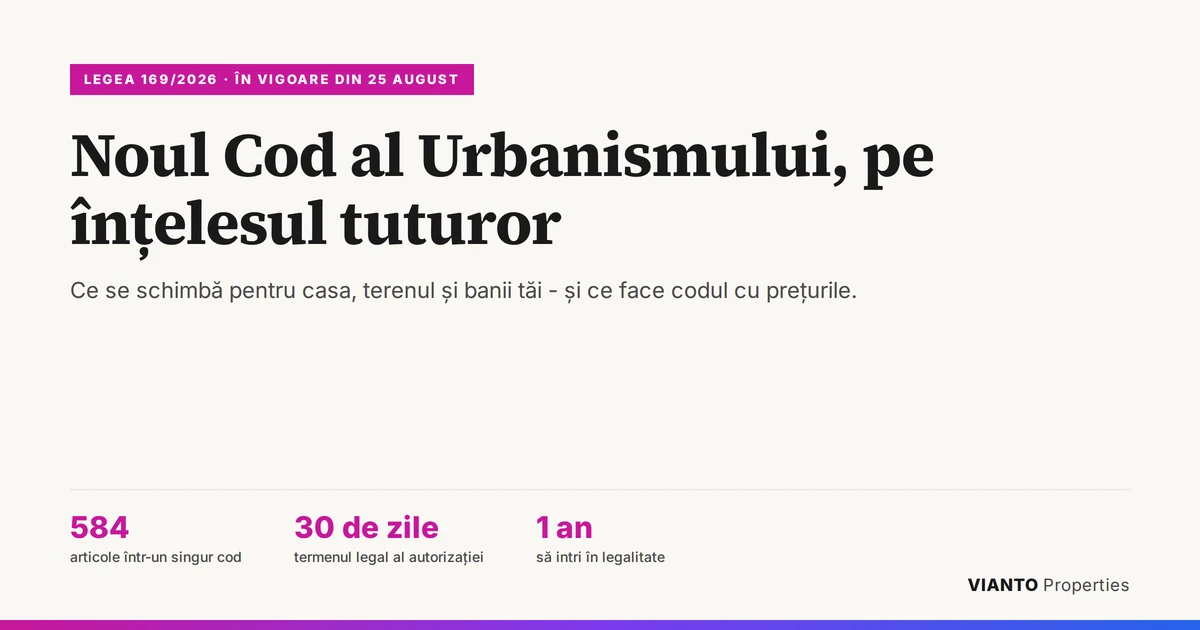
From 25 August 2026, the rules for construction in Romania have changed fundamentally. Law 169/2026, the Code for territorial planning, urbanism and construction (in short, CATUC), has come into force and replaced in one move Law 50/1991 on construction permits and Law 350/2001 on urbanism, together with their implementing rules. Instead of a mess of documents accumulated over 30 years, we now have a single code with 584 articles.
I read the code and the legal analyses that appeared in the first days and extracted what matters for three concrete people: the owner who wants to build or put their documents in order, the buyer looking for a house or land and the investor who wants to understand where prices are heading.
An honest warning before anything: the law is in force, but practice is only forming. Even in the first week, Bucharest City Hall suspended receiving building permit applications for six days, and Oradea did the same, because the new forms and procedures are still settling in. What you read here is a snapshot from the end of August 2026, and some details will be clarified through subsequent rules.
In short, if you have 30 seconds
The building permit must be issued within a maximum of 30 days from submission of complete documentation (art. 273), compared to the 4-8 months the entire process actually took. Administrative silence becomes approval: opinions that do not arrive on time are deemed given. Houses up to 150 sqm in rural areas can be built on the basis of notification with a standard design, without a classic permit. Buildings erected without permits have a one-year window to enter legality, with fees ten times higher, after which they risk doubled tax and demolition. Fines go up to 1,000,000 lei. And the building permit is now valid for three years, not two.
Law 169/2026 · in force from 25 August 2026
What changes: old law vs. new code
CATUC replaces Law 50/1991 and Law 350/2001 with a single code of 584 articles. The differences that matter for owners, buyers and investors.
1. Deadlines with teeth: from "we'll get back to you" to "silence means yes"
The biggest problem with the old system wasn't any single rule, but time: urban certificates that came late, permits shuffled between institutions for months, authorizations that took 4-8 months in major cities.
What was: the legal 30-day deadline for authorization existed before too, but only started running after you'd gathered all the permits yourself, and no one was responsible for delays.
What is now:
- Urban certificate is issued within 15 business days maximum (art. 257-258) and comes in five distinct types (art. 253), depending on purpose: information, cadastral operations, construction, engineering works, and special constructions. An incomplete certificate is no longer a disciplinary loophole—it's void.
- Permits are obtained through a single agreement, via integrated permit commissions: you file one set of documents, institutions coordinate with each other, you don't shuttle them around. Independent permits have a maximum 15 business day deadline.
- Tacit approval becomes the rule: if a permit doesn't arrive on time, it's deemed granted, and a permit issued after tacit approval is invoked has no effect (art. 93). Exception: institutions in defense, public order, and national security.
- Building authorization is issued within 30 days maximum from complete documentation, with an expedited 7 business day procedure for an additional fee.
- Authorization validity increases from two to three years.
Put together, the deadlines in the law mean authorization in weeks, not months. It's not yet a measured reality, but the mere existence of the tacit approval penalty shifts the balance between citizen and bureaucrat.
2. Three authorization tiers: not every project needs a full file
The Code divides projects into three regimes, and this is probably the change most ordinary people will notice.
How projects are authorized now
The 3 authorization tiers
The simpler the project, the shorter the trip to the town hall—or it disappears entirely.
Tier 1
No formalities
Build directly (art. 299)
- Repairs that don't change form: fences, roofs, windows, finishes
- Removable exterior terraces and pergolas, within your property
- Solar and photovoltaic panels, for own use
- Temporary removable annexes in rural areas, ≤20 sqm cumulative
Works you theoretically risked fines for before.
Tier 2
Notification with simplified project
Tacit approval in 15 business days; work starts 15 days after (art. 294-296)
- Single-family house in rural town limits, ≤150 sqm—standard design only
- Courtyard structures in rural areas, ≤50 sqm cumulative: garages, covered terraces, pergolas
- Interior renovations and reconfiguration
- Roof replacement in same form or raised max. 0.5 m
- Attic conversion in existing loft, without volume change
- Balcony and loggia enclosures
Standard designs are developed by authorities with the Architects' Order—it doesn't mean "no rules".
Tier 3
Building authorization
Max. 30 days from complete file · valid 3 years (art. 273, 309)
- Apartment blocks and residential complexes
- Houses in urban town limits
- Any work in protected areas or on monuments
- Commercial and industrial buildings
- Expedited procedure: 7 working days, with fee
Approvals come through a single agreement; an approval that does not arrive on time is deemed granted.
No formalities whatsoever (art. 299): repairs to fences, roofs, joinery and finishes that do not change shape and appearance, removable exterior terraces and pergolas within the property, photovoltaic and solar panels for own use, removable temporary annexes up to 20 sqm cumulative in rural areas. Works for which, until now, you theoretically risked a fine.
Notification with simplified project (art. 294-296): you file a notification at the town hall, and if you receive no response within 15 working days, approval is deemed tacitly granted; works may begin 15 calendar days after this deadline expires, so roughly one month from filing. This covers single-family houses up to 150 sqm in rural town limits, exclusively on standard projects, courtyard buildings up to 50 sqm cumulative in rural areas (garages, covered terraces, pergolas, summer kitchens), interior renovations and repartitioning, attic conversion in existing roof space without volume change, and balcony and loggia closures.
Classic authorization: everything else, from apartment blocks to houses in town, plus any work in protected areas or on historical monuments.
An important clarification on the "150 sqm house without authorization" topic, because many wrong versions circulate: the notification goes on standard projects developed by authorities together with the Order of Architects. It does not mean "I build what I want, how I want", but a fast track for standardized projects, with quality responsibility kept with the architect. If you want an atypical house, you stay on the classic authorization route.
If you are preparing to build around Sibiu, step zero remains unchanged: a plot with clear documentation and a urbanism certificate read carefully before any advance.
3. Unauthorized buildings: one year of grace, then the screw tightens
Here the code simultaneously makes a gift and a threat, and whoever has an unauthorized building must understand both.
The gift is the one-year regularization window, until late August 2027 (art. 301 para. 7): almost any building erected without authorization can enter legality through a regularization authorization, if it complies with urbanism rules and quality requirements. The cost, written in black and white in the law: state control fees and certificate and authorization taxes are calculated at a value ten times higher than normal (art. 301 para. 8). Expensive, but it exists.
The threat is the rest of article 301. The tax on the unregularized building increases by 100% from the date the town hall discovers the unauthorized construction, until regularization or demolition—and payment of the increased tax does not count as entry into legality (art. 301 para. 11). Attention: the increase runs from discovery, not from the closing of the window. After the year expires, the town hall may demolish unauthorized works with recovery of costs or is obliged to ask the court for demolition (art. 301 para. 12), and the authority's right to ask the court for demolition or regularization prescribes only ten years after the work is factually completed (art. 357 para. 11). The old routes into legality grown on Law 50/1991 disappear with its complete repeal.
A permanent regularization route remains even after the year expires, at normal fees (art. 301 para. 2): single-family ground floor or ground floor plus one story dwellings of maximum 150 sqm built area, annexes up to 150 sqm and balcony closures without extension on public domain—all only if they comply with urbanism rules and only outside monuments and protected areas.
A detail we see daily in transactions: an unregistered house or one with unauthorized extensions cannot be sold at real value, cannot be mortgaged, and blocks inheritances. If you are in that situation, the one-year window is probably the best moment in the last 30 years to solve the problem. We explained the steps of land registration and cadastre in Sibiu in a separate guide, and for a correct property valuation after legalization you can use our valuation service.
Do you have an unauthorized building or unauthorized modifications? We handle everything: we check the cadastral and urbanism situation, we tell you from the start if it can be regularized and how much it costs, then we coordinate the architect and the file to the end. Call us at 0791 710 606 or write to us through the contact page. The window closes in August 2027.
4. Urbanism: faster PUGs, derogations moved to PUD, court challenges limited to five years
The less visible part for the general public, but the most important for the land market:
- The PUG, the general plan of the locality, comes under time pressure: localities with a PUG older than seven years are obliged to update it within three years of the code's entry into force, otherwise they are forbidden to request or receive reimbursable or non-reimbursable funds (art. 573). Documentation approvals go through integrated commissions, with fixed deadlines and tacit approval upon exceeding them (art. 93).
- Derogations are capped: increasing POT or CUT can be done only once, by at most 20% from the maximum parameters allowed, respectively 10% in protected areas, and through PUD only one subdivision of maximum 12 plots for individual dwellings can be made. In practice, the old "derogatory PUZ", source of many abuses but also the main flexibility of the market, is replaced by instruments with limits written in law.
- Safety net for annulments: if the court fully annuls a PUG, the previous plan automatically re-enters into force, for at most 24 months, precisely so that issuing certificates and authorizations is not blocked (art. 361). Documentations can be challenged only for illegality, not for "opportunity".
5. Fines of a different caliber and a state that sees everything
Penalties move to another level (art. 357): unauthorized works are fined between 50,000 and 1,000,000 lei, depending on the severity of the violation; each construction level exceeding the authorized height limit costs an additional 50,000 to 500,000 lei; and failure to notify, where notification was required, costs between 5,000 and 50,000 lei. For some violations, the law allows a warning on first notice.
In parallel, the code builds surveillance infrastructure: a National Urban Planning and Authorization Platform, mandatory after a five-year transition, a National Building Register, and integrated digital approval. On paper, it marks the end of the era when "nobody knew" what was built and where.
6. Do you have a file submitted before 25 August? Breathe easy
The transitional provisions are clear (art. 582): procedures for urban planning documentation initiated before the code enters into force remain subject to the old law from the date of initiation, and urban planning certificates issued previously retain their validity. For approvals not yet obtained, the procedure can continue in simplified form through the new integrated approval commissions, with previously obtained approvals preserved. City halls have until 31 December 2026 to update their internal procedures (art. 578), and in Bucharest there is a fixed-date change: from 1 November 2028, certificates and authorizations are issued by the General City Hall, not by sectors (art. 584).
Dates to mark on your calendar
Timeline: what comes next and when
The code applies now, but its effects unfold over years.
10 August 2026
Publication
Law 169/2026 appears in the Official Gazette no. 661, following promulgation on 4 August.
25 August 2026
Entry into force
Law 50/1991 and Law 350/2001 exit the scene. Already-filed cases proceed under the old law (art. 582).
31 December 2026
City halls, up to date
The deadline by which local authorities must update their internal procedures (art. 578).
~25 August 2027
The window closes
The one-year regularization period with ×10 taxes expires (art. 301). After that, the city hall can request demolition in court; the +100% tax applies from the date of notice.
1 November 2028
Bucharest centralized
Certificates and authorizations move from sector city halls to the General City Hall (art. 584).
~2031
Everything digital
After the 5-year transition, the National Single Window becomes mandatory (art. 583).
Vianto analysis: what the new code will do to land and housing prices
Here we move from the facts of the law to our market interpretation. We clearly separate what the data says from what we estimate.
What the data says, before the code
The market enters the new regime with future supply already declining: residential building permits fell nationally by 9.6% in the first half of 2026 compared to the same period in 2025, and land transactions collapsed in major counties. Cluj lost 43.3%, Timiș 39.1%, Brașov 38.0%, while Sibiu declined moderately by 19.0%. The figures come from ANCPI and INS data aggregated in our market indicators, updated automatically. Developers were already buying little land before the code, partly because they were waiting for the new rules.
Land: certainty becomes a commodity
Consultants' estimates were nearly unanimous in the first week: value shifts from "potential" land to land "with certificate". NAI România estimates a 10-20% premium for land with clear urban planning regulations, and Colliers already sees 5-10% increases for land with advanced documentation.
The logic is simple and we agree with it: if major derogations disappear and only a 20% margin remains through the PUD, land without good urban planning indicators cannot be "fixed" by pen. What is written in the PUG becomes the price. We expect the price difference between regulated and unregulated land to widen noticeably in 12-18 months: the former will become more expensive, the latter will stagnate or cheapen until the new PUGs are clarified. For land outside town limits, the obligation of localities to remake their general plans will decide in the long term where the town limits can still expand, and until they are remade, caution is the rule.
New housing: fewer and more expensive in the short term
Three mechanisms push in the same direction in 2027-2028: the transitional bottleneck, in which each city hall builds its own practice and some have even suspended file intake; compliance costs with the new rules and interpretation uncertainty in the first year, exactly the type of risk developers price in; and the already-thinned authorization pipeline with a 9.6% drop. The new supply delivered in two years is decided now, and little is being decided now.
Our estimate: pressure to maintain or increase prices for new apartments in major cities in 2027-2028, even if demand remains only constant. In the long term, if digitalization and short timelines actually work, the effect reverses: faster authorization means more elastic supply and more moderate price increases. Between the two horizons, implementation, not the text of the law, makes the difference.
Rural secondary market: a wave of houses become saleable
The most underestimated effect of the code, in our view, is the regularization window. Hundreds of thousands of buildings in Romania have authorization problems, and an unregularized house is today unsaleable at the right price and impossible to mortgage. Each house that enters legality in the coming year becomes eligible for credit and effectively enters the market. In counties with much informal construction, the secondary supply of houses could increase noticeably in 2027, a factor tempering prices for houses precisely on the segment where Sibiu prices have risen steadily.
Sibiu, specifically
Sibiu enters the new regime from an atypical position: it is the only major market where permits increased in the first half, by 9.0%, against the national trend, and where total transactions rose by 15.8%. The local project pipeline is full, so the transitional shock should be felt less than in Cluj or Bucharest.
For buyers, the practical message: don't delay a good purchase waiting for "price drops from the new law", because the code's mechanisms push new housing prices up, not down, over a two-year horizon. For landowners with advanced documentation in the Sibiu, Șelimbăr and Cisnădie area, the next 12 months are an unusually good sales window. We track the effect monthly in Sibiu real estate barometer and in our 2027 predictions.
What to do concretely, depending on your situation
You have a building without permit or with unauthorized modifications. Don't wait. A one-year window with increased taxes is expensive, but the alternative after, with doubled property tax and demolition risk with a ten-year statute of limitations, is much more expensive. Start with the cadastral situation and an architect, or call us and we'll handle the coordination.
You want to build a house. Request the urbanism certificate now, it's issued within 15 business days maximum and tells you exactly which path you're on: notification or permit. If you're in rural area under 150 sqm, ask about standard projects.
You're buying land. Make the deposit conditional on the urbanism certificate with written indicators. The difference between regulated land and land "with potential" has just become a price difference, not a patience difference. See also the guide to purchase steps and the notary tax calculator for complete transaction costs.
You're selling land with completed documentation. Request an updated appraisal before you list the price, because your documentation may be worth more today than two months ago. Our team can tell you where you stand in a few days.
Vianto Properties helps you enter legality. We check the status of your documents, tell you clearly if regularization is possible and how long it takes, coordinate the architect, surveyor and municipal file, and at the end we also tell you what the property is worth once sorted out. You can call us at 0791 710 606 or write to us through the contact form.
Frequently Asked Questions
When did the new Urbanism Code come into force?
On 25 August 2026, 15 days after publication in the Official Gazette. Law 169/2026 was published on 10 August 2026 and applies directly, without waiting for other acts.
Is my permit issued under the old law still valid?
Yes. Urbanism certificates and permits issued before 25 August 2026 remain valid, and files submitted before this date are resolved under the old law.
Can I build a house without a permit in rural areas?
Single-family houses up to 150 sqm in rural building areas operate under notification regime, exclusively based on standard projects (art. 294): you file the notification, approval is deemed given tacitly if the municipality doesn't respond within 15 business days, and work can begin 15 calendar days after this period expires. This is not valid in protected areas and does not mean absence of any rules.
What happens to my house built without a permit?
You have approximately one year, until late August 2027, to regularize it, with fees and authorization taxes ten times higher than normal (art. 301 para. 7-8). Property tax on the building increases by 100% from the date the municipality discovers the unauthorized construction until regularization or demolition (art. 301 para. 11). After the year expires, the municipality can request demolition, and its right to go to court prescribes in ten years from the completion of work (art. 357 para. 11). Houses of maximum 150 sqm, ground floor or ground floor plus one storey, annexes and balcony closures, compliant with urbanism rules, can be regularized even after the year expires, at normal fees.
Will housing become cheaper because of the new code?
In the short term, rather the opposite: the transition period slows down permits, and new supply from 2027-2028, already down 9.6% in permits, is decided now. In the long term, if short deadlines and digitalization work, supply becomes more elastic and price increases more moderate.
How much does it cost to bring an unauthorized building into legality?
In the one-year window, state control fees and urbanism certificate and authorization taxes are calculated at a value ten times higher than normal (art. 301 para. 8), plus design costs, technical expertise required by law and cadastral work. The exact amount depends on the value and situation of the building. We can help with an estimate after we review your documents.
This article is an informative summary of Law 169/2026 as of August 2026 and a market analysis by Vianto Properties. It does not constitute legal advice; for your specific situation, consult an architect or lawyer specialized in urbanism. The code's application practice is still forming, and some details may be clarified by later regulations. Legal source: full text of Law 169/2026, published in Official Gazette no. 661 of 10 August 2026 - articles cited in text (art. 93, 253-258, 273, 294-301, 309, 357, 361, 573-584). Market data: INS and ANCPI, aggregated in Vianto indicators.
The correct selling price is determined by comparable transactions in your area, not by the asking prices in nearby listings. You can request a free property evaluation, with a response within 24 hours, or you can discuss with the Vianto Properties team before you decide.
Useful links