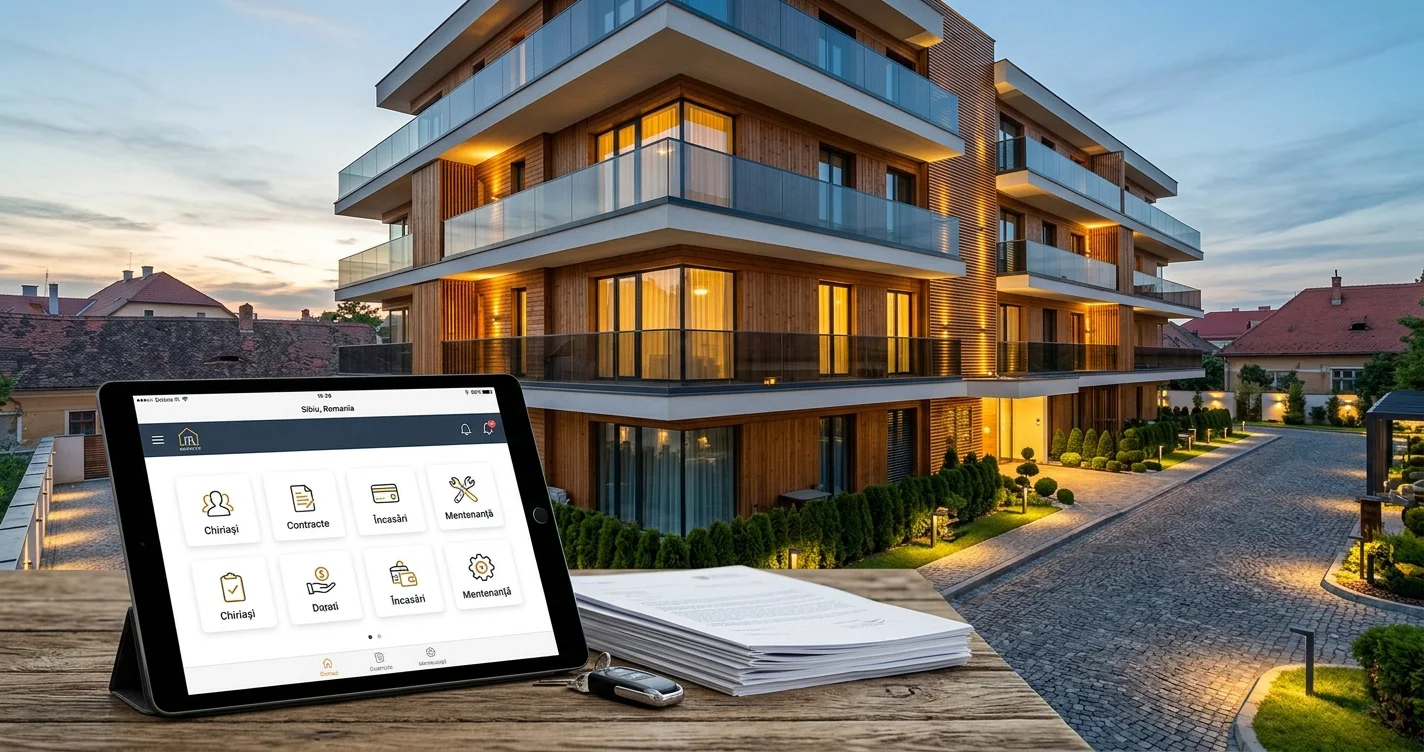
Property management in Sibiu means complete administration of a rented property: preparation, promotion, tenant selection, contract, collections, maintenance and final handover, explains Vianto Properties. Everything can run 100% online, with remote administration, including repairs, if the owner does not live in Sibiu.
Many owners start with the idea that "renting is simple". Then come phone calls at odd hours, urgent repairs, late payments and discussions about "who pays for this". This is where a property management Sibiu service comes in. In short, it is the complete administration of a rented property: from preparing the property and promotion, to tenant selection, contract, collections, maintenance and final handover. You keep control and get clear reports. The team handles operations, so you're not a "call center" for your apartment. In 2026, the difference shows especially in time, stress and risk. And risk, in real estate, always costs more than it seems.
- Property management Sibiu means complete administration: tenants, contracts, collections, maintenance and reporting.
- A good manager reduces the risk of non-payment through selection, clear rules and consistent follow-up.
- You receive documented check-in and check-out: inventory, photos, meter readings, reports.
- Maintenance is handled in a controlled way: quotes, approvals, quick interventions, invoices and warranties archived.
- You have visibility: periodic reports, payment status, intervention history and recommendations.
- Location matters a lot: in areas with high liquidity, tenant turnover is faster.
Contents
- 1. What property management in Sibiu means, concretely
- 2. What a complete package includes: from listing to handover
- 3. Tenants, contracts and rules: how to reduce risk
- 4. Maintenance and interventions: how to avoid "quick fix" costs
- 5. Areas and lifestyle in Sibiu: what people look for and why
- 6. How to choose a property management company in Sibiu
- Frequently Asked Questions
1. What property management in Sibiu means, concretely
Administration, not just "finding a tenant"
Many confuse administration with brokerage. Brokerage usually stops after the contract is signed. Administration continues throughout the rental period. A property management Sibiu service takes on the role of "manager" of the property: communicates with the tenant, monitors payments, manages repairs, organizes periodic inspections and prepares handover at the end.
You're no longer caught between "the boiler broke" and "I can't pay today". You have a process. You have documents. You have traceability. And you have a single point of contact. Everything can run 100% online, with remote administration, if you're not in Sibiu.
The real goal: predictability and lower risk
Renting is not just about collecting rent. It's about keeping the property in good condition and reducing periods without a tenant. This means:
- good response time to real requests;
- clear rules, communicated from the start;
- complete documentation, to avoid discussions at the end;
- cost control through quotes and approvals.
In practice, good administration protects your cash flow and asset value. And asset value shows in appreciation when you sell.
What property management is NOT
It's useful to know the limits too. Administration doesn't mean someone "works magic" with a poorly prepared apartment or an unrealistic rent price. A good manager tells you directly what needs to be adjusted: furnishing, amenities, rules, positioning, even the timing of listing.
Also, administration doesn't mean you don't make decisions anymore. You do, but they're informed decisions. You get options, costs, recommendations and you choose.
The owner's role in 2026: decisions, not operations
In 2026, owners who are doing well are those who treat renting as a project. Not as a chance occurrence. You set the goal: stability, long-term tenant, flexibility for sale or relocation. The manager builds the plan and executes it.
If you want to better understand the local context, you'll find analyses and guides in the Vianto Properties blog. For an overview, also see the real estate market section.
2. What a complete package includes: from listing to handover
Initial audit: property condition and "shortlist" of improvements
A serious package starts with an audit. Not with photos taken in a hurry. The audit means a visit and a clear list: what's functional, what's worn, what could cause complaints. In Sibiu, tenants pay attention to simple details: water pressure, window sealing, smells, cleanliness, lighting.
Usually, recommendations are practical. We're not talking about expensive renovations, but interventions that increase attractiveness and reduce maintenance:
- boiler service and installation check;
- replacement of leaking taps;
- new sealant at tub and sink;
- uniform lighting, warm light in the living room;
- clean curtains and drapes, no odors.
Positioning and promotion: an ad that sells, without risky promises
A good property management Sibiu service writes your ad correctly. Not "superb, luxury, unique". But clear: usable area, layout, floor, orientation, parking space, storage unit, pet rules, smoking conditions, estimated maintenance costs.
Photos are taken that show the real space. Angles that mislead are avoided. In 2026, tenants have little tolerance for differences between photos and reality. And wasted viewings mean lost time.
Viewings and pre-qualification: fewer visits, higher quality
Good management does not mean 20 viewings in a week. It means 6 viewings with the right people. Pre-qualification includes simple, but essential questions:
- how many people will live there;
- desired minimum duration;
- workplace and stability;
- pets, if any;
- move-in date and real budget.
In Sibiu, demand is diverse: employees in industry, IT, healthcare, education, but also students or relocated persons. Each profile requires different rules.
Contract, deposit and inventory: the part that saves you at the end
The contract is not a formality. It is your control tool. A good manager uses clear clauses: payment term, penalties, usage rules, maintenance, access for inspections, termination procedure.
Inventory is mandatory, if you want peace of mind. Inventory means a list of items, condition, photos, serial numbers on appliances, meter readings. It is signed at check-in and check-out.
Collections and follow-up: firm, but civil
Collecting rent seems simple until it isn't. Management means reminder before due date, confirmation after payment, immediate follow-up on late payment. Not after two months. The more you let slide, the more risk grows.
A good manager keeps the right tone. No drama. But no ambiguity either. The tenant must know that the rules are the same for everyone.
Reporting to the owner: clear, brief, useful
Reporting should not be verbose. It should be useful. Usually, it includes:
- payment status and any arrears;
- interventions made and costs;
- recommendations for prevention;
- observations about the use of the property.
If you want to see what a complete collaboration looks like, visit Vianto Properties' website and request a brief discussion. We'll tell you directly what makes sense for your property.
3. Tenants, contracts and rules: how to reduce risk
Tenant selection: "right fit" beats "fast"
The classic mistake is to choose the first tenant who says "I'll take it". In reality, you want a tenant who respects the property and pays on time. That shows in behavior, communication and consistency, not just income.
In a property management Sibiu process, selection includes reasonable checks and clear discussions. Not intrusive. But enough to understand the profile.
Checklist of questions before acceptance
- Why are they moving and what are they looking for, specifically?
- What is the realistic minimum duration?
- What is the work schedule and lifestyle?
- Have they rented before? How did their last rental end?
- Do they accept the rules: smoking, pets, visits, quiet?
In neighborhoods like Strand or Vasile Aaron, the profile is often young families. There, quiet and neighbors matter. In the Historic Center (Cetate), you more often have tenants who want quick access to cafes, events and walks. Rules must be adapted.
The contract: clauses that prevent discussions
I won't go into heavy legal language. But I'll tell you what matters practically:
- Clear payment term and established payment method.
- Deposit and retention conditions, explained simply.
- Utilities: who pays, how meter readings are submitted.
- Maintenance: tenant's responsibility, landlord's responsibility.
- Access for repairs and inspections, with notice.
- Termination: notice periods, notifications, handover.
A good contract isn't "harsh". It's clear. Clarity reduces conflicts.
Documentation: photos, inventory, meter readings
In Sibiu, many disputes arise at the end: "it was like this before". That's why check-in must be documented. Photos are taken of:
- walls and corners, especially in high-traffic areas;
- flooring and baseboards;
- bathroom, grout, fixtures;
- appliances, including inside the fridge and oven;
- balcony, if present.
Meter readings are noted. A report is signed. This prevents misinterpretation.
Relationship with tenant: rules, but also respect
Property management doesn't mean "keeping the tenant on a short leash". It means having a communication channel and a response time. The tenant must know when they'll get a response and what information to send: photos, video, description.
At the same time, the tenant must respect the property. If issues arise, communicate firmly and document. A good manager doesn't delay difficult conversations.
4. Maintenance and repairs: how to avoid unexpected costs
The difference between repair and prevention
Renting without prevention is like driving a car without servicing. It costs you more, exactly when you don't have time. In property management, prevention means regular inspections and small repairs, before they become big ones.
Common examples:
- a small leak under the sink can swell furniture;
- a dirty filter in the heating system can cause breakdowns;
- an uncleaned hood can coat walls with grease.
The correct workflow for repairs
A healthy workflow looks like this:
- report from tenant, with photos or video;
- triage: urgent or scheduled;
- quote and cost estimate;
- approval from landlord, if it exceeds an agreed threshold;
- repair, report, invoice;
- inventory update, if equipment changes.
This gives you control. And it keeps your history, useful at sale or tenant change.
Real emergencies vs. "comfort" emergencies
In any rental, requests come up. Some are real emergencies: no hot water, electrical short, water infiltration. Others are comfort issues: "I'd like different curtains". A property management Sibiu service filters correctly and maintains balance.
The tenant must feel heard. But the landlord must be protected from unnecessary costs. Experience matters a lot here.
Suppliers and quality: why the local network matters
In Sibiu, response time is important. Especially in winter, when heating systems are under pressure. A good company has verified suppliers: plumbers, electricians, painters, cleaning, heating maintenance.
Quality matters too. A cheap repair done poorly gets paid for twice. In property management, the goal is to optimize total cost, not just today's invoice.
Handover at the end: how to close without tension
Check-out is when all discussions are settled. That's why it's done by the book:
- advance scheduling;
- agreed cleaning, if applicable;
- inventory compared with check-in;
- meter readings;
- handover report;
- documented decision on the security deposit.
When you have documents, discussions are brief. When you don't, they become emotional.
5. Areas and lifestyle in Sibiu: what's sought and why
Why location changes everything in rentals
In property management, location dictates tenant profile, average duration, and type of requests. Some areas have faster turnover, others have stability. Some are preferred by families, others by active people who want the city at their doorstep.
Below is a mental map, in brief. It's not a dry list. It's about lifestyle, because that's what sells a good rental.
Historic Centre (Cetate): walkable, culture, urban rhythm
The Historic Centre (Cetate) attracts tenants who want cafés, events, and evening strolls. It's the area where "everything is close". At the same time, you have particularities: harder car access, limited parking, old buildings with stricter maintenance rules.
In property management, communication matters a lot here: quiet hours, noise management, visitor rules. And checking installations matters, because properties can have different histories.
Sub Arini and Valea Aurie: green, quiet, premium profile
Sub Arini (premium area) is about the park, fresh air, morning runs, and a calmer pace. Valea Aurie has the same vibe, with good access to green spaces. Tenants seek comfort, good finishes, and often a clear parking spot.
Here, management focuses on details: impeccable cleanliness, preventive maintenance, quick response. The premium profile has little tolerance for improvisation.
Strand and Trei Stejari: balance for families
Strand is balanced and sought by families. You have services nearby and a "settled" lifestyle. Trei Stejari has a similar feel, with good access to key points. In these areas, tenants appreciate stability and quiet neighbours.
In management, tenant selection and cohabitation rules matter here. A good family can stay for years. But it has to be the right fit.
Hipodrom and Mihai Viteazu: high turnover and accessibility
Hipodrom has high turnover. It's an area with high liquidity, because you have many apartments and constant demand. Mihai Viteazu is, likewise, a practical area, with good access and nearby services.
In property management, the advantage is speed of occupancy. The challenge is standardization: many apartments are similar, and the difference is made by photos, cleanliness, amenities, and presentation.
Vasile Aaron and Tineretului: young families, dynamic pace
Vasile Aaron is often chosen by young families. Tineretului has a name that says a lot: pace, mobility, practical needs. Tenants seek functionality, not necessarily "luxury". They want storage space, practical kitchen, good internet.
Here, efficient management means clear processes and quick interventions. A small problem left unresolved turns into dissatisfaction and departure.
Turnișor, Țiglari, Lazaret, and Terezian: accessible, pragmatic
Turnișor is accessible and has a pragmatic profile. Țiglari, Lazaret, and Terezian are areas where tenants seek good value for money. The condition of the building, stairwell, neighbours, and parking matter a lot.
In property management, it's important to set realistic expectations here. A clean, well-maintained apartment rents well. A "tired" apartment will attract tenants with higher tolerance, but also higher risk.
Calea Dumbrăvii and Ștrand: "close to everything"
Calea Dumbrăvii is a reference area. You have good access and a mix of services. It's the kind of area where tenants want to be connected, without being in the hustle of the centre. Ștrand, as we said, remains a balanced choice.
In management, these areas work well with well-presented apartments and clear rules. Demand is sustained, and good properties occupy quickly.
Gușterița and Trei Stejari: quiet and space
Gușterița has a more secluded feel. It suits tenants who want quiet and space. Trei Stejari combines good access with a calmer atmosphere. In these areas, parking and access matter a lot, especially in winter.
A good manager checks details that seem small: outdoor lighting, intercom, door closure, condition of access routes.
Comparative table: areas, tenant profile, and management focus
| Area (Sibiu) | Lifestyle and frequent profile | Focus in property management |
|---|---|---|
| Historic Center (Citadel) | Urban, walkable, events | Cohabitation rules, installation checks, parking |
| Sub Arini (premium area) | Green, quiet, premium profile | Details, preventive maintenance, high standard |
| Strand | Families, balance, stability | Tenant selection, clear contract, quick interventions |
| Hipodrom | High turnover, accessibility | Good presentation, standard process, quick occupancy |
| Vasile Aaron | Young families, practical needs | Functionality, communication, cost control |
| Turnișor | Accessible, pragmatic | Realistic expectations, maintenance, tenant verification |
For context about the city, you can read Sibiu municipality's presentation on Wikipedia. It's especially useful if you're renting to relocated people.
6. How to choose a property management company in Sibiu
Questions to ask before you sign
Don't choose based on promises. Choose based on process. Here are simple questions that separate "we do it too" from "we have a system":
- How do you select tenants and what do you verify?
- What does the inventory include and how do you document it?
- How do you handle late payments, step by step?
- What suppliers do you have and how do you control quality?
- What reports do I receive and how often?
- What is the check-out procedure and guarantee policy?
Signs that you're getting complete service, not improvisation
Look for these signs:
- you have a property management contract, not just a verbal agreement;
- there are written procedures for check-in and check-out;
- you receive photos and a signed inventory;
- there are approval thresholds for expenses;
- communication is predictable, with response times.
In 2026, tenants are used to fast services. If management is slow, your property suffers. And your reputation too.
Financial transparency: what needs to be clear
Even though this article is about process, the financial side needs to be transparent. Not necessarily with figures in the article, but with rules in the collaboration. Ask clearly:
- how rent is collected and transferred to you;
- how expenses are approved and who pays;
- how invoices and guarantees are kept;
- how repairs caused by the tenant are handled.
A good manager doesn't get upset at questions. On the contrary, they're pleased. It means you're a serious owner.
Legal and compliance: why it matters
Renting has legal and tax implications. I won't go into tax details here, but I'll tell you what matters in management: documents, traceability, correct communication. If you need macro benchmarks, check interest rate indicators on BNR's website. If you want to track transaction dynamics, you have public data on ANCPI's website. These are useful sources, even when your focus is on renting.
When property management makes sense and when it doesn't
Management makes sense especially if:
- you're away from Sibiu or out of the country;
- you have a busy schedule and don't want daily calls;
- you have multiple properties and want standardization;
- you want to reduce risk and have impeccable documents.
It may not make sense if you live two streets away, have time, enjoy managing everything and have experience. Even then, many property owners choose management for peace of mind.
Comparison table: self-management vs. property management
| Criterion | Self-management | Property management |
|---|---|---|
| Time consumed | High, especially in emergencies | Low, you delegate operations |
| Tenant selection | Depends on your experience | Standard process, screening and documentation |
| Maintenance | You search for suppliers "on the go" | Local network, quotes, quality control |
| Documents and inventory | Often incomplete | Structured check-in and check-out |
| Risk of conflict | Higher, emotional | Lower, rules and procedures |
If you want to discuss your specific case, go to the contact page and tell us two things: the area and the type of property. We'll respond with concrete steps, not generalities.
Frequently Asked Questions
1) What does a property manager actually do in a typical month?
In a typical month, a manager monitors rent collection, responds to tenant requests and organizes interventions if they arise. He checks compliance with rules, keeps records of documents and sends the owner a summary: payments, expenses, observations. The goal is to give you predictability and so you don't manage operations yourself.
2) How are late payments handled in property management?
Clear steps are followed: reminder before due date, confirmation after due date and immediate contact if late. If the delay persists, contract provisions are applied and everything is documented. It's important not to leave things "hanging" for two or three months. Consistency reduces risk and keeps the relationship civil.
3) Who decides on repairs and who pays?
The final decision is the owner's, but approval thresholds can be set. For example, minor interventions can be auto-approved, while larger ones need prior approval. Payment depends on the cause: normal wear, technical defect or misuse. A good manager documents the cause and keeps invoices and warranties.
4) What documents should I receive as an owner?
You should receive the lease agreement, signed inventory, handover report, relevant photos, meter readings and a history of interventions. Additionally, it's useful to have periodic reports on payment and expense status. Documents help you at the end, when the deposit and property condition are discussed.
5) Is property management useful if the apartment is in the Historic Centre (Cetate)?
Yes, often it's even more useful. In the Historic Centre (Cetate) there are particularities: access, parking, cohabitation rules and buildings with more sensitive installations. Professional management helps with selecting the right tenant, setting rules and quick interventions, without consuming your time. Documentation and communication matter a lot.
6) Can I use property management if I'm abroad?
Yes, this is one of the most common cases. A property management Sibiu service takes over viewings, contracting, check-in, collections and maintenance. You receive reports and approvals when needed. It's important to have clear procedures and a stable communication channel. This way you avoid situations where you make rushed decisions from a distance.
Conclusion: is property management worth it in Sibiu in 2026?
If you want to rent without it consuming your time and energy, the answer is yes. A good management service brings you order: better tenant selection, clear contract and inventory, monitored collections, controlled maintenance and hassle-free handover. Plus, it protects your property long-term. And that shows in its value, not just in your comfort.
In Sibiu, execution makes the difference. Not promises. When you have process, you have peace of mind. When you have improvisation, you have surprises. If you want to compare options and see what fits your property, you can start with our resources in the blog and useful information in the real estate market section.
Looking for property management and property management services for a property in Sibiu? Go to Vianto Properties and tell us what you have: apartment or house, area and level of amenities. We'll propose a simple plan, with clear steps and assumed responsibilities.
Looking for property management services in Sibiu? The Vianto Properties team is available to help you with personalized recommendations. Contact us at +40 791 710 606 or office@vianto.ro, or explore our available properties directly on the site.
Vianto Properties offers in Sibiu:
The correct selling price is determined by comparable transactions in your area, not by the asking prices in nearby listings. You can request a free property evaluation, with a response within 24 hours, or you can discuss with the Vianto Properties team before you decide.