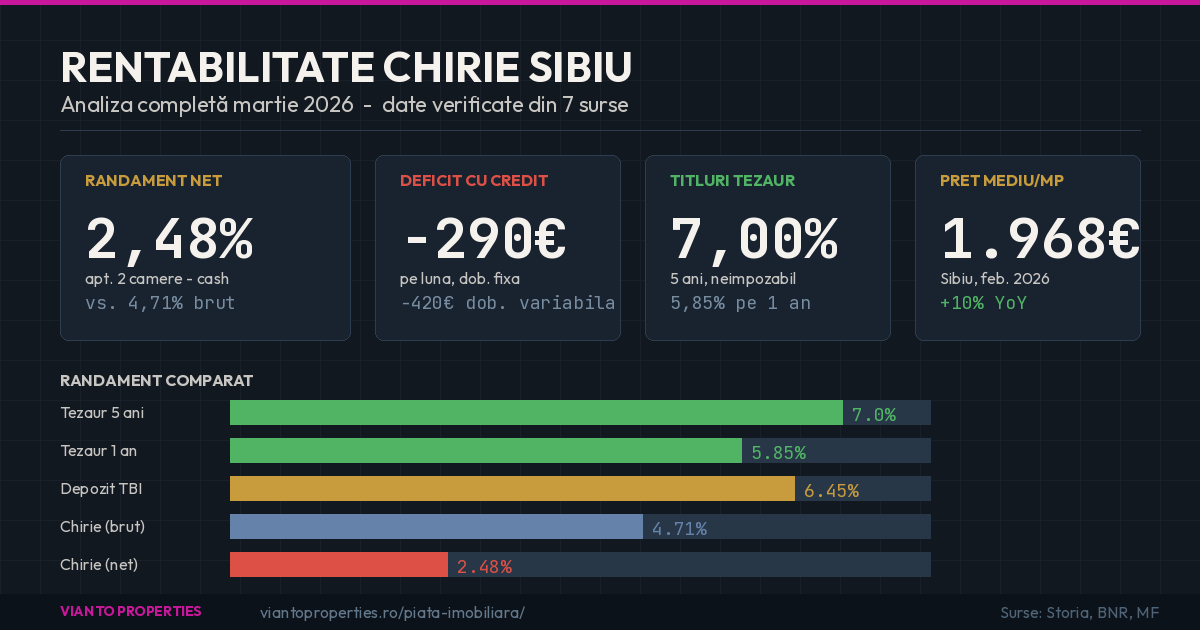
Why the rental yield calculation no longer works as it did 5 years ago
If you've ever discussed real estate investments with someone, you've probably heard the simplified version: "you buy an apartment, rent it out, the rent covers your mortgage, after 25 years you own the apartment free and clear." Sounds good. The problem is that in 2026, this calculation no longer works in Sibiu - nor in most cities across Romania.
We analysed real figures, updated in September 2026, for the real estate market in Sibiu. Not estimates, not optimistic projections - concrete data from verifiable sources: Imobiliare.ro, BNR Register, Ministry of Finance, Global Property Guide. And the conclusion is not what you usually hear at a real estate investment seminar.
This article details exactly what the real rental yield is in Sibiu, why it differs from what many promise, and what alternatives you have if your goal is yield, not necessarily physical property ownership.
How much does an apartment cost in Sibiu in 2026
Before any yield calculation, we need to establish the baseline - the purchase price. At the average price of 2,034 €/sqm (September 2026, Imobiliare.ro) and typical sizes, estimated prices in Sibiu municipality are as follows:
Average prices by type and age
| Type | Estimated price |
|---|---|
| Studio apartment | 61.000 € |
| 2-room apartment | 101.700 € |
| 3-room apartment | 142.400 € |
Average price per square metre: 2,034 €/sqm (September 2026, Imobiliare.ro), up 7.4% compared to the same period last year.
One relevant aspect: the gap between new and old buildings has compressed considerably. A year ago, the difference was visible. Today it is almost negligible - and there is a concrete explanation for this.
The effect of VAT changes on prices
From 1 August 2025, the reduced VAT rate of 9% for new residential properties was eliminated. At the same time, the standard rate increased from 19% to 21%. A concrete example: a new apartment with a base value of 100,000 € (excluding VAT) cost 109,000 € in 2024 (with 9% VAT). The same apartment costs 121,000 € in 2026 (with 21% VAT). Difference: 12,000 € extra for the same apartment, in the same building, on the same floor.
The market effect was twofold. On one hand, demand partially shifted towards the old building segment, where the displayed price is the final price, without VAT. On the other hand, developers partially absorbed the VAT increase, but the pressure on profit margins became visible - which opens real room for negotiation for buyers.
What does a rental bring in Sibiu - real figures
According to Vianto Properties calculation from active listings (September 2026), median rents in Sibiu municipality are as follows:
| Type | Median monthly rent |
|---|---|
| Studio apartment | 300 €/month |
| 2-room apartment | 400 €/month |
| 3-room apartment | 500 €/month |
What we notice immediately: sale prices have increased by 7.4% in one year (Imobiliare.ro, September 2026), and rents have not kept the same pace. This is an important divergence and tells us something fundamental about the direction of the market.
Gross rental yield - basic calculation
Gross yield is calculated simply: annual rent divided by purchase price. Here are the figures:
| Type | Purchase price | Annual rent | Gross yield |
|---|---|---|---|
| Studio apartment | 61.000 € | 3.600 € | 5,9% |
| 2-room apartment | 101.700 € | 4.800 € | 4,7% |
| 3-room apartment | 142.400 € | 6.000 € | 4,2% |
At the national level, the average gross rental yield is approximately 6.33% (source: Global Property Guide, Q3 2025). Sibiu is below the national average, at around 5% - which reflects the fact that sale prices have risen faster than rents.
Net yield - the figures you don't see in brochures
Gross yield is only half the story. The real costs of owning a rental apartment significantly reduce this percentage:
- Income tax on rental income: 10% of net income (after deducting standard expenses of 20%). Effectively, you pay 8% of gross rent.
- CASS (health contribution): 10% of net income, if you exceed the threshold (6 minimum gross salaries in the economy). For most owners with a single apartment, this applies.
- Mandatory insurance: approximately 100-150 €/year.
- Repairs and maintenance: the standard convention is 1% of property value per year, i.e. approximately 600-1,400 €/year depending on type.
- Vacancy periods: on average, an apartment sits empty 1-2 months per year (between tenants, minor renovations). This reduces income by 8-17%.
- Management: if you manage it yourself, the cost is zero in money but significant in time. If you use an agency, the commission is 5-10% of rent.
Let's do the full calculation for a 2-room apartment - the most traded type in Sibiu:
| Element | Annual amount |
|---|---|
| Gross rent (12 months) | 4.800 € |
| Estimated vacancy (1 month) | -400 € |
| Effective rent | 4.400 € |
| Income tax (8% of gross) | -384 € |
| CASS (10% of net income) | -352 € |
| Insurance | -120 € |
| Repairs and maintenance (1%) | -1.016 € |
| Net rental income | 2.528 € |
| Net yield | 2,49% |
2.49%. This is the real net return on a 2-room apartment rented out in Sibiu, purchased with cash at the average market price. And this is the optimistic scenario - no tenant problems, no major repairs, no extended vacancy periods.
What happens when you add a mortgage
Most investors don't buy with cash. They use bank financing - and here the calculation becomes even more revealing.
Lending conditions in 2026
IRCC (Reference Rate for Consumer Credits) stands at 5.57%, the latest published value (April 2026).
Effective interest rates on mortgages:
- Variable rate: approximately 8.07% (IRCC 5.57% + bank margin 2-2.5%)
- Fixed rate: approximately 5.49% (BNR average for new fixed-rate credits over 1-5 years, July 2026)
Concrete calculation: 2-room apartment, 80% loan
Let's take the standard scenario: 2-room apartment at 101,700 €, down payment 20% (20,340 €), mortgage of 81,360 €.
| Element | Variable rate (8.07%) | Fixed rate (5.49%) |
|---|---|---|
| Estimated monthly payment (25 years) | ~630 € | ~500 € |
| Annual credit cost | 7.560 € | 6.000 € |
| Annual net rent | 2.528 € | 2.528 € |
| Annual deficit | -5.032 € | -3.472 € |
| Monthly deficit | -420 € | -290 € |
With variable rate, you need to add 420 € from your pocket every month. With fixed rate - better situation, but you still add 290 €/month. The rent doesn't cover the payment. Not now, probably not in the next 3-5 years either, even if IRCC continues to fall.
This is not an opinion. It's mathematics. And it's the situation you're exposed to if you invest in real estate with a loan at current Sibiu prices.
Why many investors ignore these numbers
There are several arguments you hear frequently to justify real estate investment even with negative cash flow. They deserve to be analyzed one by one.
"The apartment appreciates over time"
Yes, historically, real estate prices in Sibiu have risen. The last year brought an increase of +7.4% in asking prices (September 2026, Imobiliare.ro). But three things are important:
Asking prices are not transaction prices. Real transactions are usually closed below the listed price. Transaction volume in Sibiu fell 7.5% in February 2026 compared to the same period in 2025 (645 vs 697 transactions). And in real estate markets, volume reacts first - price is the last thing to adjust.
Update September 2026: the February decline did not turn into a trend. In June 2026, ANCPI registered 936 transactions in Sibiu County, 26.7% above June 2025.
Past appreciation does not guarantee future appreciation. The Sibiu market has a Market Pulse score of 29 out of 100 (June 2026) - a moderate market, far from aggressive expansion phase. A high price is not synonymous with a healthy market.
If you project 5% annual appreciation, the 101,700 € apartment should reach approximately 130,000 € in 5 years. But if the market stagnates or corrects by 10-15% (which has happened before), you lose more than you gained from rent in all those years.
"Inflation erodes the debt"
Partially true. If you have a fixed-rate loan in lei and inflation remains high, the debt erodes in real terms. But variable rate adjusts with inflation (through IRCC), so this advantage applies only to fixed-rate loans. And fixed rate over 25-30 years in Romania comes with an extra cost - banks protect themselves for exactly this scenario.
"It's the safest investment"
Real estate has a perceived low risk. But perceived risk and real risk are different things. An apartment is an illiquid asset - you can't sell it in 24 hours at your desired price. When you urgently need capital, you'll accept a below-market price. Concentrating all your capital in a single asset, in a single city, is the opposite of diversification. And leverage (the loan) amplifies both gains and losses.
Real estate is not "the safest" investment. It's the most leveraged investment an ordinary investor makes. And leverage cuts both ways.
Alternatives: what else can you do with 20,000 €
Let's say you have 20,000 € - the amount many have saved and would use as a down payment for an apartment. What options do you have in March 2026?
1. Bank deposits - 4.5-6.5% in lei
Best offers from March 2026:
- TBI Bank: 6.45% for 12 months
- Exim Banca: 6.80% for 7 months
- CEC Bank: 4.50% for 12 months
Advantages: state-guaranteed up to €100,000, liquid, zero administration effort.
Disadvantages: interest is taxed at 10%, and deposits are in lei. If the lei loses 1-2% per year against the euro (historical trend), real returns decline. Realistic net: approximately 3.5-5% in euro equivalent.
2. Tezaur Government Bonds - 5.85-7%
Edition 3, subscription 9 March - 1 April 2026:
- 1 year: 5.85%
- 3 years: 6.50%
- 5 years: 7.00%
Major difference from deposits: Tezaur bonds are tax-free. A 7% untaxed return is equivalent to approximately 7.8% taxed. You cannot lose the principal, and credit risk is that of the Romanian state.
The main disadvantage is lower liquidity - you need to hold for the full term to benefit from the full rate. But in terms of risk/return ratio, Tezaur government bonds are probably the best financial instrument available in Romania today.
Realistic net: 5.85-7% clear. Compare that to 2.49% net return from rent on an apartment bought with cash.
3. Romanian Stock Exchange (BET) - high volatility
BET closed 2025 at 24,439 points, with a return of +46% versus 2024. With dividends included (BET-TR): +55%. The best performance in the last 15 years.
But 2025 was exceptional. It won't repeat. Historically, the Romanian stock exchange has had years with -30% or more. If you don't have the stomach for volatility and a minimum horizon of 7-10 years, the stock exchange is not an alternative to real estate - it is a completely different asset class.
Stock market advantage: liquidity (you sell in seconds), diversification (through ETFs or funds), minimal trading costs. Disadvantage: volatility that is psychologically hard to bear.
4. Real Estate with Mortgage - negative cash flow
I showed the calculation above. 2-room apartment at €101,700, 80% mortgage, best interest rate: deficit of minimum €3,472/year. Returns don't come from rent. They come from appreciation - if they come.
Synthetic comparison
| Instrument | Estimated net return | Risk | Liquidity | Effort |
|---|---|---|---|---|
| Bank deposit | 3,5-5% | Very low | High | Zero |
| Tezaur government bonds | 5,85-7% | Low | Medium | Minimal |
| BET/stock ETF | Variable (-30% to +55%) | High | High | Medium |
| Apartment rent (cash) | 2,49% | Medium | Low | High |
| Apartment rent (mortgage) | Negative | High | Low | High |
The 5 common mistakes of real estate investors in Sibiu
From our experience on the Sibiu market, these mistakes repeat with surprising frequency:
1. Calculating returns without all costs
Most investors calculate returns by dividing rent by apartment price. The result - a percentage of 5-6% - looks good on paper. But it is gross return, which ignores taxes, insurance, repairs, vacancy periods and the cost of administration time. Net return, which is what actually matters, is almost always 2-3 percentage points lower.
2. Comparison with "the friend who bought 10 years ago"
Yes, whoever bought an apartment in Sibiu in 2015 at €40,000 made an excellent investment. The price doubled or even tripled. But conditions in 2015 were fundamentally different: prices at post-crisis lows, declining interest rates, growing demand, reduced VAT. Extrapolating performance from 2015-2025 for the next decade is like driving a car looking only in the rear-view mirror.
3. Ignoring opportunity cost
The €20,000 down payment you use for an apartment does not generate zero return if you don't invest it in real estate - it generates 5.85-7% in government bonds, with no effort, no risk of problematic tenants, and no phone calls at 2 AM about a burst pipe. Opportunity cost is real, even if it doesn't appear on any invoice.
4. Underestimating liquidity risk
An apartment is not a bank deposit. If you need capital urgently, selling takes an average of 3-6 months in Sibiu (for properties correctly valued at market price). If the asking price is above market, the duration extends to 6-12 months or more. Throughout this time, costs keep flowing: mortgage payments, taxes, maintenance.
5. Emotional decision, not rational
The feeling of ownership, of tangible security, of "a brick that doesn't lie" - all are real from a psychological standpoint. But an investment decision based on emotion, not calculation, is a risky decision. And the larger the invested sum, the greater the risk.
When it still makes sense to invest in real estate
The calculations above do not mean that real estate investment is always a bad decision. There are scenarios where it makes sense - but they are more specific than most people believe.
Scenario 1: Purchase below market price
If you identify a property at a price 15-20% below the area average - due to the seller's urgency, inheritance, divorce, or another particular situation - the calculation changes significantly. A 2-room apartment bought at €85,000 instead of €101,700 generates a gross return of 5.65% from rent, not 4.7%. And the safety margin in case of a market correction is much larger.
But these opportunities are not found on listing portals. They require connections, constant market presence, and the ability to make decisions quickly.
Scenario 2: Added value through renovation
An apartment bought at €80,000, renovated for €15,000 and repositioned on the rental market at €500/month (instead of €350) generates a return of 6.3% on invested capital. And the resale value increases simultaneously. This strategy works, but requires project management skills, technical knowledge, and time.
Scenario 3: Short-term rental (Airbnb)
Sibiu is a tourist city - historic centre, festivals, Transfăgărășan. A well-positioned apartment can generate €50-80/night in season. With an average occupancy rate of 50-60% per year, income can be 2-3 times higher than traditional long-term rent.
But managing an Airbnb is a job, not passive income. Check-in, cleaning, guest communication, reviews, seasonality, local regulations - all come with the package. And competition on Sibiu's Airbnb market is growing.
Macroeconomic context: what's ahead for Sibiu's real estate market
The real estate market does not function in isolation. A few macroeconomic factors define the context for 2026.
Interest rates - possible decline towards year-end
Inflation remains a concern, especially in Q2 2026. The base scenario for analysts: a gradual reduction to 5.75% by the end of 2026, possibly 5.25-5.50% in the optimistic scenario.
If interest rates fall, credit accessibility improves, which supports demand. But a drop from 8.07% to 7.5% variable interest reduces the monthly payment by only about €30 - insufficient to turn negative cash flow into positive.
Transactions - declining, but not collapsing
The total transaction volume in Sibiu fell 7.5% in February 2026 compared to the same period in 2025. Transactions on individual units remained stable - 171, identical to last year. The market shows signs of cooling, not collapse.
On real estate markets, volume reacts first. Price is the last to adjust. If volume continues to decline in 2026, it is possible that prices will follow, with a lag of 6-12 months.
Rental demand - increasingly clear segmentation
Appetite for rentals in Sibiu declined slightly at the beginning of 2026. Studio apartments fell 12%, 3-room apartments fell 9%. But the market has segmented: energy-efficient apartments in new residential complexes maintain demand, while old, poorly efficient apartments are increasingly difficult to rent at competitive prices.
This is a trend that will intensify. European regulations on building energy performance will increasingly penalize properties in the old, unrenovated segment.
Sibiu in regional context - where it stands
Compared to Romania's main urban centres, Sibiu is positioned in the middle of the price range requested, but with solid economic fundamentals:
| City | Average price/sqm | Market Pulse Score |
|---|---|---|
| Cluj-Napoca | €3,316/sqm | - |
| Brașov | €2,309/sqm | - |
| București | €2,312/sqm | - |
| Sibiu | €2,034/sqm | 29/100 (June 2026) |
| Iași | €2,000/sqm | - |
| Timișoara | €1,984/sqm | - |
Cluj-Napoca remains the most expensive market in the country - 63% above Sibiu. However, the average net salary in Cluj does not proportionally justify this difference. The price-to-income ratio is much more strained there.
Sibiu maintains one of the most balanced ratios between asking price, actual demand, and purchasing power in Romania. This does not mean prices will necessarily increase - it means fundamentals remain solid, even as market dynamics cool.
Our recommendation: a rational, not emotional approach
There is no "best investment". There is the right investment for your risk profile, time horizon, and financial objectives.
If your goal is annual returns with minimal risk, Tezaur government bonds offer 5.85-7% tax-free - significantly more than the net return from apartment rent (2.49%).
If your goal is building wealth over the long term (15-25 years) and you can sustain a negative cash flow of 300-400 €/month, real estate remains a valid option - but only if you understand that returns come from appreciation, not rent.
If you have available capital and project management skills, value-add strategies (below-market acquisition + renovation) or short-term rental (Airbnb) can generate superior returns - but with proportional effort and risk.
And if you already have an investment apartment with negative cash flow and are thinking about optimization, here are some concrete directions: evaluate whether the rent price is correct against the market, check energy efficiency (insulation, heating system, fixtures - which directly influence attractiveness to tenants) and analyze the option of refinancing at a fixed rate if you're on a variable rate.
How to monitor the market correctly
Any real estate investment decision must be based on updated data, not on intuition or other people's success stories.
We monitor the Sibiu real estate market with data updated monthly, from 7 official sources and over 130,000 data points. The Market Pulse Score, calculated through principal component analysis (PCA) on 6 indicators, provides a synthetic picture of market health - not just price.
All data is freely accessible at viantoproperties.ro/piata-imobiliara/, updated monthly.
Frequently asked questions about rental returns in Sibiu
What is the average rental return in Sibiu in 2026?
Gross rental returns in Sibiu range between 4.2% and 5.9%, depending on apartment type. Studio apartments offer the highest gross return (5.9%), followed by 2-room apartments (4.7%) and 3-room apartments (4.2%). Net return, after deducting all costs (taxes, vacancy, repairs, insurance), drops to approximately 2.49% for a 2-room apartment - the most traded typology.
Does rent cover the bank mortgage in Sibiu?
No, under current market conditions. For a 2-room apartment purchased at the average price (101,700 €) with 80% financing, the monthly deficit is between 290 € (fixed rate) and 420 € (variable rate). The median rent of 400 €/month does not even cover the monthly mortgage payment, without accounting for additional management costs.
What alternative offers the best risk/return ratio?
In March 2026, Tezaur government bonds offer 5.85-7% tax-free - significantly above net rental returns (2.49%). They are guaranteed by the Romanian state, require no management, and are accessible from small amounts. For investors with low-to-medium risk profile and a 1-5 year horizon, they represent the most efficient alternative to traditional real estate investment.
Is it worth buying an investment apartment in Sibiu in 2026?
It depends on context. If you have cash capital, renovation skills, or access to below-market properties - yes, it could be a good investment. If the plan is "I buy with a mortgage, rent it out, rent covers the payment" - the numbers show this model doesn't work at current Sibiu prices. We recommend a personalized analysis, on the specific property you're targeting, not on statistical averages.
Conclusion
Net rental return from an apartment in Sibiu is 2.49% in 2026 (August 2026 prices, September 2026 rents) - below bank deposit levels and well below government bonds. With a mortgage, rent does not cover the payment, generating a deficit of at least 290 € per month.
Real estate investments are not the "safest" investment. They are the most exposed to leverage effects. And leverage effects can have positive or negative consequences.
Before any decision, calculate. Not with figures you heard over coffee, but with real, updated figures from verifiable sources.
Looking for a personalized analysis for a specific property in Sibiu? The Vianto Properties team is available for free consultation. Contact us at +40 791 710 606 or office@vianto.ro. viantoproperties.ro
Explore Vianto Properties offers:
Vianto Properties offers in Sibiu:
For rentals, a realistic price and tenant verification before signing matter more than speed. See apartments for rent in Sibiu or, if you have a property to rent out, contact us for a free consultation with the Vianto Properties team.