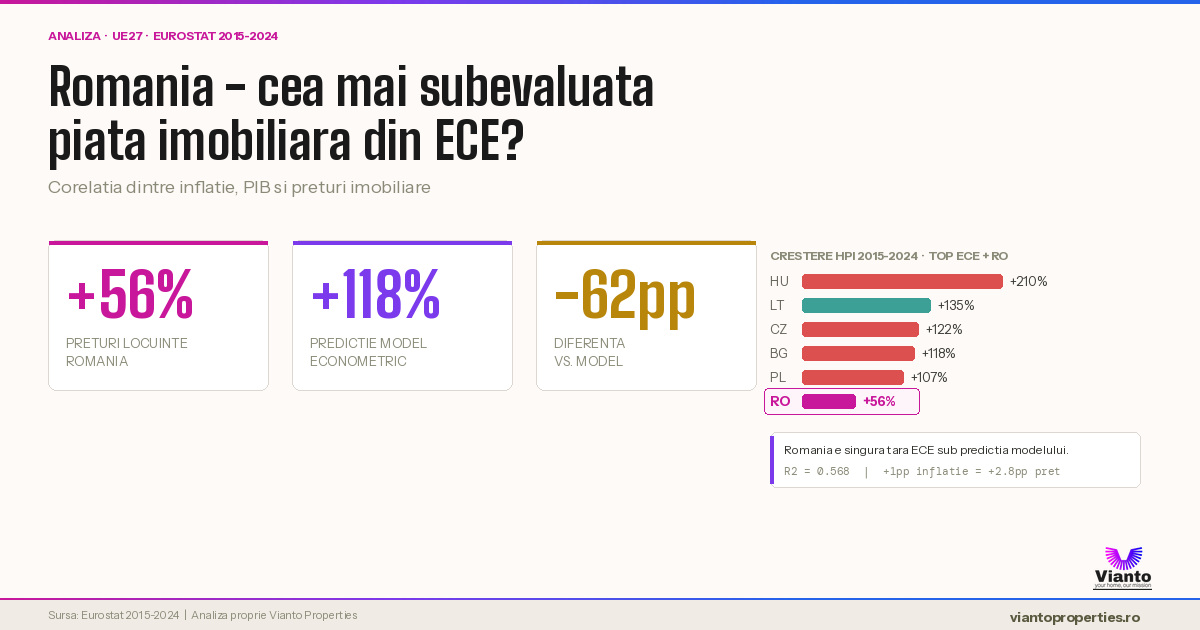
The European Parliament has published Eurostat data on housing price developments across all 27 EU countries for the 2015-2024 period. We analysed the figures, built an econometric model and compared Romania with the rest of Europe. The results are surprising: the real estate market in Romania appears significantly undervalued relative to economic fundamentals.
What Eurostat data shows: a decade of unequal growth
Housing prices in the European Union have risen on average by 53% over the past decade. However, differences between countries are considerable.
The top growth rankings are dominated by Central and Eastern Europe (CEE): Hungary (+210%), Lithuania (+135%), Portugal (+124%), Czechia (+122%), Bulgaria (+118%) and Poland (+107%). At the opposite end, Finland stagnated (+1%), while Greece recorded a decline (-9%).
Romania, with +56%, ranks 18th out of 27 - below the CEE regional average (+115%) and even below Western Europe (+60%).
By region, the picture is clear: CEE has doubled Western Europe's pace in terms of real estate price appreciation appreciation (+115% HPI vs +60% HPI), against the backdrop of nearly double inflation (+46% vs +24%).
Why Romania is undervalued: the econometric model
We built a regression model across all 27 states, using cumulative inflation (HICP) and real GDP growth as explanatory variables.
Main result: inflation explains 57% of the variation in housing prices at European level (R² = 0.568). Specifically, each additional percentage point of inflation generates on average +2.8 percentage points of housing price growth.
Romania's figures are telling:
- Cumulative inflation: +44% (almost identical to Poland, +42%)
- Cumulative real GDP: +33% (above Czechia)
- Housing price growth: +56%
- Model prediction: +118%
- Difference: −62 percentage points
In other words, based on macroeconomic fundamentals, housing prices in Romania should have risen by +118%, not +56%. Romania is the only CEE country that falls below the econometric model's prediction. All others - Poland, Czechia, Hungary, Bulgaria - are above it.
What factors explain the 62-point gap
The model based on inflation and GDP explains approximately 64% of price variation. The remaining 36% comes from structural factors which, in Romania's case, have acted as brakes:
Supply of new housing - massive construction over the past decade has kept prices in check, unlike markets such as Hungary or Portugal, where supply has not kept pace with demand.
Access to credit - LTV ratios, interest rates and First Home-type programmes significantly influence purchasing power.
Foreign capital - programmes such as Golden Visa (active in Portugal, Greece) or flows of investment from international funds have fuelled growth in other countries. Romania has not benefited from these injections on the same scale.
Regulation - rent controls, taxation and Airbnb rules vary significantly between countries and influence investment attractiveness.
Demographics and migration - urbanisation, emigration and tourism reshape demand in different ways from country to country.
A relevant detail: geography (West vs. East) alone explains only 22% of variation - it becomes irrelevant when we control for inflation.
Current macro context: signs of maturation, not collapse
Update Q3 2025: the HPI index has reached 166 points (base 2015 = 100), i.e. +66% cumulative. The trend continues, but at a moderate pace.
A few macroeconomic benchmarks to monitor (as of Q3 2025 update):
- BNR rate: 6.50%
- GDP growth: ~1%
- Real estate transactions: -5.4% YoY
- Building permits in the EU: -20% vs 2021
These are signs of a market maturing, not one collapsing. New supply remains insufficient - demand continues to outpace supply. A relevant point: in real terms (adjusted for inflation), housing price growth in Romania in 2024 was below the inflation rate. In practice, the Romanian market is not overheated - it is below potential.
What this means for investors
Three conclusions from our analysis:
1. Economic fundamentals support further appreciation. The 62 percentage-point gap versus the econometric model is not a statistical accident - it is a window of opportunity.
2. Rental yields remain competitive, especially in university cities and economic hubs such as Sibiu, Cluj or Timișoara.
3. Geography does not matter - market structure does. Supply, credit and regulation are the real factors that differentiate markets. And Romania has room for recovery across all these dimensions.
Data source: European Parliament / Eurostat, House Price Index (prc_hpi_a), 2015 = 100. Vianto Properties analysis.
Looking for real estate investment opportunities in Sibiu? The Vianto Properties team can provide you with a personalized analysis of the local market. Contact us at +40 791 710 606 or explore available properties on our website.
Explore Vianto Properties offers:
Vianto Properties offers in Sibiu:
Frequently Asked Questions
How much have house prices increased in the EU between 2015 and 2024?
House prices in the European Union have increased by an average of 53% over the past decade, according to Eurostat. The top growth rates are dominated by Central and Eastern Europe: Hungary (+210%), Lithuania (+135%), Portugal (+124%), Czechia (+122%), Bulgaria (+118%), Poland (+107%). At the opposite end, Finland stagnated (+1%), and Greece recorded a decline (-9%).
Where does Romania rank in the European house price growth ranking?
Romania, with +56%, ranks 18th out of 27 EU states - below the average for the Central and Eastern Europe region (+115%) and even below the Western Europe average (+60%). It is the only CEE country that falls below the prediction of the econometric model based on economic fundamentals.
Why is Romania's real estate market undervalued?
The econometric model built on the 27 EU states (using cumulative inflation and real GDP growth as explanatory variables) predicts a +118% increase in house prices for Romania, based on macroeconomic fundamentals. In reality, prices have risen only +56%, a difference of -62 percentage points.
What role does inflation play in real estate price appreciation?
Inflation explains 57% of the variation in real estate prices across Europe (R² = 0.568). Specifically, each additional percentage point of inflation generates on average +2.8 percentage points of growth in house prices. Romania has cumulative inflation of +44% and cumulative real GDP growth of +33% - solid fundamentals.
What structural factors explain Romania's gap?
The model based on inflation and GDP explains approximately 64% of the variation in prices. The remaining 36% comes from structural factors (financial system, regulations, housing stock, migration, taxation) which in Romania's case have acted as brakes on price appreciation compared to other CEE states.
The correct selling price is determined by comparable transactions in your area, not by the asking prices in nearby listings. You can request a free property evaluation, with a response within 24 hours, or you can discuss with the Vianto Properties team before you decide.