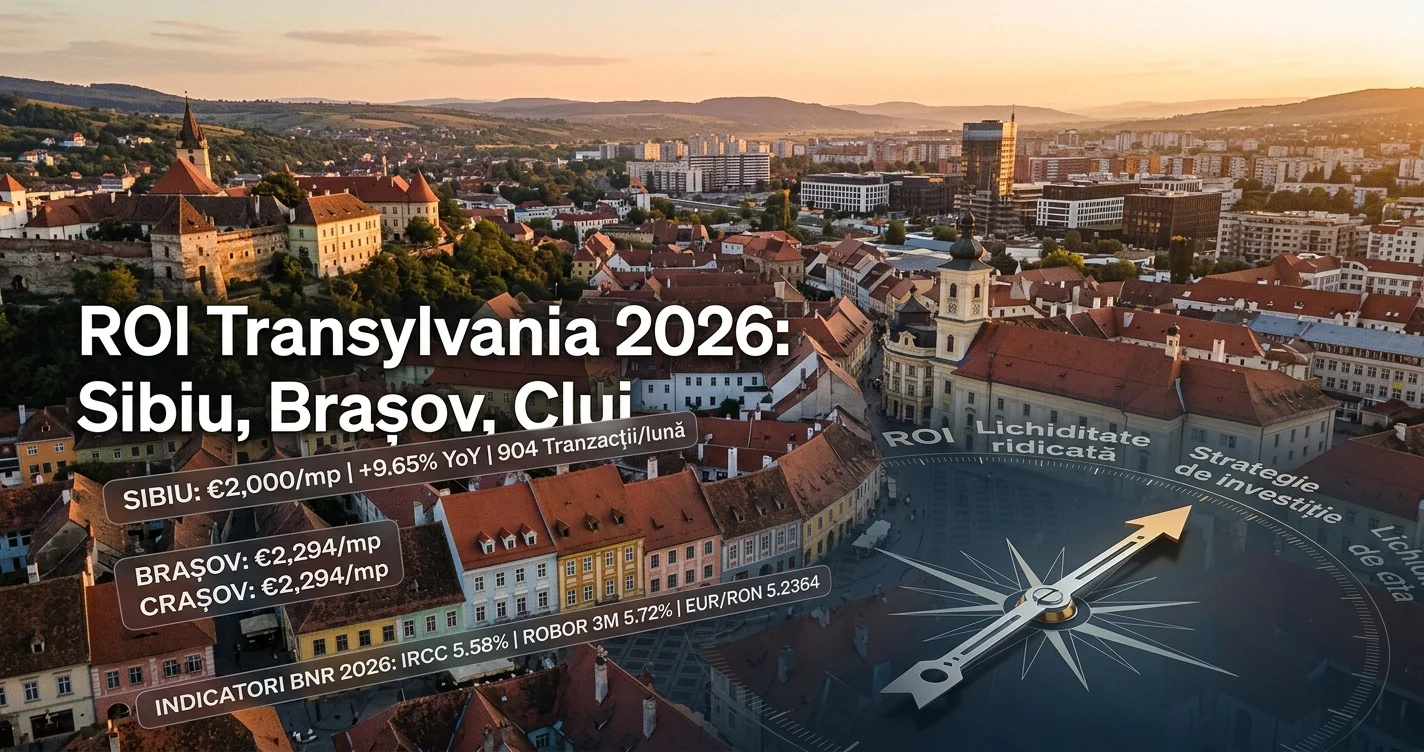
Transylvania real estate investment is no longer just a forum topic. It has become a serious portfolio decision. In 2026, the differences between Sibiu, Brașov and Cluj are clear. They show in asking price, in transaction pace and in stock pressure. In Sibiu, the average asking price is 2,034 EUR/sqm, according to Imobiliare.ro (September 2026). And the momentum is +7.4% YoY. At the same time, transactions rose to 936 in June 2026, with +26.7% YoY, according to ANCPI. That tells you something simple: there is sustained demand, and many areas are already high-liquidity zones. If you want ROI, you need discipline, not luck.
- Sibiu: average asking price 2,034 EUR/sqm (Imobiliare.ro, September 2026).
- Sibiu: annual change +7.4% YoY (Imobiliare.ro, September 2026).
- Sibiu: 936 transactions in June 2026, +26.7% YoY (ANCPI data).
- Sibiu: 500 new mortgages in June 2026 (ANCPI data).
- Cost of money: IRCC 5.57% and ROBOR 3M 5.84% (according to BNR).
Contents
- 1) What ROI means in 2026 for transylvania real estate investment
- 2) Price comparison: Sibiu vs Brașov vs Cluj
- 3) Sibiu: high-liquidity zones, lifestyle and investment scenarios
- 4) Financing, risk and debt service in 2026
- 5) Acquisition strategy: negotiation margin, checks, notarial deed
- 6) Exit plan: capital gains, orderly correction and timing
- FAQ
What ROI means in 2026 for Transylvania real estate investment
Positive ROI doesn't mean just rent
In Transylvania real estate investment, positive ROI comes from two engines. The first is rental cashflow. Here you discuss gross yield and net yield. The second engine is capital gains, that capital gain at resale. In 2026, many markets are still in appreciation mode. But not all properties grow the same. Location and building quality make the difference.
In practice, a good investor asks themselves two questions. First: how quickly can I rent out, without a big discount? Second: if I sell in a few years, do I have a high-liquidity zone? If the answer is "yes" to both, you have an investment with good chances to stay healthy.
Why liquidity matters, not just entry price
Many look only at asking price. That is a classic mistake. In Transylvania real estate investment, liquidity is your insurance. In a high-liquidity zone, you have more buyers and tenants. That reduces your risk of periods without rent. It also reduces your risk of selling at a big discount.
In Sibiu, ANCPI data shows 936 transactions in June 2026, with +26.7% YoY. That suggests an active market. It does not automatically mean any apartment sells fast. It means there is movement. And movement helps the disciplined investor.
Market Pulse and cooling signals
In Sibiu, Market Pulse was 29/100 in June 2026. It is a useful indicator for pace and tension in the market. I do not treat it as an oracle. I use it as a traffic light. When pulse is low, negotiations can be slower. When pulse rises, stock pressure appears. In 2026, in many segments you feel limited available stock and even supply deficit.
At the same time, it is healthy to accept that the market shows cooling signs in certain micro-zones. It is not a crisis. Often it is an orderly correction. Fundamentals stay solid when you have real demand, wages and working credit.
Macro context: interest rates, inflation, exchange rate
In 2026, the cost of money matters more than in low-rate years. IRCC is 5.57%, and ROBOR 3M is 5.84%, according to BNR - interest rate and exchange rate indicators. Inflation is 6.17% YoY (August 2026), according to INS - inflation data. Average EUR/RON rate in August 2026 is 5.2498 (BNR).
In this context, that translates simply. If you finance, debt service can bite into cashflow. If you have income in lei and prices in euros, the exchange rate matters. Do not panic. Just calculate conservatively and keep a reserve.
Price comparison: Sibiu vs Brașov vs Cluj
Comparative table: asking prices in major cities
For this topic, price comparison is the first filter. It is not the only one. But it shows you the entry barrier and the potential for yield compression. Below are average asking price values per city, in EUR/sqm, according to real estate portals.
| City | Average asking price (EUR/sqm) |
|---|---|
| Cluj-Napoca | 3.316 |
| Brașov | 2.309 |
| Sibiu | 2.034 |
Cluj is clearly the most expensive. Brașov is in the middle. Sibiu is lower, but not "cheap". The big difference between Cluj and Sibiu changes strategy. In Cluj, entry costs a lot. That can compress net yield. In Sibiu, entry is more accessible, and liquidity can stay good in the right zones.
What these differences mean for ROI
In this analysis, ROI is sensitive to entry price. If you pay a lot, you need either higher rent or faster capital gains. We do not have rents by property type in this article, because we do not use unvalidated numerical estimates. But the logic remains. A higher asking price demands better execution.
Sibiu, at 2,034 EUR/sqm, can offer good balance. Especially when you choose a reference zone and a well-maintained building. Brașov, at 2,309 EUR/sqm, comes with tourist pressure and seasonality. Cluj, at 3,316 EUR/sqm, demands very strict selection and firm negotiations.
Transactions and mortgages: signal of real demand
A serious investor looks at volume, not just prices. In Sibiu, ANCPI reports 936 transactions and 500 new mortgages in June 2026. Transactions grew by +26.7% YoY. That indicates sustained demand and a market still absorbing stock.
Important: ANCPI publishes transactions and mortgages, not prices. We get prices from real estate portals. If you want to check the source, go to ANCPI - transaction and mortgage statistics.
Where Sibiu ranks in Romania
In the comparative ranking of 8 cities (Imobiliare.ro, September 2026), Sibiu is at 2,034 EUR/sqm. It is above Oradea (1,885) and Timișoara (1,984). It is close to Constanța (2,020) and Iași (2,000). It is below Bucharest (2,312) and Brașov (2,309).
In this discussion, this tells you that Sibiu is not a marginal market. It is a mature market, with prices already at "big city" levels. But it still has room for selection. Especially in micro-zones and product quality.
Sibiu: high-liquidity zones, lifestyle and investment scenarios
Why Sibiu is attractive for investors
Sibiu has a rare advantage: it combines urban life, tourism and a good transaction pace. In September 2026, the average asking price is 2.034 EUR/sqm, with +7.4% YoY, according to Imobiliare.ro. In parallel, ANCPI shows 936 transactions and 500 new mortgages in June 2026. This suggests the market has momentum.
There is something else. Sibiu has a strong identity. It is a city where people come for quality of life. If you want general context, see Wikipedia - Sibiu city overview. For an investor, this translates into rental demand and purchase demand, especially in the right zones.
Sibiu neighbourhoods: lifestyle, tenant profile, buyer profile
In this assessment, a neighbourhood is more than a map. It is a lifestyle. And lifestyle defines your tenant and final buyer. Below are a few local landmarks, explained briefly, as between friends.
- Centre and Ultra-Centre - for people who want cafés, walkability and events. Building condition and maintenance matter a lot here. You have good demand, but also high expectations. It is a reference zone for premium residential.
- Strand - neighbourhood pace, with good access to the city. It is preferred by young families. Parking and layout matter. In many cases, it is a high-liquidity zone.
- Hipodrom - dense, practical, with services nearby. It is sought for functionality. Here you can have good rental turnover if you choose the building correctly.
- Turnișor - mix of houses and blocks, with a quieter vibe. Attracts people who want space and quick access to exits. Good for medium-term tenants.
- Sub Arini - good perception, greenery, quiet. Location matters a lot here. It suits buyers looking for comfort and privacy.
- Calea Dumbrăvii - reference zone for walks, park and access to facilities. It is a magnet for families and professionals. Liquidity is good when the product is right.
There is no "best neighbourhood" for everyone. There is the right neighbourhood for your strategy. In this subject, strategy beats personal preference.
Investment scenarios: conservative, balanced, opportunistic
I propose three simple scenarios. I do not use rental figures because we do not have rental data by typology in our database. But I show you how to think correctly, without fooling yourself.
- Conservative - you buy in a reference zone, in a good building. You target stability and low turnover. You seek predictable net yield and reduced risk.
- Balanced - you buy in a high-liquidity zone, but you also seek appreciation potential. Here it matters to enter below market price, through negotiation and timing.
- Opportunistic - you buy a property that needs improvements. You target value growth through renovation. Here the difference between asking price and transaction price becomes essential.
In all scenarios, you verify the documents and costs. And do not skip the exit plan. In this subject, the exit is half the investment.
Where investors get stuck: limited stock and unrealistic expectations
In 2026, in many segments there is limited available stock. Sometimes there is even supply shortage on good products. This pushes asking price up. But it does not mean you have to buy anything. It means you have to be fast and prepared.
A frequent mistake is to chase "bargains" that do not exist. Or to ignore real maintenance costs. A cheap apartment in a building with problems can eat your returns. In this analysis, building quality is part of ROI.
For an updated picture of local dynamics, follow our dedicated page: Real estate market - analysis and trends Vianto Properties. And for practical guides, visit the Vianto Properties Blog.
Financing, risk and debt service in 2026
Interest rates: how they affect your debt service
In this discussion, financing can accelerate ROI. But it can also ruin everything if you do not calculate correctly. In 2026, IRCC is 5.57%, and ROBOR 3M is 5.84%, according to BNR. This means rates more sensitive to income and periods without rent.
The key concept is debt service. That is, the monthly amount you pay for the loan. If debt service consumes too much of your available income, the investment becomes fragile. In practice, you want to be able to sustain the payment even if you have a period without a tenant.
EUR/RON exchange rate: why it matters even for local investments
Prices are often expressed in euros. Income is often in lei. In August 2026, the average EUR/RON rate is 5.2498 (BNR). The difference can change your acquisition budget.
My recommendation is simple. If you have a budget in lei, calculate with a safety margin. Do not rely on the "best" rate. In this assessment, budget discipline is a competitive advantage.
Inflation and rent: protection, but not guarantee
Inflation is 6.17% YoY (August 2026), according to INS. In theory, real estate can partially protect against inflation. In practice, it depends on demand and purchasing power. The average net salary in Sibiu is 6.025 RON, and the national average net salary is 5.820 RON (July 2026).
This shows you one thing. The local market has an income base. But you cannot raise rent indefinitely. You have to stay in the zone where the tenant can pay. In this subject, the tenant is your partner, not your adversary.
Credit vs cash: when each makes sense
With cash, you have flexibility and better negotiation. With credit, you preserve liquidity and can scale. But credit comes with stress. Especially when interest rates are high. In Sibiu, ANCPI shows 500 new mortgages in June 2026. This confirms that financing is still actively used.
A practical criterion is this: if you have credit, aim for realistic positive ROI. If it does not work out, do not force it. Better to wait for a better property or negotiate more firmly. In this subject, patience is a strategy, not a weakness.
Risk checklist for investors
- Check if the zone is a high-liquidity zone or a slow one.
- Calculate debt service with IRCC 5.57% or ROBOR 3M 5.84% (BNR).
- Keep track of exchange rate: average 5.2498 in August 2026 (BNR).
- Do not confuse asking price with transaction price. Ask for arguments and comparables.
- Prepare a plan B for periods without a tenant.
If you want to discuss your case, go to Vianto Properties contact page. I'll tell you directly what makes sense and what doesn't.
Acquisition strategy: negotiation margin, due diligence, notarial deed
Asking price vs market price vs transaction price
In this analysis, the difference between these terms protects your money. Asking price is what you see in the listing. Market price is the level at which similar properties can sell in a reasonable time. Transaction price is what is actually paid, after negotiation.
The problem is that many investors negotiate "by feel". My recommendation is to negotiate based on data and real defects. Floor, orientation, parking, maintenance costs, neighbourhood. That's where you build negotiation margin and negotiation discount.
How to get negotiation margin without losing the property
In markets with strong demand, good properties sell fast. That doesn't mean you don't negotiate. It means you negotiate professionally. You prepare your financing. Your documents are up to date. You know what you want. And you offer a clear timeline.
- Make a written offer with a short response deadline.
- Tie the discount to a verifiable reason, not "that's what I want".
- Propose a reasonable deposit, if the property is worth it.
- Don't ask for big discounts without argument. You lose credibility.
- Keep in mind limited available stock on good products.
In this discussion, speed and clarity increase your chances of getting a good price.
Due diligence: land register, encumbrances, mortgage
Never buy without checks. Ask for land register extract without encumbrances or at least clarify existing encumbrances. Ideally, you want a clean land register. If there is a loan, discuss discharge and payment terms. If you buy with a loan, the bank will usually require first-rank mortgage, i.e. a primary mortgage guarantee.
Check the property history too. Check if there are any disputes. Check if the areas in the documents match reality. In this assessment, a small problem in the documents can block a sale for months.
Notarial deed and transfer costs
The transfer is done through a notarial deed. That's where the transaction closes. In your budget, also account for property transfer tax, plus notarial fees and other costs. I won't go into figures, because these vary by case and are not in the database here.
It's important not to stretch to the limit. If you spend your entire budget on acquisition, you're left with no money for furnishing, repairs and periods without rent. On this topic, cash reserve is part of the strategy.
Quick checklist before making an offer
- Location in a reference area or area with high liquidity.
- Real comparables for market price, not just listings.
- Check land register extract without encumbrances or clarify encumbrances.
- Financing plan and pre-approval, if applicable.
- Rental plan and tenant profile.
If you want to see current opportunities, go directly to Vianto Properties website. We show you properties that make sense for investment, not just "beautiful in photos".
Exit plan: capital appreciation, orderly correction and timing
Capital appreciation: how you build it, not how you hope for it
On this topic, capital appreciation is not magic. It's the result of three things. Good location, good product and good timing. You choose the location from the start. You choose the product or improve it. You manage timing through patience and exit plan.
Sibiu has an appreciating market, with +7.4% YoY in average asking price, according to Imobiliare.ro (September 2026). That's a tailwind. But don't rely on it alone. Look for properties that remain attractive even when the market slows.
Orderly correction vs crisis: how to tell them apart
Many investors get scared when they hear that the market is showing signs of cooling. I see it as a normalization. An orderly correction means that some asking prices adjust. Usually, they adjust where asking price was too optimistic.
A crisis would mean massive blockage, lack of credit and forced sales. In Sibiu, ANCPI data shows activity: 936 transactions and 500 new mortgages in June 2026. That doesn't show blockage. It shows a live market. Sure, the pace can vary. But fundamentals remain solid when demand is real.
Timing: when to sell and when to hold
In this analysis, timing doesn't mean guessing the peak. It means selling when you've reached your goal. If you bought for cashflow, you sell when a better opportunity appears. If you bought for appreciation, you sell when the market pays for your improvements.
A good sign is when you have steady interest in viewings and offers. A weaker sign is when you have many viewings but no one offers. There, usually, asking price is above market price. Adjustment becomes part of the strategy.
Table: how to choose the city based on your goal
Below you have a simple table, with no promises. It's a decision map for this discussion, based on the asking price level and market logic.
| Goal | Sibiu (2.034 EUR/sqm) | Brașov (2.309 EUR/sqm) | Cluj (3.316 EUR/sqm) |
|---|---|---|---|
| Entry with controlled budget | More accessible | Medium | Most challenging |
| Focus on liquidity | Good in reference areas | Good in central zones | Good, but expensive |
| Focus on appreciation | Possible, with selection | Possible, depends on product | Requires very strong entry |
Mini-guide: how to set your break-even without inventing numbers
I won't give you a number of years, because that would be a guess without exact rents and costs. But I'll give you the method. Calculate your total investment. Then conservatively estimate your annual rental income. Subtract real costs and applicable taxes. That gives you net yield. Then see in how many years you reach break-even.
If you want a tool and examples, we have guides in the blog. Go to Vianto Properties Blog and search for materials on yield and investments. In this evaluation, the correct method beats the "tip" of the moment.
FAQ - Transylvania Real Estate - ROI Sibiu, Brașov, Cluj 2026
1) How many times a year does the market price change in Sibiu?
Market price moves gradually, not like a switch. In 2026, we see an appreciating market in Sibiu, with +7.4% YoY in average asking price, according to Imobiliare.ro (September 2026). But micro-zones can have different rates. I recommend you re-evaluate comparables quarterly and track volume too, not just listings.
2) How do I check if an area is a high-liquidity zone?
You look at time to sale, the number of similar listings, and real interest in viewings. Then correlate with market data. In Sibiu, ANCPI shows 936 transactions and 500 new mortgages in June 2026, so there is activity. At neighbourhood level, liquidity shows in how many properties trade quickly and at what negotiation discount.
3) What does transylvania real estate investment concretely mean for a beginner investor?
It means choosing a city and zone with real demand, then buying a property that is easy to rent and easy to resell. In 2026, the differences in asking price are large: Cluj 3.316 EUR/sqm, Brașov 2.309 EUR/sqm, Sibiu 2.034 EUR/sqm, according to Imobiliare.ro (September 2026). For a start, you usually choose a balance between price and liquidity.
4) How do I protect myself from interest rate risk if I take a loan?
First, calculate debt service with current interest rates: IRCC 5.57% or ROBOR 3M 5.84%, according to BNR. Then keep a cash reserve for periods without rent. Third, buy in a high-liquidity area. That way you can sell more easily if you need to exit.
5) What documents are essential before the notarial deed?
Before the notarial deed, you check land register extract without encumbrances or clarify any encumbrances. Ideally, you want a clean land register. If there is a mortgage, you establish the steps for discharge. If you buy with a loan, the bank will typically require first-rank mortgage. Also, verify the owner's identity, areas and any disputes.
6) Is 2026 a good year for transylvania real estate investment in Sibiu?
2026 looks good on activity and asking price indicators. Sibiu has 2.034 EUR/sqm average asking price and +7.4% YoY, according to Imobiliare.ro (September 2026). ANCPI shows 936 transactions in June 2026, with +26.7% YoY, plus 500 new mortgages. Still, property selection remains decisive. Not every listing is an investment.
Conclusion: how to choose wisely between Sibiu, Brașov and Cluj
If you look at transylvania real estate investment as a project, not as an emotion, the decision becomes simpler. Cluj has the highest asking price, so it demands flawless execution. Brașov is in the middle and can be attractive, but you need to understand local demand and seasonality. Sibiu, at 2.034 EUR/sqm, with +7.4% YoY and 936 transactions in June 2026 (ANCPI), shows a good combination of affordability and liquidity.
The key is to buy right. Differentiate asking price from transaction price. Negotiate with arguments and verify the documents. Enter a reference area with lifestyle suited to the tenant. In Sibiu, neighbourhoods like Centru, Strand, Hipodrom, Turnișor, Sub Arini and Calea Dumbrăvii have different profiles. That lets you choose strategically, not randomly.
Want to build a realistic investment plan with scenarios and clear steps? Go to our analyses on the real estate market and Vianto Properties blog. And if you want to discuss it in practice, find the team here: contact Vianto Properties.
Looking for consultancy on transylvania real estate investment? The Vianto Properties team is available to help you with personalized recommendations. Contact us at +40 791 710 606 or office@vianto.ro, or explore our available properties directly on the site: https://viantoproperties.ro/.
Vianto Properties offers in Sibiu:
The correct selling price is determined by comparable transactions in your area, not by the asking prices in nearby listings. You can request a free property evaluation, with a response within 24 hours, or you can discuss with the Vianto Properties team before you decide.