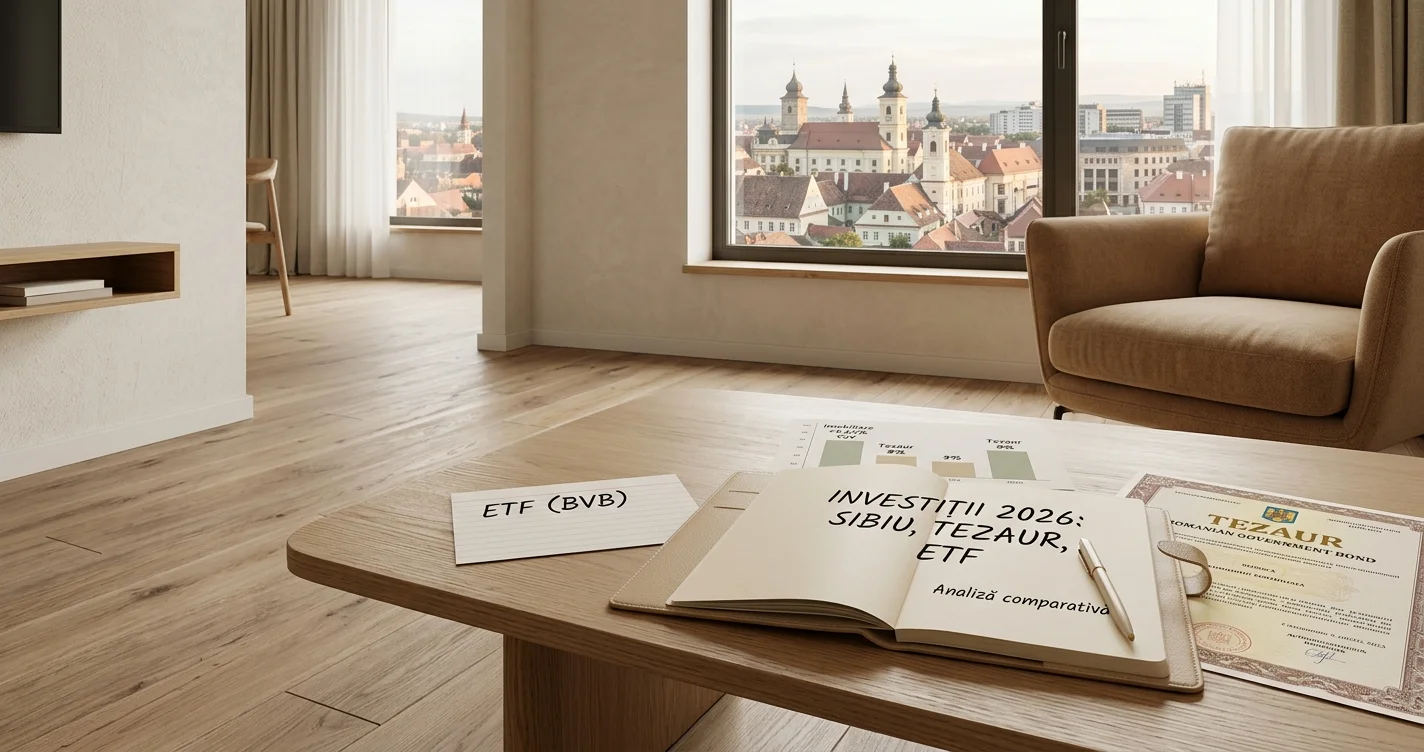
In 2026, the question is no longer whether you invest. The question is where you put your money so you can sleep soundly. Many seek a safe investment 2026 real estate vs alternatives, but get stuck between three popular options: apartment in Sibiu, Tezaur government bonds and ETFs. The real difference comes down to numbers and discipline. In Sibiu, the average asking price is 2,034 EUR/sqm (September 2026), according to Imobiliare.ro. The market shows +7.4% versus September 2025, also per Imobiliare.ro. And on activity, 936 transactions and 500 new mortgages in June 2026, per ANCPI, clearly indicate sustained demand. At the same time, interest rates remain high: IRCC 5.57% and ROBOR 3M 5.84%, per BNR. Let's put them side by side, no stories.
Key Takeaways
- Sibiu: average asking price 2,034 EUR/sqm in September 2026, per Imobiliare.ro.
- Trend: annual change +7.4% versus September 2025, per Imobiliare.ro.
- Activity: 936 transactions in June 2026, +26.7% versus June 2025, per ANCPI - transaction statistics.
- Lending: 500 new mortgages in June 2026, per ANCPI - mortgages.
- Interest rates and exchange rate: IRCC 5.57%, ROBOR 3M 5.84%, average EUR/RON rate 5.2498 (August 2026), per BNR - indicators.
Contents
- 1) The 2026 framework: interest rates, inflation, exchange rate and decision psychology
- 2) Real estate in Sibiu: market price, liquidity and appreciation
- 3) Tezaur: what you get in exchange for peace of mind
- 4) ETFs: diversification, volatility and discipline
- 5) Mixed strategy: how to combine real estate, Tezaur and ETFs
- 6) Practical checklist: how to choose a safe investment in 2026
- FAQ
1) The 2026 framework: interest rates, inflation, exchange rate and decision psychology
Interest rates change the rules of the game
In 2026, the cost of money is still high. Per BNR - reference interest rates, IRCC is 5.57%, and 3-month ROBOR is 5.84%. This shows directly in debt service. If you take a loan, the monthly payment becomes a hard filter. Many buyers look more carefully at location and zones with high liquidity.
At the same time, high interest rates can create a negotiation margin. Not everywhere, not always. But situations arise where the asking price drops toward the transaction price. This is where data-driven negotiation comes in, not impressions.
Inflation and exchange rate: two forces that bite differently
Inflation is 6.17% in August 2026, per INS - CPI inflation. In such a context, cash loses purchasing power. This is where the drive for a safe investment 2026 real estate vs alternatives comes from. People seek assets that can keep pace, at least partially.
On currency, you have a useful benchmark. The average EUR/RON rate in August 2026 is 5.2498, per BNR. If you save in lei but target an asset priced in euros, the rate matters. In Sibiu, many prices are quoted in euros per square metre. This changes your calculations, especially for the down payment.
What does "safe" mean in 2026, really
"Safe" does not mean risk-free. It means risk you understand and can manage. For some, safe means capital protection. For others, it means returns above inflation. And for investors, safe means having exit options. This is where liquidity and time to sale come in.
In real estate, safety comes from location, building quality and sustained demand. In Tezaur, safety comes from simplicity and predictability. In ETFs, safety comes from diversification and a long horizon. If you want to explore this topic, you need to choose what kind of safety you're looking for.
Local context: Sibiu as an investment city
Sibiu has a unique profile. It is a tourist, university and industrial city. It has historic areas, but also new neighbourhoods. For general context, it's worth reading Wikipedia - Sibiu, general information. In practice, this means mixed demand: residential, relocation, long-term rental and, in some cases, short-term rental.
From a market perspective, we have clear activity signals. In June 2026, there are 936 transactions in the county, per ANCPI. And 500 new mortgages, also per ANCPI. These are not prices, they are volumes. But volumes show that the market is not frozen. This matters when you want a quick exit, in a zone with high liquidity.
A short table with the benchmarks that matter
| Indicator | Value | Source |
|---|---|---|
| Average asking price Sibiu | 2,034 EUR/sqm | Imobiliare.ro, September 2026 |
| Annual variation Sibiu | +7.4% YoY | Imobiliare.ro, September 2026 |
| Monthly transactions (June 2026) | 936 (+26.7% YoY) | ANCPI |
| New mortgages (June 2026) | 500 | ANCPI |
| IRCC | 5,57% | BNR |
| ROBOR 3M | 5,84% | BNR |
| CPI inflation | 6.17% (August 2026) | INS |
| Average net salary, Sibiu county | 6.025 RON | Aggregated local data |
If you want to track local updates, visit Vianto Properties page on the real estate market. And for practical guides, check Vianto Properties blog.
2) Real estate in Sibiu: market price, liquidity and appreciation
Asking price vs transaction price: how to think correctly
In discussions on this topic, real estate is always in the top. But the first step is to separate asking price from transaction price. On the market you see listings, so you see asking price. In reality, the transaction closes at a transaction price, influenced by the negotiation margin, the seller's urgency and the property's quality.
In Sibiu, the average asking price is 2,034 EUR/sqm (September 2026), per Imobiliare.ro. This is a good benchmark for market price, at city level. It does not mean every apartment is worth that much. Location, floor, layout and building condition can change the outcome significantly.
Why liquidity matters: 936 transactions in one month
A strong argument for real estate is liquidity, in the right zones. Per ANCPI, in June 2026 there are 936 transactions in the county, with +26.7% versus June 2025. This suggests sustained demand and an appreciating market, even if some segments may show signs of cooling.
In practice, "high-liquidity zone" means places where things sell constantly. Not just "nice neighbourhood". Things sell constantly where you have good access, services, schools, transport and a stock that rotates. When limited available stock combines with sustained demand, good properties move fast.
Neighbourhoods in Sibiu: lifestyle and tenant or buyer profile
In Sibiu, neighbourhoods are not just points on a map. They are lifestyles. And for this analysis, it matters who will buy or rent your property.
- Historic Centre and Ultra-Central - urban life, cafés, walkability. Here the building and legal status matter a lot. For investment, check carefully the land register for a clean title and property extract without encumbrances.
- Strand - neighbourhood pace, good access, mix of apartment blocks and services. It is sought by families and people who want everything nearby, without city centre congestion.
- Hipodrom - dense, practical, with many points of interest. For long-term rental, it can be a zone with high liquidity, if you choose the building and location correctly.
- Turnișor - quieter atmosphere, with good access to work areas. It is attractive for those who want a balance between city and peace.
- Sub Arini - premium perception, close to nature. Here construction quality and parking matter a lot. Limited available stock appears often with good properties.
- Valea Aurie - green, walks, better air. It is a lifestyle oriented towards peace and space, good for families.
- Șelimbăr - dynamic, many new projects, quick access to retail. For investment, check the developer and documents carefully, plus management costs.
If you want to see real options, with photos and details, you can start directly from the Vianto Properties homepage. For applied discussions, you can request a recommendation on the contact page.
Real estate as investment: gross yield, net yield and real risks
Many buy for gross yield, but forget about net yield. Gross yield is what you collect before costs. Net yield is what remains after taxes, periods without a tenant, repairs and management. In 2026, the difference between the two can be large, especially if you have poor finishes or an association with problems.
I cannot put rent figures on property types without a dedicated database. But I can tell you the practical rule: yield comes from a good purchase and a good tenant. A good purchase means not paying just for the "story". You pay a market price, with negotiation discount where arguments exist.
Mortgage credit: first-rank mortgage and debt service
With interest rates like IRCC 5.57% and ROBOR 3M 5.84%, according to BNR, credit must be thought conservatively. If the investment depends on perfect rent, without breaks, risk increases. A safe investment means you can handle debt service even in slower months.
At the bank, you will have mortgage guarantee, usually first-rank mortgage. This is standard. Important is to have documents in order: property extract without encumbrances, property checks, and an authentic notarial deed at the end. If encumbrances or disputes appear, the whole timeline changes.
Table: Sibiu compared to other cities
| City | Price (EUR/sqm, September 2026, Imobiliare.ro) | Note |
|---|---|---|
| Cluj-Napoca | 3.316 | Highest level in the list |
| Brașov | 2.309 | Strong tourism, sustained demand |
| București | 2.312 | Large market, very different segments |
| Sibiu | 2.034 | Balance between demand and stock |
| Constanța | 2.020 | Seasonal in some areas |
| Iași | 2.000 | University centre, constant demand |
| Timișoara | 1.984 | Mature market, different pace |
| Oradea | 1.885 | Long-term growth, mixed profile |
Data are average requested prices, according to Imobiliare.ro (September 2026).
Mini case study: what a healthy negotiation looks like
Say you see an apartment in Strand or Hipodrom. The asking price is aligned with the market, but the property needs improvements. Here you have justified negotiation margin. You don't ask for negotiation discount "because that's how it's done". You ask for it with arguments: installations, finishes, lack of parking, floor, orientation.
In a zone with high liquidity, good properties sell. So negotiation has limits. But if limited available stock is real, you don't force it. You choose your battles. That makes the difference between investment and lottery.
Want to see what the market looks like, in your own terms? Go to Vianto Properties - real estate market. If you want applied articles, you have Vianto Properties - blog.
3) Treasury bonds: what you get in exchange for peace of mind
Why Treasury bonds seem like the "safe investment" classic
Treasury bonds are chosen by people who want simplicity. You don't want tenants, you don't want repairs, you don't want viewings. You want to know you put money somewhere and have a predictable result. In the discussion at hand, Treasury bonds win on peace of mind.
Still, you must pay attention to one thing: "safe" does not automatically mean "profitable above inflation". Inflation is 6.17% in August 2026, according to INS. If your yield does not keep pace, purchasing power decreases. This is not a tragedy, but it is a real cost.
Treasury bonds and opportunity risk
The big risk with Treasury bonds is opportunity risk. That is, you miss other opportunities while money sits locked. In real estate, you can have appreciation and capital gain, if the market stays in appreciation. In ETFs, you can have long-term growth, but with volatility.
Treasury bonds can be a good piece in a portfolio. Especially as a reserve, or as a defensive part. But if you choose it as the only solution, you must accept that you have no exposure to real local assets, like a home in a zone with sustained demand.
When Treasury bonds make sense, practically
- When you have a short horizon and want predictability.
- When you're saving a down payment for real estate and don't want volatility.
- When you want a buffer for debt service, if you have a loan.
- When you already have large real estate exposure and want balance.
Treasury vs real estate: the effort difference
Real estate requires work. Even with a good agent, you make decisions. You do checks, get a clean property register extract, discuss the notarial deed, and sometimes deadlines shift. Treasury requires almost zero effort. That's its value.
But real estate gives you control over a local asset. You can improve the property. You can increase its appeal. You can reduce risk through location and tenant selection. You can't do that with a passive instrument.
Table: how to simply compare the three options
| Criterion | Real estate (Sibiu) | Treasury | ETF |
|---|---|---|---|
| Control | High (location, renovation, tenant) | Low | Low |
| Liquidity | Medium, depends on the zone with high liquidity | Depends on instrument conditions | Usually high, but with volatility |
| Volatility | Lower in perception, but it exists | Very low | Higher |
| Effort | High | Very low | Low |
| Upside potential | Yes, if the market stays in appreciation | No | Yes, over the long term |
If you want to see how the local market moves, to decide between these options, start with Vianto Properties' analyses.
4) ETF: diversification, volatility and discipline
What the ETF solves for the busy investor
The ETF is the preferred solution for those who want diversification. You don't pick a single company. You pick a basket. In the logic of this topic, the ETF gives you a form of safety through dispersion. But it doesn't give you stability in the short term. That's where many get confused.
The ETF requires discipline. That means not selling at the first drop. If you can't tolerate fluctuations, you'll turn a good instrument into a bad experience. That's the reality, no moral judgment.
ETF and currency risk for Romanians
In 2026, the exchange rate matters. According to BNR, the average EUR/RON rate in August 2026 is 5,2498. If you invest in instruments denominated in euros or dollars, you also have the currency component. Sometimes it helps you. Sometimes it hurts you.
In real estate in Sibiu, many transactions are negotiated in euros. So you have indirect currency exposure there too. The difference is that you have a local, usable asset. You can live in it. You can rent it out. An ETF doesn't give you direct utility.
ETF vs real estate: volatility vs friction
The ETF has volatility. Real estate has friction. By friction I mean costs and time: viewings, deeds, notary, property transfer tax, possibly renovation. In return, real estate has less visible volatility. The price doesn't change daily on screen. But it changes through asking price and transaction price.
In an appreciating market, real estate can bring capital gains. But it can also have periods of orderly correction. Don't confuse orderly correction with a crisis. In 2026, we see that transactions are up, according to ANCPI. That suggests fundamentals remain solid, even if some segments may show signs of cooling.
When an ETF makes sense, practically
- When you want global diversification, without hassle.
- When you already have a home and don't want another property.
- When you want to invest monthly, disciplined.
- When you accept volatility and have a long horizon.
An example decision: investor from Sibiu, conservative profile
A conservative investor from Sibiu wants this approach. He has a local salary, and the average net salary in Sibiu county is 6.025 RON. He doesn't want stress. In such a case, a mix can be healthier: a defensive part, a growth part, and a part in local assets.
If he has no time for management, an ETF can be the growth part. If he wants stability, Tezaur can be the defensive part. If he wants control and utility, real estate can be the local part. The key is proportion, not ideology.
For local examples and buying guides, you'll find useful materials on the Vianto Properties blog. If you want to discuss your case, go to contact.
5) Mixed strategy: how to combine real estate, Tezaur and ETF
Why mixed strategy is, often, the safest one
This analysis doesn't have to be an exclusive choice. In fact, the most stable portfolios are mixed. The reason is simple: each instrument has a different risk. When you combine them, you reduce dependence on a single scenario.
Real estate depends on location, sustained demand and financing. Tezaur depends on instrument conditions and inflation. ETF depends on global markets and your discipline. There is no "risk-free". There is only risk distributed intelligently.
Real estate in Sibiu: how to choose the right area for investment
In Sibiu, I'd start with a question: do you want tenants or do you want appreciation on resale? Ideally you have both, but one dominates. For tenants, access and functionality matter. For appreciation, area perception and limited available stock matter.
Lifestyle examples, to choose more easily:
- Centru - for people who want the city on foot. Good for those who work downtown or love culture.
- Valea Aurie - for families who want green and quiet. Parking and access matter.
- Sub Arini - for those seeking a premium profile. Here, supply shortage often appears for good properties.
- Ștrand - balance between access and comfort. Good for living and long-term rent.
- Turnișor - more relaxed, with good access to exits. Good for practical people.
- Șelimbăr - new projects, retail nearby. Good for those who want new and parking.
Tezaur as a reserve: "airbag" for credit and opportunities
If you have a loan, Tezaur can function as a reserve for debt service. It's not a spectacular idea, but it's a mature one. In periods with high interest rates, like IRCC 5,57% and ROBOR 3M 5,84% (BNR), the reserve gives you time. And time means better decisions.
Plus, the reserve helps you negotiate. When you're not under pressure, you don't pay the asking price just to "close". You can wait for a property with good location and clean land register.
ETF as growth engine: the rule of discipline
The ETF is the growth engine, if you use it correctly. That is, you invest constantly, not emotionally. In August 2026, inflation is 6,17% (INS). That puts pressure on any strategy. If you stay only in cash, you lose. If you go only into volatility, you can get scared. Mixed strategy reduces extremes.
Table: how each instrument fits your objectives
| Goal | Real estate (Sibiu) | Treasury | ETF |
|---|---|---|---|
| Perceived stability | Medium to high | High | Low in the short term |
| Protection against inflation | Possible, if the market remains in appreciation | Depends on return vs inflation | Possible in the long term |
| Direct utility | Yes (living, rent) | No | No |
| Requires time and management | Yes | No | Little |
| Quick exit | Depends on high-liquidity area | Depends on conditions | Usually yes, but at market price |
A realistic scenario: how to avoid bad decisions
You have three classic mistakes I see often. First: you buy real estate just because "it keeps getting more expensive". Second: you put everything in defensive instruments and stay below inflation. Third: you enter ETF expecting quick gains and sell at the first drop.
Instead, a good strategy starts with budget, horizon and risk tolerance. If you want a face-to-face discussion, define "safe" for you. Then you build the mix.
Want to see which properties make sense as an investment, in high-liquidity areas? Go to Vianto Properties and ask for a short selection, by budget and objective.
6) Practical checklist: how to choose a safe investment in 2026
Checklist for real estate: from location to notarized deed
If you choose real estate, treat the purchase as a project. Not as an emotion. In Sibiu, the market is active, with 936 transactions in June 2026, according to ANCPI. That means competition for good properties. So you need a clear process.
- Location: choose a reference area, with access and services.
- Liquidity: look for high-liquidity area, not just "nice".
- Price: compare asking price with market price, not wishes.
- Negotiation: ask for negotiation discount only with verifiable arguments.
- Deeds: ask for land register extract without encumbrances and check history.
- Notary: finalize with notarized deed, no improvisation.
- Costs: budget property transfer tax and related costs.
Checklist for Treasury: what you verify before you lock in the money
- Your horizon: do you need money in the coming months?
- Purpose: reserve, down payment, or defensive component?
- Inflation: is 6.17% in August 2026 (INS). Compare with your target.
- Alternative: do you already have exposure to real estate or ETF?
Checklist for ETF: how to avoid emotional volatility
- Invest consistently, not "on impulse".
- Accept that price moves daily.
- Think in years, not weeks.
- Keep track of exchange rate: average 5.2498 in August 2026 (BNR).
Signals from the local real estate market: how to read them correctly
In 2026, we see an active market. Transactions are up, according to ANCPI. New mortgages were 500 in June 2026, also according to ANCPI. This shows that financing exists, even if interest rates are high. At the same time, the average asking price is 2,034 EUR/sqm, according to Imobiliare.ro, with +7.4% versus September 2025.
What does this mean for you? It means the market is appreciating, but not without friction. Some segments may show signs of cooling, especially where the asking price has been pushed too high. This can create an orderly correction, not a crash. Fundamentals remain solid, as long as demand is high and the city remains attractive.
A useful table: quick benchmarks for decision in Sibiu
| Question | If the answer is "YES" | Likely direction |
|---|---|---|
| Do you want control and direct utility? | Can you manage tenants and maintenance | Real estate |
| Do you want predictability and minimal effort? | You don't want volatility | Treasury |
| Do you accept fluctuations for diversification? | You have a long horizon | ETF |
| Do you have a loan or a loan plan? | Interest rates are high (BNR) | Reserve + caution with debt service |
If you want to make a decision based on local data, not rumours, follow the real estate market on Vianto Properties. For guides and explanations, visit our blog.
FAQ - Frequently Asked Questions
1) What is the safest real estate investment in 2026 vs others, for a beginner?
It depends on what you call "safe". If you want minimal effort and predictability, Treasury bonds may be more comfortable. If you want control and a local asset, real estate can be suitable, especially in areas with high liquidity. If you want diversification and accept volatility, ETFs are a good option. Ideally, a mix is best, so you don't depend on a single scenario.
2) Does it still make sense to buy in Sibiu in 2026, at 2.034 EUR/sqm?
The average asking price is 2.034 EUR/sqm (September 2026), according to Imobiliare.ro. That doesn't mean every property is worth it. It makes sense if you find a good location, in a reference area, and if the asking price is close to the market price. Negotiation must be backed by arguments. Also, check the documents carefully and get a land register extract without encumbrances.
3) What does it tell me that there were 936 transactions in June 2026?
According to ANCPI, 936 transactions in June 2026, with +26.7% compared to June 2025, shows an active market. It doesn't directly tell you the transaction price, because ANCPI doesn't publish prices. But it tells you there is demand and properties are moving. For investment, that matters at exit. In areas with high liquidity, selling time tends to be better.
4) How does IRCC 5.57% and ROBOR 3M 5.84% affect me if I take a loan?
According to BNR, IRCC 5.57% and ROBOR 3M 5.84% mean high cost of money. This increases your debt service and reduces your eligible budget. In practice, you need to be more careful with the down payment, debt ratio and safety reserve. If the investment depends on uninterrupted rent, the risk increases. A healthy approach is conservative.
5) What checks are mandatory before buying, to make it a safe investment?
First, check a clean land register and request a land register extract without encumbrances. Then verify the owner's identity and history. Look at the location and reference area, to ensure liquidity. Negotiate based on actual condition, not emotions. And finally, close the transaction with a notarial deed. Don't skip steps, even if you're in a hurry.
6) How do I choose between Centru, Ștrand, Hipodrom, Turnișor, Sub Arini and Șelimbăr for investment?
Choose based on the tenant or final buyer profile. Centru is for urban lifestyle and walkability, but requires attention to building and legal status. Ștrand and Hipodrom are more practical, with steady demand for living. Turnișor is quieter, good for balance. Sub Arini has a premium profile and sometimes a supply shortage. Șelimbăr attracts with new projects and retail access.
Conclusion: how to choose without regret in 12 months
If you want a safe real estate investment in 2026 vs others, don't look for the perfect answer. Look for the right decision for you. In Sibiu, the average asking price is 2.034 EUR/sqm, with +7.4% compared to September 2025, according to Imobiliare.ro. Activity is high, with 936 transactions and 500 new mortgages in June 2026, according to ANCPI. This supports the idea of sustained demand, even if the market may show signs of cooling on certain segments.
Treasury bonds can offer you peace and order. ETFs can offer you diversification, but require discipline. Real estate can offer you control, utility and appreciation potential, but require work and attention to detail. For many, the mature solution is the mix. A defensive part, a growth part, a part in local assets.
If you want to discuss it in practical terms, on budget and objective, visit Vianto Properties. You can also follow our analysis on the real estate market and guides on our blog.
Looking for advice on a real estate investment in Sibiu? The Vianto Properties team is available to help you with personalized recommendations. Contact us at +40 791 710 606 or office@vianto.ro, or explore our available properties directly on the site.
Vianto Properties offers in Sibiu:
The correct selling price is determined by comparable transactions in your area, not by the asking prices in nearby listings. You can request a free property evaluation, with a response within 24 hours, or you can discuss with the Vianto Properties team before you decide.