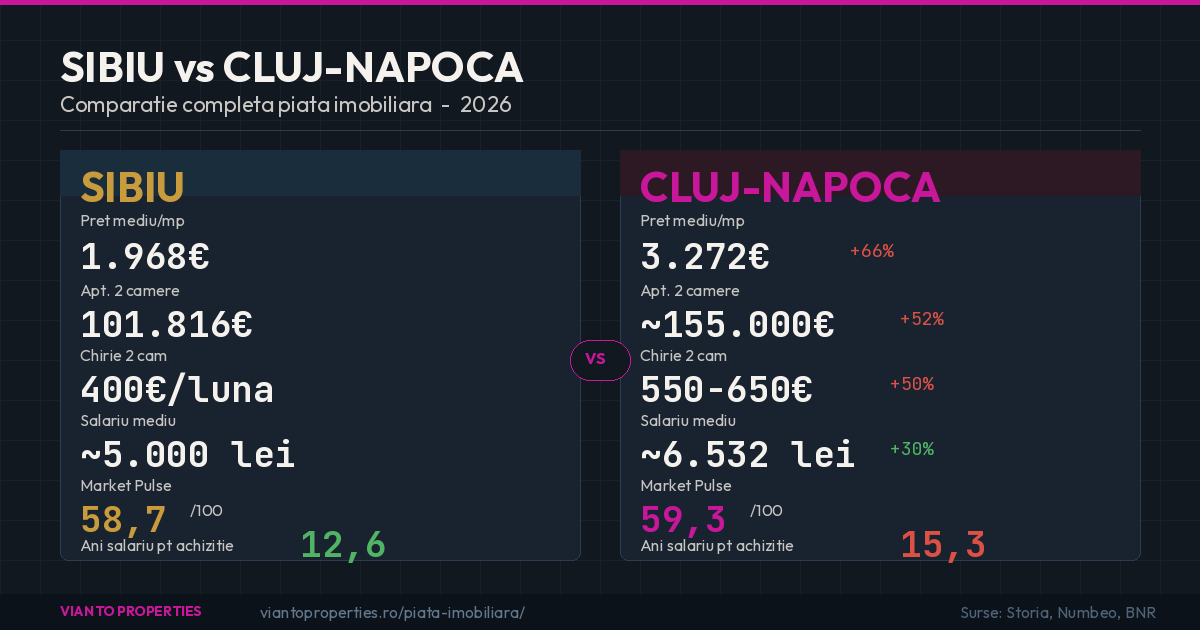
Two markets, two realities - why comparison matters
Cluj-Napoca and Sibiu are separated by 275 km of motorway (under construction) and a 63% price difference. One square metre in Cluj costs €3,316 - in Sibiu, €2,034 (September 2026, Imobiliare.ro). But raw figures don't tell the whole story.
Both cities are located in Transylvania, both attract investors and professionals, both have diversified economies and high quality of life. Nevertheless, real estate markets operate according to different logic, with distinct risks and opportunities.
This article compares the two markets across 8 concrete dimensions - from prices and rents to salaries, cost of living, infrastructure and demographic trends. No subjective opinion, only verified data from public sources, updated in September 2026.
Sale prices - 63% difference
According to Imobiliare.ro (September 2026), with prices per room estimated on typical areas, the two markets look like this:
| Indicator | Sibiu | Cluj-Napoca | Difference |
|---|---|---|---|
| Average price/sqm | 2.034 € | 3.316 € | +63% |
| 2-room apartment | ~101.700 € | ~165.800 € | +63% |
| 3-room apartment | ~142.400 € | ~232.100 € | +63% |
| Annual change (2025 vs 2024) | +10% | +8% | - |
Cluj-Napoca remains Romania's most expensive real estate market - more expensive than Bucharest (€2,312/sqm) and well above the national average. Sibiu ranks 4th in the urban ranking, after Cluj, Brașov and Bucharest.
Why are prices so different?
The difference is not explained by a single factor, but by the convergence of multiple elements. Cluj-Napoca has become "Romania's Silicon Valley" - with over 15,000 professionals in the IT sector, a mature entrepreneurial ecosystem and top universities that attract a constant flow of young people. Demand has consistently outpaced supply over the past decade, and prices have responded accordingly.
Sibiu has a diversified economy, but with a different structure. German companies represent about 15% of local business (Continental, Marquardt, Siemens), and major state-owned companies - ROMGAZ (7.5 billion lei turnover, over 5,000 employees) and TRANSGAZ (2.2 billion lei, approximately 4,000 employees) - are the stable pillars of the economy. However, the IT sector is smaller than in Cluj, and average salaries reflect this difference.
Salaries and purchasing power
The price of an apartment becomes relevant only in relation to local income. Here's how the two markets compare:
| Indicator | Sibiu | Cluj-Napoca |
|---|---|---|
| Average monthly net salary | ~6,025 lei | ~6,532 lei |
| Average net annual salary | ~72,300 lei | ~78,384 lei |
| Average price 2-room apartment | ~533,900 lei | ~870,400 lei |
| Years of average salary for purchase | ~7.4 years | ~11.1 years |
Sibiu requires 33% less time (relative to average local salary) to purchase a comparable apartment. In other words, even though the average salary is 8% lower, housing affordability is significantly better in Sibiu.
This price-to-income ratio is one of the most relevant indicators of the health of a real estate market. A much higher ratio (as is the case in Cluj, at 11.1 years) indicates a tight market, where prices have partially decoupled from local economic fundamentals. A ratio of 7.4 years (Sibiu) suggests a more balanced market.
Rents - same trend, different proportions
| Type | Average rent Sibiu | Average rent Cluj | Difference |
|---|---|---|---|
| Studio apartment | 300 € | ~400 € | +33% |
| 2-room apartment | 400 € | 550-650 € | +40-60% |
| 3-room apartment | 500 € | 700+ € | +40% |
Rents in Cluj are 30-60% higher than in Sibiu, but the rent-to-salary ratio is different. In Sibiu, a rent of €400 for 2 rooms represents about 35% of the average salary. In Cluj, a rent of €600 represents about 48% - above the 30% threshold recommended by financial experts.
Gross rental yield in Sibiu is approximately 4.7% for 2 rooms, and in Cluj higher rents are offset by the higher entry price. The difference is small and does not compensate for the higher risk of investing in a market with tight prices.
Cost of living - 17-20% difference
According to Numbeo data updated for 2026, the overall cost of living in Sibiu is 17-20% lower than in Cluj-Napoca. The difference is evident in all major categories:
| Category | Sibiu vs. Cluj |
|---|---|
| Housing (rent + purchase) | 25-40% cheaper |
| Restaurants | 10-15% cheaper |
| Transport | 10-15% cheaper |
| Food | 5-10% cheaper |
| Sports and leisure | 10-15% cheaper |
To maintain the same standard of living, a family needs approximately 13,200 lei/month in Sibiu, compared to 16,000 lei/month in Cluj. The difference of 2,800 lei/month (approximately 530 €) is significant over the long term.
Market dynamics - Market Pulse score
Market Pulse is an index we developed at Vianto Properties, calculated through principal component analysis (PCA) on 6 indicators from 7 official sources and over 130,000 data points. It provides a synthetic picture of real estate market health - not just price.
| City | Market Pulse score (December 2025) | Interpretation |
|---|---|---|
| Cluj-Napoca | 59,3/100 | Moderate market, positive dynamics |
| Sibiu | 58,7/100 | Moderate market, positive dynamics |
| București | 39,3/100 | Market in moderation |
The result is revealing: Cluj and Sibiu have almost identical market dynamics (a difference of only 0.6 points), but at radically different price levels. This suggests that both markets are governed by similar forces - sustained demand, limited supply, solid economic fundamentals - but that Sibiu offers this dynamic at an entry price 39% lower.
A high price is not synonymous with a healthy market. And an affordable price does not automatically mean a weak market.
Economy and employers - different structures, similar resilience
Cluj-Napoca - Romania's IT engine
Cluj has reinvented itself over the past two decades as a technology hub. The IT sector employs over 15,000 professionals, IT salaries exceed 10,000 lei net/month, and the entrepreneurial ecosystem is the most developed in the country. Cluj was named the fastest-growing city in the EU over the past two decades.
Advantages: high salaries (which support real estate demand), diversification in financial services, education and construction, and a steady flow of young professionals from across the country. Disadvantage: relative dependence on the IT sector, which is sensitive to global technology investment cycles.
Sibiu - industrial stability and diversification
Sibiu's economy is anchored in the industrial sector (automotive, energy, logistics) and state-owned companies with billion-euro turnovers. German companies bring 15% of local business and have invested heavily in production infrastructure.
Advantages: resilience to economic cycles (energy and industry are more stable than IT during recessions), competitive operating costs and strategic geographic position (logistics hub between West and East). Disadvantage: lower average salaries, less developed IT sector and some dependence on decisions by large German corporations.
Both economies have distinct strengths. Cluj performs during periods of global economic boom (especially in tech). Sibiu performs in stability and resists better during periods of contraction.
Infrastructure and development projects
Cluj-Napoca
Infrastructure projects in Cluj-Napoca are ambitious and well-funded. The modernization of the Cluj-Oradea railway received funding in the 2026 budget, and the TransRegio Feleac metropolitan network (29.87 km) is under construction. The metro project remains on the agenda, but with a realistic timeline after 2030. Also, RIVUS Cluj-Napoca - an urban regeneration project worth over 500 million euros on the former Carbochim site - has entered construction.
Sibiu
Sibiu is betting on the Sustainable Urban Mobility Plan (SIBIU SMART, 2021-2030) and road connections - especially the Sibiu-Pitești Highway and the Sibiu-Făgăraș road, both national priorities. The Gușterland project (recreation and ecotourism complex) and the ULBS dual education campus are under construction.
The scale difference is visible: Cluj-Napoca is investing billions in urban and metropolitan infrastructure, while Sibiu is investing tens of millions in local projects. However, the relative impact on the real estate market can be comparable - Sibiu starts from a much lower price base, where even moderate investments can generate significant percentage appreciation.
Demographics - the critical factor
This is probably the most underestimated factor in long-term real estate market analysis.
| Indicator | Sibiu | Cluj-Napoca |
|---|---|---|
| Urban population (2026) | ~135.000 | ~308.000 |
| Annual trend | -0,56% | stable (0%) |
| Metropolitan area | ~190.000 | ~500.000 |
| Metropolitan trend | stable | +5%/year (periphery) |
Sibiu is losing population at the urban level (-0.56% per year), caused by migration of young people to cities with higher salaries (including Cluj) and natural demographic decline. Cluj-Napoca is stable at the urban level, but growing rapidly at the metropolitan level - active suburbanization, with expansion along the Florești, Apahida, Baciu axes.
In the long term (10-20 years), demographics directly influence real estate demand. A declining population implies declining demand - which puts pressure on prices. Sibiu partially compensates by attracting industrial investment and tourism, but the demographic trend remains a risk factor for investors on a long horizon.
Quality of life - what is not reflected in price
The real estate market does not function in isolation from quality of life. And here, the difference between the two cities is smaller than prices suggest.
Safety and cleanliness
Both cities rank among the safest in Romania. Sibiu has a perceptual advantage in terms of urban cleanliness and order - the historic centre is exceptionally well-maintained, and the city's smaller size allows for more efficient administration. Cluj-Napoca has invested heavily in smart city infrastructure, but rapid growth has put pressure on public services.
Tourism and cultural life
Sibiu was European Capital of Culture in 2007 and remains one of the most visited cities in Romania. The International Theatre Festival (FITS), Sibiu Jazz Festival, Christmas market - all generate constant tourist flow that supports the local economy. Cluj has TIFF (Romania's most important film festival), Untold and Electric Castle - international-scale events that attract hundreds of thousands of participants.
From a real estate investor's perspective, Sibiu's cultural tourism creates specific opportunities for short-term rental (Airbnb), especially in the historic centre and areas with easy access to tourist attractions.
Education and healthcare
Both cities have major universities. Babeș-Bolyai University (Cluj) is consistently ranked first in Romania, and Lucian Blaga University (Sibiu) was ranked 2nd for education quality in the THE 2025 ranking. The medical system is competitive in both locations, with university teaching hospitals and modern infrastructure.
Nature and outdoor activities
Sibiu has a significant natural advantage: Transfăgărășan, Munții Făgăraș, Păltiniș (the only ski resort in Sibiu county, 30 minutes from the city), Pădurea Dumbrava and the Astra open-air museum. Cluj has Tarnița, Răchitele and proximity to the Apuseni Mountains, but the distance to major mountain areas is greater.
For families who prioritize quick access to nature and mountain activities, Sibiu offers a clear advantage - and this is reflected in the city's attractiveness to professionals working remotely.
Zone comparison - where you position yourself with the same budget
To make the comparison more concrete, here's what you can get in equivalent zones in the two cities:
Central / premium zone
In central Sibiu, a renovated 2-room apartment sells above the city average. In central Cluj, an equivalent apartment costs much more, especially in premium zones (Grigorescu, Europa). In both cases, rents in the centre are the highest in the city - but the location premium is more accessible in Sibiu.
Popular residential zones
Hipodrom (Sibiu) vs. Mărăști/Zorilor (Cluj): a 2-room apartment with 55-60 sqm costs in Hipodrom around the city average, and in Mărăști or Zorilor significantly more. Both zones are well served by public transport, with access to schools, parks and shopping centres.
Periurban / developing zones
Șelimbăr (Sibiu) vs. Florești (Cluj): both are metropolitan expansion zones with dominant new construction. Șelimbăr offers new apartments. Florești - Romania's densest periurban zone - offers similar apartments. The price difference is smaller here, but Florești's infrastructure is notoriously undersized for population density.
Non-financial factors influencing the decision
The decision to invest (or live) in Sibiu or Cluj is not just about the financial figures. There are a few subjective, but important factors:
Pace of life
Sibiu is a compact city, which you can traverse in 20-25 minutes by car. Traffic exists, but is not comparable to the congestion in Cluj (especially on the Florești-centre and Mănăștur-centre axes). For families and those who value short commute time, Sibiu offers a clear advantage.
Professional network
Cluj-Napoca has Romania's most developed networking ecosystem - tech conferences, startup communities, coworking hubs, business events almost daily. If your career depends on professional connections and presence in the business community, Cluj offers a density of opportunities that Sibiu (for now) cannot match.
Long-term personal plans
If you're investing to live, choose the city where you see yourself in 10-15 years. If you're investing purely financially (rental yield or appreciation), choose based on the figures. The two logics can lead to different conclusions - and both are valid.
Case studies: 100,000 € investment in each market
Let's compare concretely what you get with a 100,000 € budget invested in real estate in each city.
Sibiu - 100,000 €
With 100,000 € you can purchase a 2-room apartment (old construction, 50-55 sqm, renovated) in areas such as Hipodrom, Ștrand or Vasile Aaron. Estimated rent: 380-420 €/month. Gross yield: 4.6-5%. On cash purchase, net yield (after taxes, vacancy, repairs) is approximately 2.4-2.8%. Alternatively, you can purchase a studio apartment (new construction, 35-40 sqm) in a residential complex, with estimated rent of 300-320 €/month and gross yield of 3.6-3.8%.
Cluj - 100,000 €
With 100,000 € in Cluj, options are significantly more limited. You can purchase a studio apartment of 25-35 sqm in the peripheral zone (Florești, Baciu) or a 2-room apartment of 40-45 sqm in less central neighbourhoods, probably requiring renovation. Estimated rent: 350-400 €/month. Gross yield: 4.2-4.8%. Property quality and location are inferior to what you get for the same amount in Sibiu.
Case study
At the same budget, Sibiu offers a superior quality property, in a better location, with comparable or slightly higher yield. Cluj offers greater appreciation potential in the long term - but at higher risk and with a visible compromise on property quality.
If the budget exceeds 150,000 €, the calculation changes: in Cluj you can access good quality properties in central zones, and appreciation potential becomes more relevant. Below this threshold, Sibiu objectively offers more value.
Market-specific risks
Cluj market risks
High entry price is the main risk. At 3,316 €/sqm, the correction margin in a negative scenario (recession, global IT crisis, demand decline) is significant. A 15% correction in Cluj means a loss of approximately 25,000 € on a 2-room apartment - equivalent to approximately 3.5 years of gross rent.
The price-to-income ratio of 11.1 years average salary indicates a tight market, dependent on continued IT salary growth. If the global tech sector enters a decline cycle (mass layoffs, budget cuts - as partially happened in 2023), the impact on Cluj's real estate demand would be proportional.
Sibiu Market Risks
Demographic decline (-0.56%/year) is the main long-term risk. A shrinking population implies potentially declining demand. Sibiu partially compensates by attracting industrial investments (automotive, energy), but the demographic trend remains a structural negative factor.
The second risk: dependence on major corporate decisions. If Continental or Marquardt were to relocate production, the impact on the labour market (and implicitly on real estate demand) would be significant. This risk is lower in Cluj, where the economy is more diversified and less dependent on a few large employers.
Trends 2026-2028 - What We Anticipate
Cluj-Napoca
Prices will continue to rise, but more slowly than in 2024-2025. Infrastructure projects (RIVUS, railway, metropolitan network) will support demand in the medium term. The premium segment and office sector will be best positioned. The risk of correction remains if interest rates do not fall significantly or if the global IT sector contracts.
Sibiu
Stabilization in 2026, with potential for moderate growth (3-5%/year) in 2027-2028 if the Sibiu-Pitești motorway advances significantly. The new construction segment will perform better than the existing stock. Rents will remain stable, with pronounced segmentation between energy-efficient and inefficient apartments. Tourism and remote work will remain positive factors.
Which city suits each investor profile best
Sibiu - the pragmatic investor
Sibiu is suitable if you have a tighter budget (under €120,000 for a 2-room apartment), seek affordability and diversification (you can buy 2 apartments in Sibiu at the price of one in Cluj), prioritize rental yield (even if modest, it is positive on cash purchase), or if you have local knowledge and can identify opportunities below market price.
Main risk: long-term demographic decline and limited potential for aggressive price appreciation.
Cluj - the appreciation investor
Cluj is suitable if you have a larger budget (€150,000+ for a decent apartment), invest long-term (10+ years) and count on appreciation, want exposure to the IT sector and Romania's most dynamic urban economy, or if you can tolerate volatility and sustain larger negative cash flow.
Main risk: high entry price, tight price/income ratio and sensitivity to global IT cycles.
Diversification - the rational option
If you have sufficient capital, the most rational approach is diversification: exposure in both markets or combining real estate with financial instruments (government bonds, ETFs). Concentrating all capital in a single apartment, in a single city, is the opposite of diversification - no matter how "safe" that city seems.
What You Should Monitor - Indicators That Matter
Regardless of which city you choose, a few indicators must be constantly monitored to correctly assess the timing of entry (or exit) from the market.
Transaction volume - the first signal of a change in direction. If volume declines consistently for 3-6 consecutive months, prices will follow with a lag of 6-12 months. In Sibiu, volume fell 7.5% in February 2026 versus 2025 - a sign of cooling, not collapse, but worth monitoring closely.
Price/income ratio - the affordability indicator. If it exceeds 15 years of average salary, the market enters overheating territory. Cluj is at 11.1, and Sibiu at 7.4 - balanced zone.
IRCC and BNR key rate - determine the cost of loans and implicitly purchasing power. Any 1 percentage point decrease in the BNR key rate translates to approximately €40-50 less per month on the rate for a standard loan.
New housing supply - the number of building permits and completed dwellings. A wave of new supply can put pressure on prices, especially in the standard segment (not premium).
Market Pulse Score - the synthetic index we developed at Vianto Properties, calculated from 6 indicators and 7 sources. Available free on viantoproperties.ro/piata-imobiliara/ for all 42 counties.
Frequently Asked Questions
Is Sibiu cheaper than Cluj for buying an apartment?
Yes, significantly. The average price per square metre in Sibiu (€2,034, September 2026) is 39% lower than in Cluj-Napoca (€3,316). A 2-room apartment costs approximately €101,700 in Sibiu versus approximately €165,800 in Cluj. The price difference is larger than the salary difference (8%), making Sibiu more affordable relative to local incomes.
Where is the yield better - Sibiu or Cluj?
Gross rental yield is approximately 4.7% in Sibiu for a 2-room apartment, and in Cluj higher rents are offset by the higher entry price. The difference is small, and the risk associated with the much higher entry price in Cluj offsets this marginal advantage. On loan purchase, both markets generate negative cash flow in 2026.
Which city will grow more in value?
No one can predict with certainty how prices will evolve. Cluj has the advantage of IT dynamics and metropolitan growth. Sibiu has the advantage of a low price base and a favourable price/income ratio. In December 2025, both markets had similar Market Pulse scores (58-59/100); in June 2026, Sibiu's score dropped to 29/100.
Can I invest in both markets simultaneously?
Yes, and this is probably the most rational approach for investors with sufficient capital. Geographic diversification reduces concentration risk and provides exposure to different economic profiles (IT in Cluj, industry and tourism in Sibiu).
Conclusion
Cluj and Sibiu are not mutually exclusive markets - they are complementary markets, each with specific advantages. Cluj offers appreciation potential and exposure to Romania's most dynamic urban economy. Sibiu offers affordability, solid fundamentals and a favourable price/income ratio.
The only real mistake is to buy without calculating, regardless of city. Numbers don't lie - but they must be read correctly.
All market data for Sibiu and the other 42 counties, updated monthly from 7 official sources and over 130,000 data points, are freely accessible on viantoproperties.ro/piata-imobiliara/.
Considering a real estate investment in Sibiu? The Vianto Properties team offers free consultancy based on up-to-date data. Contact us at +40 791 710 606 or office@vianto.ro.
Explore Vianto Properties offers:
Vianto Properties offers in Sibiu:
The correct selling price is determined by comparable transactions in your area, not by the asking prices in nearby listings. You can request a free property evaluation, with a response within 24 hours, or you can discuss with the Vianto Properties team before you decide.