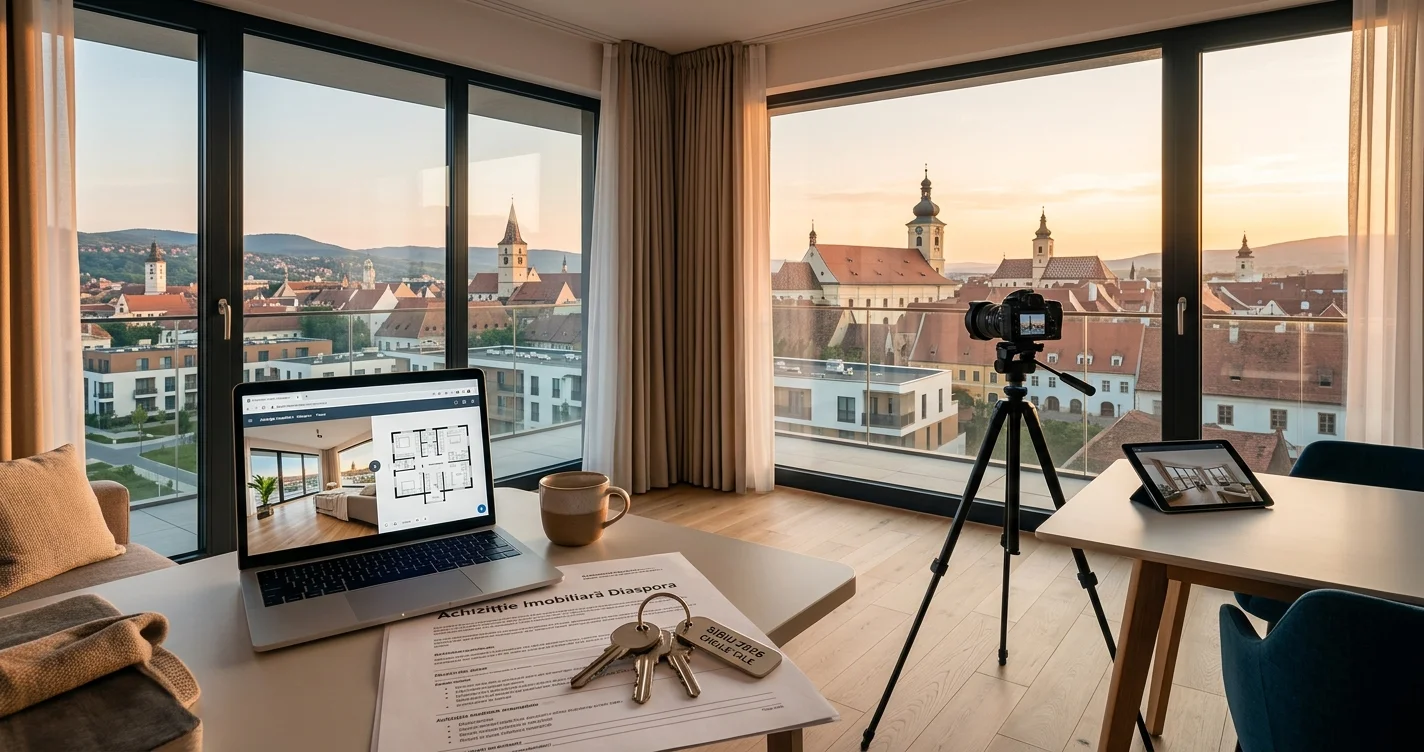
An agency that manages diaspora property purchases in 2026 is one that can handle the entire process from start to finish. No unnecessary trips to the country. No "send me another photo" and no surprises at the notarial deed. If you're abroad and want to buy in Sibiu, you need a partner who works clearly: verifies the property, negotiates the margin, coordinates the bank and notary, then hands you the keys with a handover report. That means, in practice, diaspora property purchases done professionally. The most realistic catch? The classic mistake: people choose based on "low commission", not risk control. And at a distance, risks cost the most.
- Choose the agency by process: verifications, reporting, negotiation, notary-bank coordination, handover.
- Request a written plan for diaspora property purchases: steps, deadlines, documents, responsibilities.
- Don't skip legal verifications: land register extract without liens, mortgages, restrictions, document history.
- You want efficiency at a distance: video tour, technical sheet, defect checklist, indicative quote.
- Negotiation is based on data: asking price vs market price, possible appreciation, limited available stock.
- Signing can be organized legally: power of attorney, signature, notarial appointment, traceable payments.
Contents
- 1) What it means for an agency to manage diaspora property purchases
- 2) Clear criteria to choose the right agency
- 3) Complete process: from brief to keys, no unnecessary trips
- 4) Legal and technical verifications: what you cannot skip
- 5) Sibiu: neighbourhoods, lifestyle and how to choose the right location
- 6) Negotiation, financing and notarial deed: how to coordinate them from abroad
- Frequently Asked Questions
1) What it means for an agency to manage diaspora property purchases
The difference between "I'll show you apartments" and "I'll manage your purchase"
In 2026, many agencies can open doors. Few can manage the purchase completely, especially for diaspora. The difference is process control. A good agency doesn't just send you links. It translates the market into simple decisions. It shows you the risks and hidden costs. It tells you what document is missing and who gets it.
For diaspora property purchases, the agency becomes your "hand" in Sibiu. That means: efficient viewings, verifications, negotiation, coordination with the notary, bank and appraiser. Plus, predictable communication. Not random messages, but short reports with conclusions.
What deliverables you should receive, concretely
A good sign is when the agency tells you from the start what you get. Not just "we'll take care of it". Here are the deliverables I consider standard for diaspora property purchases:
- Purchase brief: budget, purpose, areas, deal-breakers.
- Short list: 5-10 filtered options, not 50 links.
- Video tour and relevant photos: light, view, surroundings, staircase.
- Technical sheet: year, layout, utilities, orientation, noise risk.
- Market report: asking price vs market price, negotiation margin.
- Legal checklist: land register extract without liens, deeds, property history.
- Transaction plan: preliminary agreement, financing, notarial deed, handover.
Why diaspora needs a stricter process
At a distance, you don't have the luxury of "I'll go see it again". Or the luxury of "I'll ask the neighbour". That's why the process needs to be stricter than for a local buyer. Plus, specific details come up: power of attorney, time zone differences, international payments, translated documents, notarial appointments.
An agency that truly manages diaspora property purchases reduces your decision risk. And it reduces your time spent. Instead of getting lost in details, you receive validated options. Then you choose informed.
Where things usually break down
From experience, long-distance transactions get stuck at three points:
- Incomplete documents: missing deeds, liens appear, discrepancies arise.
- Weak negotiation: asking price is confused with transaction price.
- Weak coordination: bank, notary and seller are not aligned.
If the agency has a transaction manager, things flow. If not, you end up doing project management from abroad. And that's exhausting.
For local context and useful guides, you can also follow Vianto resources: Vianto Properties blog and the page about Sibiu's real estate market.
2) Clear criteria to choose the right agency
1) Real expertise in diaspora property acquisitions
Ask directly: "How many diaspora client transactions have you handled in the past year?". You don't need public figures. You need clarity. An agency experienced with diaspora knows the steps. Knows how to prepare a power of attorney. Knows how to prepare the bank file. Knows how to handle handover when you're not in the country.
Plus, it knows how to communicate concisely. Diaspora has no time for stories. It needs conclusions and options.
2) Transparency: contract, commission, representation
You want to know from the start who the agency represents. Representation matters. If the agency works for the seller, its goal is the highest asking price. If it represents you, its goal is market price and realistic negotiation discount.
Ask for a clear contract. Ask what the commission includes. Ask what it doesn't. In diaspora property acquisitions, "doesn't include" can mean many lost hours.
3) Legal verification system: the mandatory minimum
There is no safe transaction without legal verification. The agency must know how to request documents and read them. Not instead of the notary, but before the notary. So you don't end up at the notarial deed and find something is missing.
Minimum checklist:
- land register extract without encumbrances or with explained and removable encumbrances;
- deed of ownership and transfer history;
- cadastral status and land registration;
- verification of first-rank mortgage, if any;
- verification of prohibitions and litigation, where applicable.
4) Coordination capacity: notary, bank, appraiser, developer
A good agency has a "transaction calendar". Knows when to order the extract. Knows when the appraiser comes in. Knows when the preliminary agreement is signed. Knows when the deposit is paid. Knows how to sync everything so you don't lose the property.
In areas with high liquidity, good properties move fast. And in periods with limited available stock, delay costs you opportunities.
5) Reporting: how to tell if the agency is "on the job"
Set a reporting format from the start. Simple, repeatable, easy to read. For example:
- weekly update with status on each property;
- conclusion: "worth it / not worth it" and why;
- next step and who does it;
- missing documents and deadline.
If you only get messages like "found something else", it's not enough. In diaspora property acquisitions, communication discipline is part of the service.
Table: quick agency selection checklist
| Criterion | Simple question | Good answer |
|---|---|---|
| Diaspora experience | What processes do you have for clients abroad? | Clear steps, deliverables, deadlines, examples. |
| Legal verifications | What do you verify before the preliminary agreement? | Land register extract, deeds, cadastre, encumbrances, risk. |
| Negotiation | What do you base your negotiation on? | Asking price vs market price, comparables. |
| Coordination | Who stays in touch with the notary and bank? | A dedicated contact, with calendar. |
| Reporting | How often do I get updates? | Weekly, plus alert on changes. |
3) The complete process: from brief to keys, no unnecessary trips
Step 1: the right brief, so you don't search for months
A good brief saves you time. And money. In diaspora real estate purchases, the brief needs to be stricter than "2 rooms, nice". Discuss with the agency about:
- purpose: residence, investment, mix;
- horizon: 1 year, 5 years, 10 years;
- total budget: asking price, taxes, furnishing, renovation;
- preferred areas and excluded areas;
- deal-breakers: floor, lift, parking, orientation;
- renovation tolerance: "move-in ready" vs "project".
The clearer you are, the better the agency filters. And you make decisions faster.
Step 2: pre-filtering and shortlist, not "spam" with listings
A good agent doesn't send you the whole internet. They send you a shortlist. Then discuss it with you. Ideally, you get 5-10 options, with pros and cons.
In Sibiu, location differences matter a lot. Two apartments at the same asking price can have different values. One can be in a high-liquidity area. The other can be in an area where selling takes time.
Step 3: video viewing like a book
Video viewing doesn't just mean "panning the camera". It means seeing what you'd check if you were there. Ask for:
- filming in natural light, not in the evening;
- frames with windows, frames, exterior walls;
- ambient sound: traffic, neighbours, courtyard;
- building stairs and access;
- parking and the way to the property;
- surroundings: shops, school, park.
A small but important detail: ask for filming with "pauses". If everything is fast, things are hidden.
Step 4: offer and negotiation, on logic, not emotion
Negotiation from a distance needs to be cool. Not aggressive, but cool. The agency explains the difference between asking price and market price. Then proposes a realistic negotiation margin.
In practice, you negotiate on arguments:
- technical condition and costs to bring to standard;
- floor, orientation, no lift, no parking;
- comparisons with similar properties;
- exposure time and seller pressure.
In diaspora real estate purchases, good negotiation pays for your commission. Often, many times over.
Step 5: preliminary sale agreement and safety conditions
The preliminary sale agreement is when you "lock" the property. This is where most mistakes happen. Conditions must be clear: deadline, deposit, penalties, suspensive conditions, mortgage situation.
A simple example: if there's a mortgage, it must be clear how it's discharged. If you buy with a loan, the approval deadline must be clear. If discrepancies appear in the documents, you need a legal way out.
Step 6: notarial deed and organized handover
In the end, everything closes at the notary, by notarial deed. Then comes the handover. Handover is not "take the keys". It's a process with:
- handover-receipt report;
- utility readings;
- keys, remotes, cards;
- documents: warranties, manuals, plans;
- confirmation of payments and conditions met.
If you're not in the country, the agency must be able to manage the handover with clear power of attorney. This is where you see who has procedures and who improvises.
4) Legal and technical checks: what you must not skip
Land register verification: what "clear" means in practice
In simple terms, you want a clean land register. Correctly put, you want a land register extract with no encumbrances. Or, if encumbrances exist, you want them explained and removable before the notarial deed.
What you look for in the extract:
- who is the owner and their share;
- property description and area;
- first-rank mortgage or other mortgages;
- restrictions on transfer;
- easements and usage rights.
The land register extract is obtained for authentication. The notary requests it. But you want to see it in advance, so you don't lose weeks.
Deeds of ownership and history: why it matters
A property can have a long chain of deeds. Sale contract, donation, inheritance, partition. Each can bring risks. We're not being dramatic. We're just checking.
Useful questions:
- Are there heirs who have not signed?
- Is there an unfinalized partition?
- Are there differences between the cadastre and reality?
A good agency tells you what the notary asks. And it tells you what documents are missing, before it's too late.
Technical check: what you can control without expertise
You're not an engineer. You don't need to be. But you can check a lot, if you have a checklist. At viewing, ask the agency to verify:
- signs of water infiltration at corners and near windows;
- smell of dampness in bathrooms and storage areas;
- water pressure and leaks;
- electrical panel and circuit breakers;
- boiler, if present, and its inspections;
- sound insulation, at least roughly.
For renovations, you can ask for an indicative quote. Not fixed figures. Just a market estimate, to compare options.
New building vs old building: different risks
In a new building, the risk is construction quality and developer documentation. In an old building, the risk is the installations, the homeowners' association, and building maintenance.
Checklist for new:
- reception, land registration, cadastre;
- parking space status;
- warranties and deadlines;
- building regulations.
Checklist for old:
- roof and basement condition;
- recent repairs to the stairwell;
- recurring costs and association debts;
- neighbours and noise.
Official sources worth bookmarking
Even if the agency handles it, it's good to know the sources. For loans and interest rates, check the BNR website for IRCC and ROBOR regularly. For benchmarks on transactions and mortgages, follow ANCPI, the institution that publishes transaction data. And for context about the city, you can read the Wikipedia page about Sibiu.
5) Sibiu: neighbourhoods, lifestyle and how to choose the right location
Historic Centre (Citadel): walkable, cultural, but with rules
The Historic Centre means urban life, cafés and events. It's the kind of place where you step out and you're already "in the city". For the diaspora, it's attractive if you want a weekend apartment or for short-term rental, where it fits legally and practically.
But there are constraints. Car access can be more complicated. Parking is a sensitive issue. And some buildings have technical particularities. Here, technical and legal checks need to be more thorough.
Sub Arini (premium area): green, quiet, good pace
Sub Arini is a premium area for many buyers. You have the park nearby, pleasant streets and a calmer pace. It's a good choice for living, especially if you want quiet and quality of life.
In such areas, demand is usually strong. This can mean limited available stock. If a good property appears, the decision needs to be made quickly, but informed.
Ștrand: balanced, for families, with good infrastructure
Ștrand is a balanced neighbourhood. Families often choose it. You have good access to the city, services and a mix of apartment blocks and houses. For the diaspora, it's a practical area. It's not "touristy", but it's functional.
If you want a home for your parents or for returning to the country, Ștrand is the kind of choice that ages well.
Hipodrom: high turnover and many options
Hipodrom has high turnover. This means you find more options and, as a rule, transactions move. For investment, liquidity matters. For living, exact positioning matters: quiet street vs busy artery.
In Hipodrom, the difference is made by micro-location. Two neighbouring buildings can have different experiences. That's why video viewings should include the exterior too.
Turnișor: accessible, with community vibe
Turnișor is a good choice if you want accessibility and a neighbourhood with identity. You have older areas and developing areas. For the diaspora, it can be a good option when you want a controlled budget, but also reasonable access to the city.
Here, check the surrounding infrastructure and parking carefully. These are details that affect your daily comfort.
Vasile Aaron: suitable for young families
Vasile Aaron is sought after by young families. You have services, schools, shops. It's a practical neighbourhood. For diaspora real estate purchases, it's a good area when you want an "everyday" home, not a vacation apartment.
As a tip: check the orientation and light. In classic apartment blocks, this changes the experience a lot.
Trei Stejari and Valea Aurie: quiet, green, slower pace
Trei Stejari and Valea Aurie are appreciated for quiet and access to green areas. If you want a calm lifestyle, with walks and less traffic, they are good options.
In such areas, well-positioned properties sell quickly. This is where you see if the agency can move checks and offers fast.
Calea Dumbrăvii: reference area, well-connected
Calea Dumbrăvii is a reference area. You have good access, services and a clear urban profile. For the diaspora, it's attractive for living, but also for long-term rental, depending on the property type.
In reference areas, market price forms more stably. This helps with valuation and resale.
Terezian, Lazaret, Țiglari, Gușterița: different budgets, attention to micro-area
Terezian, Lazaret, Țiglari and Gușterița can offer interesting options, especially at tighter budgets. But here micro-area matters even more. Street, access, neighbourhoods, parking. All can change perception and liquidity.
Don't avoid them by reflex. Just analyse more carefully. A good agency tells you directly: "here it's ok, here it's not". And explains why.
Mihai Viteazu and Tineretului: good connectivity, urban pace
Mihai Viteazu and Tineretului are areas with urban pace and good connectivity. If you want quick access to key points, they are practical options. For the diaspora, they are suitable when you want a home that's easy to manage and easy to rent.
As a rule: look for secondary streets, if you want quiet. Main arteries can bring noise.
Table: neighbourhoods and lifestyle profile (indicative)
| Neighbourhood | Lifestyle profile | Suitable for |
|---|---|---|
| Historic Center (Citadel) | urban, walkable, cultural | weekend, investment, city break |
| Sub Arini | green, premium, quiet | long-term living |
| Ștrand | balanced, services, families | family, returning to the country |
| Hipodrom | dynamic, high turnover | investment, practical living |
| Turnișor | accessible, community | controlled budget, living |
| Calea Dumbrăvii | reference area, well-connected | living and long-term rental |
6) Negotiation, financing and notarial deed: how to coordinate them from abroad
Correct negotiation: asking price, market price, transaction price
Good negotiation starts with the right terms. The asking price is what the seller wants. The market price is what makes sense compared to alternatives. The transaction price is what you sign at the end.
In real estate acquisitions from abroad, the agency must explain where you stand. If you're above market price, you need to know why. Maybe it's a rare property. Maybe it has an excellent location. Or maybe it's just overvalued.
Negotiation margin: how to set it without "offending"
Negotiation margin is not a random number. It's a strategy. In practice, the agency proposes a negotiation discount based on:
- real defects and real costs;
- seller's urgency;
- market comparables;
- payment terms and signing deadline.
A simple trick: negotiate on conditions too, not just money. For example, quick handover, furniture included, removal of liens at the seller's expense.
Financing: credit, interest rates and "debt service"
If you take a loan, the bank looks at your income and debt service. That is, how hard it is for you to pay monthly. In 2026, interest rates are tied to indices like IRCC and ROBOR. For current values, check BNR.
What you need to coordinate from a distance:
- pre-approval, so you know your real budget;
- property valuation;
- insurance and bank conditions;
- first-rank mortgage and its registration.
A good agency tells you in advance what documents the bank needs. And it tells you what timelines are realistic.
Power of attorney: when you need it and how to do it correctly
If you can't come to signing, you can mandate someone. This is done through a power of attorney. The power of attorney must be clear, with precise powers: signing preliminary agreement, signing notarial deed, payments, key collection.
Important: discuss with the notary in Romania what form they prefer. If you're abroad, also check local conditions. Sometimes you need an apostille or translation. The agency can guide you, but the notary decides the final form.
Payments and traceability: how to avoid complications
In transactions, payments must be traceable. Bank transfer, receipts, documents. Avoid improvisation. If you pay a deposit, make sure it's clearly mentioned in the preliminary agreement. If you pay the balance, make sure it's linked to the notarial deed.
In real estate acquisitions from abroad, traceability is even more important. You're not there to "sort things out" on the spot. You want everything clear, in writing.
Table: who does what in an acquisition from abroad
| Stage | Buyer (abroad) | Agency | Notary / Bank |
|---|---|---|---|
| Brief and criteria | define purpose and budget | structure criteria and filtering | - |
| Selection and viewings | choose from shortlist | video tour, fact sheet, comparisons | - |
| Negotiation | approve final offer | argue and negotiate | - |
| Preliminary agreement | sign or mandate | coordinate documents and timelines | notary: drafting and verification |
| Mortgage | send documents, sign | liaise with the appraiser | bank: approval, first-rank mortgage |
| Deed and handover | sign or mandate | handover, deed of transfer, utilities | notary: notarial deed |
Where Vianto Properties fits in the equation
If you want a local team that works by procedures and clear communication, Vianto Properties is built exactly for such cases. We have clients abroad who want to buy in Sibiu without stress. We manage selection, verification, negotiation and coordination until handover of keys.
You can start simply, with a clarification discussion and a plan. Visit Vianto Properties' website and tell us what you're looking for. If you're just starting out, also read the guides in our blog.
Frequently Asked Questions
1) Can I buy in Sibiu if I can't come to the country at all?
Yes, often you can. The usual solution is a power of attorney, by which you authorize a trusted person to sign. The powers in the power of attorney and the steps must be clearly defined: preliminary agreement, notarial deed, handover. Discuss this in advance with the notary, so the form is accepted. The agency can coordinate the schedule and documents.
2) How do I check if a property has legal issues?
Start with a land register extract without encumbrances or with encumbrances clearly explained. Then verify the deed of ownership and its history. If there is a first-rank mortgage, it must be clear how it will be discharged. The notary does the final checks, but you want to identify risks before the preliminary agreement. A good agency gives you a checklist and tells you what's missing.
3) What does it concretely mean, "an agency that manages the acquisition"?
It means the agency doesn't stop at viewings. It pre-filters for you, provides video tours, technical sheets, market reports, negotiation and coordination with the notary and bank. It tracks your deadlines and tells you what comes next. At the end, it helps you with handover and utilities. For diaspora property acquisitions, that's the difference between control and chaos.
4) How do I choose the right neighbourhood if I don't know Sibiu?
Start with your lifestyle. Do you want walkability and urban atmosphere? Historic Centre. Do you want greenery and quiet? Sub Arini, Valea Aurie, Trei Stejari. Do you want balance for family? Ștrand, Vasile Aaron. Do you want high turnover and many options? Hipodrom. Then validate the micro-area through video viewings and discussions about traffic, parking and neighbourhoods.
5) What if my bank is in another country or my income is from abroad?
It's possible, but it depends on the bank and documents. In Romania, banks usually ask for proof of income, contracts, statements and translations, depending on the country. The most efficient way is to get a pre-approval, so you know your real budget. Then the agency coordinates the appraisal and schedule, so you don't lose the property because of deadlines.
6) How do I avoid paying above market price?
Don't just look at the asking price. Ask for comparisons and arguments. A good agency explains the market price to you, based on similar offers and real differences: location, floor, condition, parking. Then it sets a realistic negotiation margin. In diaspora property acquisitions, this discipline protects you from emotional decisions.
Conclusion: what agency manages diaspora acquisitions, in 2026
An agency that manages diaspora acquisitions, in 2026, is one that offers you a complete and predictable process. Not just access to listings. But filtering, verification, negotiation and coordination until notarial deed and handover. For Sibiu, this means choosing the right location too, not just the apartment. The Historic Centre has charm and energy. Sub Arini and Valea Aurie bring quiet and greenery. Ștrand and Vasile Aaron are practical for families. Hipodrom has high turnover and options. And Calea Dumbrăvii remains a reference area.
If you want to do diaspora property acquisitions without stress, start with a plan. Visit Vianto Properties and tell us what you're looking for. We'll suggest a short list, send you relevant video tours and explain the risks in plain language. For guides and detailed steps, you also have resources in our blog, plus the page about the real estate market.
Looking for diaspora property acquisition services? The Vianto Properties team is available to help you with personalized recommendations. Contact us at +40 791 710 606 or office@vianto.ro, or explore our available properties directly on the site. For a quick discussion, use our contact page.
Vianto Properties offers in Sibiu:
Before putting down a deposit, it's worth checking the land register extract, the price against comparable apartments and notary costs. See apartments for sale in Sibiu or write to us, and the Vianto Properties team will reply within 2 hours, during business hours.