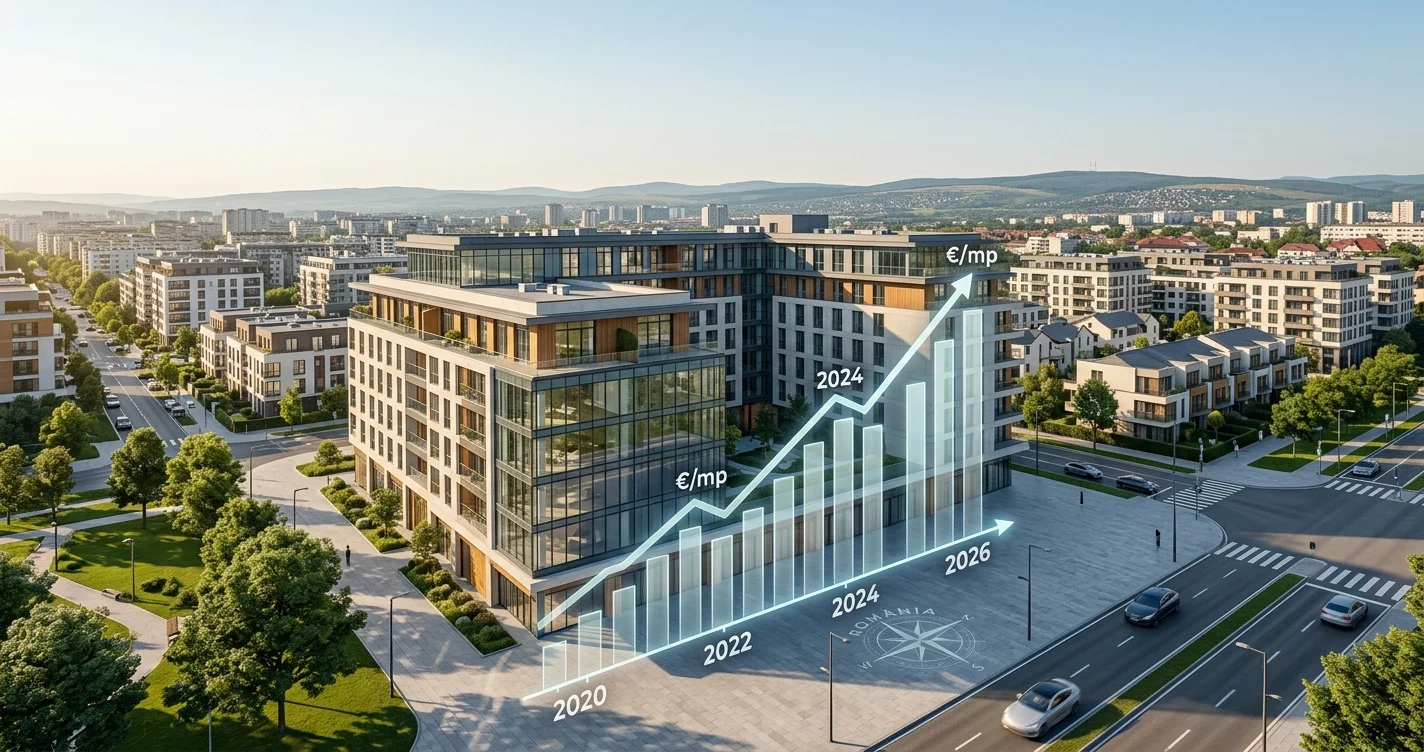
In 2020, many postponed decisions. In 2026, most want clarity. You don't want stories. You want benchmarks. And benchmarks come from numbers and real market behaviour. In Sibiu, the average asking price is 2,034 EUR/sqm, according to Imobiliare.ro (September 2026). That means a year-on-year change of +7.4%. At the same time, transactions in the county reached 936 in June 2026, with +26.7% versus June 2025, according to ANCPI data. When you put these signals together, you understand better real estate price evolution Romania 2026. And, more importantly, you understand how to negotiate, how to choose location and how to avoid costly decisions.
Key Takeaways
- Sibiu: average asking price 2,034 EUR/sqm, according to Imobiliare.ro (September 2026).
- Sibiu: year-on-year change +7.4%, according to Imobiliare.ro.
- Sibiu: 936 transactions in June 2026 and +26.7% versus June 2025, according to ANCPI transaction data.
- Sibiu: 500 mortgages in June 2026, according to ANCPI mortgage data.
- National: IRCC 5.57%, ROBOR 3M 5.84%, average EUR/RON rate 5.2498 (August 2026), according to BNR.
Contents
- 1) Context 2020–2026: what changed the game in Romania
- 2) Romania in 2026: indicators that move the market
- 3) Sibiu, case study: market price, liquidity, neighbourhoods
- 4) Comparison of 8 cities: where Sibiu stands
- 5) Strategy 2026: buyer, investor, seller
- 6) Checklist: safe transaction, negotiation, documents
- FAQ
1) Context 2020–2026: what changed the game in Romania
Why 2020–2026 matters for price evolution
When we talk about real estate price evolution Romania 2026, we're not just talking about a chart. We're talking about how expectations have changed. In 2020, buyers became more attentive to space. In 2026, they are attentive to financing costs and transaction safety. The difference is big. Today, an apartment is no longer valued just "by how it looks". It is valued by location, access, limited available stock and document quality.
In practice, the market has gone through phases. Sometimes it was an appreciating market. Other times, the market shows signs of cooling. What matters is that in many areas, fundamentals remain solid. This is visible in sustained demand, in transactions and in mortgages. It's not a story. It's measurable behaviour.
How to read "price" correctly in 2026
In 2026, you need to separate three concepts. Asking price is what you see in the listing. Transaction price is what gets paid at the end. Market price is the realistic range for a comparable location and condition. If you mix them up, you make wrong decisions. Especially when stock is low and supply shortage appears.
In Sibiu, for example, Imobiliare.ro shows an average asking price of 2,034 EUR/sqm in September 2026. That doesn't mean every apartment is worth 2,034 EUR/sqm. It means the market has a benchmark. And the benchmark helps you estimate negotiation margin and see if an asking price is optimistic or realistic.
Why liquidity matters, not just price
Many look only at "how much it costs". I look at "how fast it sells". That means an area with high liquidity. In such areas, the gap between asking price and transaction price tends to be smaller. And the risk of being stuck with a blocked property drops.
In 2026, liquidity shows in ANCPI data. In Sibiu county there were 936 transactions in June 2026, with +26.7% versus June 2025, according to ANCPI. Note: ANCPI does not publish prices. It publishes volumes. And volumes tell you if the market is breathing or freezing. For price situation, volume is a key indicator.
A local benchmark: Sibiu as a lifestyle city
Sibiu is not just a point on a map. It is a city with identity. If you want context, it's worth reading the Sibiu city description on Wikipedia. For buyers, what matters is how you live day to day. For investors, what matters is what tenants are looking for and how stable demand is.
That's why, when we discuss price evolution, Sibiu is a good example. It has sustained demand, it has areas with high liquidity and it has a mix of neighbourhoods for different lifestyles.
For an overview, you can also follow our dedicated market page: analysis and benchmarks from the real estate market. And for applied articles, there's also the Vianto Properties blog.
2) Romania in 2026: indicators that move the market
Interest rates: IRCC and ROBOR, explained
In 2026, financing matters hugely. According to BNR, IRCC is 5.57%, and ROBOR 3M is 5.84% (August 2026). I won't go into formulas. But I'll tell you straight: interest rates influence debt service. That is, the monthly amount you carry, without stress.
In a market with high interest rates, buyers become more selective. This can increase negotiation margin in certain segments. In others, supply shortage keeps the asking price up. Here's where the difference appears between "the market shows cooling signs" and "orderly correction". Cooling means slower pace. Orderly correction means targeted adjustments, without panic.
EUR/RON rate: why you feel it in listing prices
According to BNR, the average EUR/RON rate in August 2026 was 5.2498. In real estate, many asking prices are quoted in euros. But incomes are in lei. This creates natural tension.
When the rate goes up, a buyer with income in lei feels pressure. When the rate drops, the seller feels they "lose" on conversion. In 2026, this dynamic influences price dynamics more than it seems. It doesn't just change price. It also changes decision speed.
Inflation and salaries: real purchasing power
According to INS, inflation is 6.17% (August 2026). Also nationally, average net salary is 5,820 RON (July 2026), according to INS. In Sibiu county, average net salary is 6,025 RON. When inflation is high, people seek protection. Some seek it in properties. Others prefer to wait.
In practice, salaries and inflation influence the psychological ceiling. That is, the maximum amount a family accepts as debt service. Here you see the difference between an asking price "of desire" and a market price "of transaction".
Transactions and mortgages: the real pulse of the market
In Romania, volumes matter. In Sibiu County, ANCPI shows 936 transactions and 500 mortgages in June 2026. These are not prices. They are signals of activity. When transactions rise, demand is more active. When mortgages rise, financing is present, even at higher interest rates.
In plain language: if you have transactions and mortgages, the market has energy. If they fall sharply, a contraction of X% in transactions would be a stress signal. In Sibiu's case, we have volume growth. This supports the idea that price levels are not about crashes, but about adjustments and selection.
Where Vianto fits in
In 2026, information makes the difference. Not just "what's the price per sqm". But what sells, at what pace, with what documents and with what negotiation margin. If you want to track benchmarks constantly, visit our market page. If you want practical guides, check out our blog library.
And if you want to discuss your specific case, go directly to our contact page. In 15 minutes, you can avoid an expensive mistake.
3) Sibiu, case study: market price, liquidity, neighbourhoods
What the latest available data tells us
To understand the price topic, you need a benchmark city. Sibiu is good for that. In September 2026, the average asking price is 2,034 EUR/sqm, according to Imobiliare.ro. Year-on-year variation is +7.4%, also according to Imobiliare.ro. Market Pulse was 29/100 in June 2026, a Vianto Properties indicator of market pace and tension.
In parallel, ANCPI shows 936 transactions and 500 mortgages in June 2026. This suggests sustained demand and active financing. In such a context, limited available stock appears frequently in well-positioned properties. Especially in areas with high liquidity.
Sibiu neighbourhoods and lifestyle: how to choose location
In Sibiu, "neighbourhood" is not just a label. It is your daily routine. I'll give you some benchmarks to help you choose location based on lifestyle. Not just by asking price.
- Centre and Ultra-centre: urban life, cafés, short walks. It's for those who want the city on foot. Usually, demand is sustained, and the area can have high liquidity.
- Strand: balanced pace, good access, many services at hand. It's a suitable neighbourhood for active families. Here, layout and parking matter a lot.
- Hipodrom: practical life, quick access to shops and transport. Many buyers seek functionality. In such areas, market price is formed from many comparable transactions.
- Sub Arini: quieter atmosphere, close to green areas. It's for those who want a slower pace, but stay close to the city.
- Turnișor: good mix between residential and access. It's a frequent choice for those who want space and connectivity.
- Valea Aurie: more relaxed air, closeness to nature. For many, light, orientation and quiet matter here.
These lifestyle differences directly influence asking price and, ultimately, transaction price. In 2026, buyers pay more easily for daily comfort. This supports the price discussion in suitable areas.
Why some properties sell fast and others don't
In an appreciating market, things sell a lot and fast. In a market showing signs of cooling, things sell selectively. In Sibiu, properties that move quickly usually have three things: good location, correct layout and clear documents. This includes land register extract without encumbrances or, in short, clean land register.
Also, presentation matters. An apartment with light, order and correct photos attracts more viewings. And more viewings reduce negotiation margin. This shows in the difference between asking price and transaction price.
Investment in Sibiu: yield, ROI and realistic expectations
Investors ask directly: "What do I get out?". The correct answer starts with two concepts: gross yield and net yield. Gross yield is before costs. Net yield is after costs, vacant periods and maintenance. In 2026, the difference between them matters more than ever.
I don't use made-up figures about rents. That wouldn't be right. But I can tell you how to think: look for properties in areas with high liquidity, with sustained rental demand. Then track a positive ROI and a break-even in X years, calculated realistically. For a useful tool, you can use our blog guides, starting here: Vianto Properties resources for investors.
A short, useful CTA, no pressure
If you want to see what's on the market now, visit Vianto Properties and compare similar properties. In 2026, limited available stock appears exactly at good offers. And time becomes a real cost.
4) Comparison of 8 cities: where Sibiu stands
Comparison table: average asking prices (EUR/sqm)
To understand the price situation, a comparison helps a lot. Below you have average asking prices, in EUR/sqm, according to Imobiliare.ro (September 2026). These are not transaction prices. They are listing benchmarks, useful for positioning.
| City | Average asking price (EUR/sqm) |
|---|---|
| Cluj-Napoca | 3.316 |
| București | 2.312 |
| Brașov | 2.309 |
| Sibiu | 2.034 |
| Constanța | 2.020 |
| Iași | 2.000 |
| Timișoara | 1.984 |
| Oradea | 1.885 |
What this positioning means for the buyer
Sibiu is at 2,034 EUR/sqm, close to Constanța and above Timișoara, Iași and Oradea, according to Imobiliare.ro (September 2026). It's neither the most expensive nor the cheapest. This makes it interesting for two profiles: the buyer who wants quality of life and the investor who seeks appreciation.
In very expensive cities, negotiation margin can be smaller when demand is sustained. In cheaper cities, sometimes you have larger negotiation discount, but also lower liquidity. In Sibiu, the combination of lifestyle and transaction volume can support a balanced decision.
What it means for the investor: capital gain and liquidity
The smart investor doesn't just look for rent. He also looks for appreciation, that is capital gain, on resale. Here, it matters to buy at a correct market price and sell in an area with high liquidity. If you choose the wrong location, you can have decent gross yield, but difficult resale.
In 2026, when interest rates are high, the investor must be more careful about net yield. Real costs eat into profit. That's why a property that rents easily and sells easily is more valuable than one that's "cheap" only on paper.
A practical example: how to compare two cities without being fooled
Let's say you're comparing Sibiu versus Brașov. Brașov has 2,309 EUR/sqm average asking price. Sibiu has 2,034 EUR/sqm (September 2026, Imobiliare.ro). The difference may seem large. But the real question is different: where is there sustained demand for your property type? Where is stock limited on your segment? Where is a reference area that trades consistently?
That's why, for price evolution, comparing cities is just the beginning. The decision is made at neighbourhood, street and building level.
Different CTA: see the market, not just listings
If you want to better understand how market price is formed, follow updates in the Real Estate Market section. You'll see benchmarks, not just listings. And that helps you negotiate correctly.
5) 2026 Strategy: buyer, investor, seller
Buyer in 2026: how you approach price evolution
If you're a buyer, you have two risks. The first is paying above market price. The second is waiting too long and losing a good property. In 2026, with IRCC rates at 5.57% and ROBOR 3M at 5.84%, according to BNR, many buyers are more cautious. This can create short negotiation windows.
In an appreciating market, good properties disappear fast. In a market showing signs of cooling, poor properties sit. Your strategy is to look for quality, not bargains. And verify documents before you fall in love with an apartment.
In any discussion about price dynamics, the buyer wins when they have a clear plan. The plan starts with budget, continues with a reference area and ends with realistic negotiation.
Investor in 2026: gross yield, net yield and discipline
The investor needs discipline. You don't buy just because "it appreciates". You buy because you have a complete scenario. The scenario includes: gross yield, net yield, periods without a tenant, maintenance costs and taxes. This also includes property transfer tax, which you discuss clearly before the notarial deed.
In August 2026, the average EUR/RON rate was 5.2498, according to BNR. If you collect rent in lei and your purchase price is in euros, the rate matters. Don't worry. Just put it in your calculations. That helps you maintain a positive ROI.
Also, a good investor buys in areas with high liquidity. There, at resale, you have better chances of capital gain. In Sibiu, neighbourhoods like Ștrand and Hipodrom are sought for practical living. Centre and Ultra-Centre are sought for urban style. Valea Aurie and Sub Arini are sought for peace. Each has its tenant profile.
Seller in 2026: how you set the asking price correctly
If you're selling, the biggest mistake is confusing asking price with market price. An asking price that's too high eats up your time. And time means money. In 2026, buyers compare a lot. And negotiate more informed. If you want a good transaction price, you start with correct positioning.
In Sibiu, the benchmark of 2,034 EUR/sqm is average asking price, according to Imobiliare.ro (September 2026). But your property can be above or below, depending on location, floor, orientation and condition. If you have limited stock on your segment, you can hold price better. If you have strong competition, you need a realistic negotiation margin.
Table: how tactics change based on market
Below you have a simple table. It has no invented figures. It has decision logic, useful in 2026.
| Context | Signal | Recommended tactic |
|---|---|---|
| Appreciating market | Sustained demand, limited available stock | You act fast, but verify documents before making an offer. |
| Market shows signs of cooling | Multiple properties are on the market | You look for negotiation discount, but only on comparable properties. |
| Orderly correction | Targeted adjustments, no general blockage | You negotiate on real defects, not rumours. |
Strategy checklist: 10 simple steps
- Define clearly: residence or investment.
- Set budget and debt service limit.
- Choose 2-3 reference areas, not the whole city.
- Compare asking price with similar properties, not with "dreams".
- Ask directly about land register extract without encumbrances.
- Check if there is a first-rank mortgage or other mortgage guarantee.
- Calculate gross yield and estimate realistic net yield.
- Negotiate based on defects, not emotions.
- Plan the notarial deed and related costs.
- Think about the exit: how you sell in 3-5 years.
In 2026, this discipline makes the difference. And it helps you understand, practically, the price level, without getting lost in the noise.
6) Checklist: safe transaction, negotiation, documents
Negotiation: margin, discount and right timing
Good negotiation is not aggressive. It is informed. In 2026, the negotiation margin depends on three things: property quality, competition in the area and seller urgency. If the property is in an area with high liquidity and has limited available stock, the negotiation discount is usually smaller.
You need to enter negotiations with solid arguments. The arguments are: real comparisons, renovation costs, lack of parking, floor level, orientation, neighbourhood quality. Don't negotiate based on "what you've heard". That doesn't hold up. Especially in an appreciating market.
In the discussion about pricing, negotiation is where theory becomes real money. A good asking price leaves room for negotiation. An inflated asking price consumes your time and energy.
Documents and checks: what you never skip
Before anything else, you request a land register extract without encumbrances. If there are encumbrances, you want clarity. It could be a first-rank mortgage or another type of mortgage guarantee. It's not the end of the world. But it needs to be managed correctly, with clear steps, until the notarial deed.
Plus, you verify the owner's identity, the areas and the history. If there are discrepancies, you resolve them before signing. Not after. In 2026, informed buyers no longer accept "let's see later". That's good. It protects you.
Costs you plan ahead
In your budget, you don't just put the price. You also put transaction costs. This includes property transfer tax, plus notarial costs. I won't give figures, because they vary. But I recommend you discuss them early, so you don't get stuck at the end.
If you take a loan, the bank will also analyse the property. This can affect the timeline. In a market with sustained demand, timeline matters. If you delay, you lose the property. That's why preparation is a competitive advantage.
Table: data sources and how to use them correctly
In 2026, information is everywhere. But not all of it is correct. Below is a simple table, so you know what to take from where.
| Indicator | What it tells you | Correct source |
|---|---|---|
| Average asking price | Listing benchmark, useful for positioning | Real estate portals (e.g. Storia, Imobiliare.ro) |
| Transactions and mortgages | Volume, liquidity, activity | ANCPI |
| IRCC, ROBOR, EUR/RON rate | Cost of financing and currency conversion | BNR |
| Inflation and wages | Purchasing power and budget pressure | INS |
A friendly CTA: let's discuss your case
If you want a quick opinion on market price and negotiation margin, go to contact and tell us what you're looking for. We'll answer you directly, no beating around the bush. In 2026, speed and clarity are real advantages.
FAQ
1) What does "real estate price evolution Romania 2026" concretely mean?
It means tracking how the asking price, the transaction price and the market price change, in the context of interest rates, exchange rates and demand. In 2026, interest rates (IRCC 5.57% and ROBOR 3M 5.84%, according to BNR) influence debt service. And volumes (transactions and mortgages, according to ANCPI) show whether the market has liquidity.
2) Why is ANCPI important, if it doesn't publish prices?
ANCPI is important because it publishes volumes: transactions and mortgages. This shows you real activity. In Sibiu county, there were 936 transactions and 500 mortgages in June 2026, according to ANCPI. When volumes rise, demand is more active. When they fall, the market may show signs of cooling. For real estate price evolution Romania 2026, volume is a barometer.
3) Is the average asking price from portals the same as the transaction price?
No. The average asking price is a listing benchmark, i.e. what sellers ask in ads. The transaction price is what is paid at the end. The difference between them is the negotiation margin, which depends on location, limited available stock and property quality. In Sibiu, the average asking price is 2,034 EUR/sqm, according to Imobiliare.ro (September 2026).
4) How do I choose the right neighbourhood in Sibiu if I want both lifestyle and investment?
Start with your lifestyle. Centre and Ultra-centre are for walking and urban life. Strand and Hipodrom are for practical pace and nearby services. Valea Aurie and Sub Arini are for quiet and closeness to nature. Then you check liquidity: how easy it is to sell and rent. That way you link lifestyle to gross yield and net return.
5) What minimum checks do I do before the notarial deed?
You request a land register extract without encumbrances and check if there is a first-rank mortgage or other mortgage guarantee. You verify areas, owner, any discrepancies. You discuss property transfer tax and notarial costs early. If you take a loan, you prepare documents for the bank, so you don't waste time. In 2026, preparation increases your chances of a good negotiation.
6) Is 2026 a good year to buy, or should I wait?
It depends on your purpose and budget. If you need housing, debt service and income stability matter. If you're an investor, net yield and positive ROI matter. In Sibiu, the average asking price is 2,034 EUR/sqm, up +7.4% from September 2025, according to Imobiliare.ro. And ANCPI volumes show high activity. This suggests a functioning market, not a blocked one.
Conclusion
In 2026, the discussion about real estate price evolution Romania 2026 is not just about "up or down". It's about how you buy right, how you sell right and how you invest disciplined. You have clear benchmarks: IRCC 5.57% and ROBOR 3M 5.84% interest rates, according to BNR. You have EUR/RON rate that affects budgets. You have 6.17% inflation (August 2026), according to INS. And you have ANCPI volumes that show liquidity.
In Sibiu, the average asking price of 2,034 EUR/sqm and annual growth of +7.4%, according to Imobiliare.ro (September 2026), combine with 936 transactions and 500 mortgages in June 2026, according to ANCPI. This describes a market with sustained demand, where limited available stock appears in well-positioned properties. If you choose the right neighbourhood for lifestyle, and verify documents correctly, you have real chances at a good transaction price and appreciation over time.
Want to see what options you have, without spending weeks on ads? Go to https://viantoproperties.ro/ and tell us what you're looking for. We'll suggest real alternatives, based on location and budget.
Looking for advice on buying, selling or investing in Sibiu? The Vianto Properties team is available to help you with personalised recommendations. Contact us at +40 791 710 606 or office@vianto.ro, or explore our available properties directly on the site.
Explore Vianto Properties offers:
Vianto Properties offers in Sibiu:
The correct selling price is determined by comparable transactions in your area, not by the asking prices in nearby listings. You can request a free property evaluation, with a response within 24 hours, or you can discuss with the Vianto Properties team before you decide.